
Where Is Essaouira? Locating Morocco's Windy Atlantic Gem
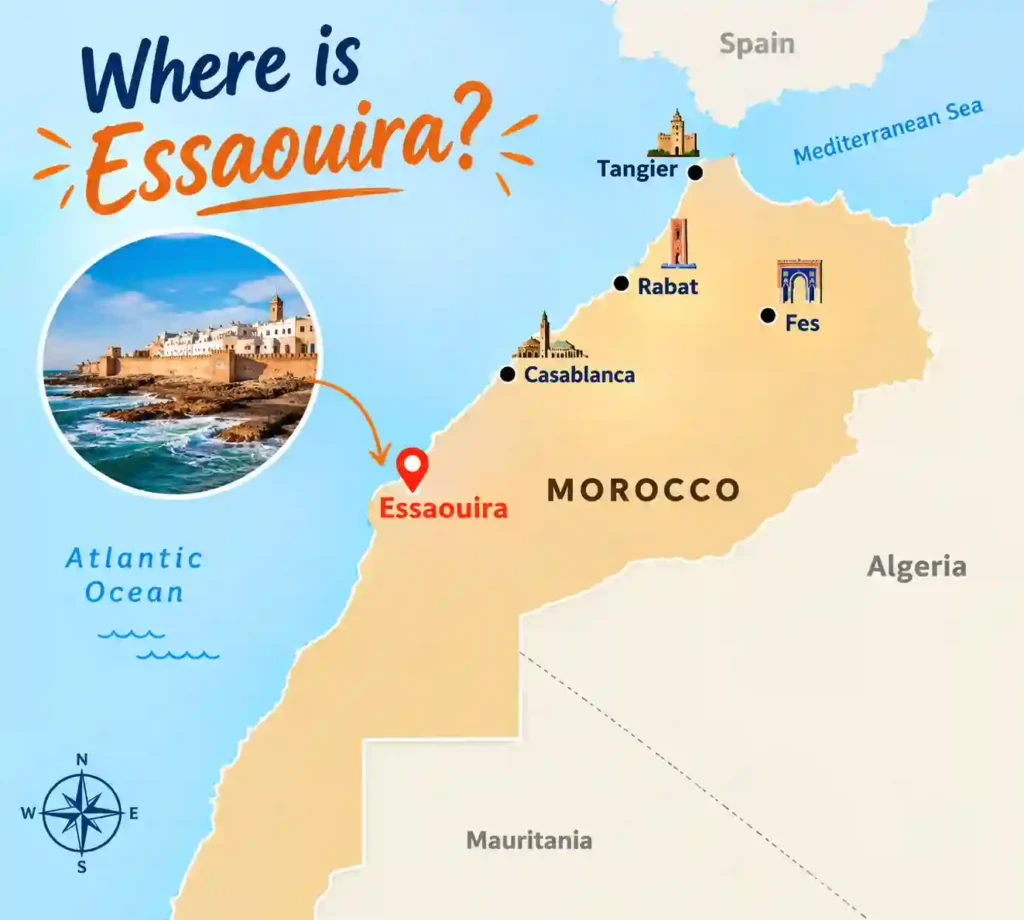
If Marrakech is hot, dusty, and inland, Essaouira is its exact opposite, cool, breezy, and planted right on the edge of the Atlantic. It’s one of the most popular day trips and weekend escapes from Marrakech, but a lot of travelers booking a Morocco trip aren’t entirely sure where it actually sits on the map, or why it feels so different from the rest of the country. This guide breaks down Essaouira’s exact location, how it fits into a Morocco itinerary, and what makes its coastal position such a defining part of the experience.
Table of Contents: Where is Essaouira
Essaouira's Location at a Glance
Essaouira sits on Morocco’s Atlantic coast, in the western Marrakesh-Safi administrative region, at coordinates approximately 31.51°N, 9.77°W. It’s a coastal port city facing directly out into the open ocean, which explains a lot about its climate, its history as a trading post, and its reputation today as Morocco’s “Windy City.” The city serves as the capital of Essaouira Province, and it’s known historically by an older name, Mogador, a name still used occasionally in older maps, guidebooks, and references to the city’s colonial-era past.
How Far Is Essaouira From Marrakech?
This is the single most common question travelers ask, since the two cities are so often paired together on a Morocco trip. Essaouira sits roughly 190 km (118 miles) west of Marrakech, on the opposite side of the country from the Atlas Mountains and the Sahara. The drive typically takes between 2.5 and 3.5 hours depending on traffic and stops, following a mostly flat, scenic route through semi-arid plains, small Berber villages, and stretches of argan tree forest, some travelers even spot goats climbing the trees along the way, a genuinely local sight tied to the region’s argan oil industry.
Because the drive is manageable in either direction, Essaouira works well both as a full day trip from Marrakech and as an overnight or multi-night stop on a along coastal route.
Where Essaouira Sits Relative to Morocco's Other Cities
Beyond Marrakech, it helps to place Essaouira within the wider map of Morocco’s Atlantic coast.
- Marrakech is about 190 km (118 miles) to the east, the most common gateway city for visiting Essaouira.
- Agadir lies roughly 180 km (112 miles) to the south, another popular coastal city along the same stretch of Atlantic coastline.
- Casablanca sits considerably further north, around 350 km (217 miles) away.
- Safi , a smaller coastal city, is much closer, just north of Essaouira along the same coast within the Marrakesh-Safi region.
This positions Essaouira roughly midway along Morocco’s central Atlantic coastline, between Casablanca to the north and Agadir to the south, with Marrakech as its natural inland connection point.
Why Essaouira Feels So Different From Marrakech
Essaouira’s coastal position isn’t just a geography fact, it’s the reason the city feels like an entirely different country from Marrakech despite being less than three hours away. Because it juts directly into the Atlantic’s path, Essaouira catches strong, near-constant sea winds, keeping temperatures noticeably cooler and more stable year-round than inland cities like Marrakech or Fes, where summer heat regularly climbs well past 35°C. Those same winds have made Essaouira one of the world’s respected windsurfing and kitesurfing destinations, drawing a very different kind of traveler than the ones filling Marrakech’s souks. The city’s whitewashed, blue-shuttered medina, wrapped in 18th-century fortified walls, adds to the sense that you’ve arrived somewhere distinctly coastal and Portuguese-influenced rather than deep in the Moroccan interior.
A Port City With a Long History
Essaouira’s location at a natural harbor point on the Atlantic has attracted settlement for a genuinely long time. Evidence of settlement here goes back to prehistoric times, and the site was later controlled in turn by Phoenician, Carthaginian, and Roman traders drawn by its useful position along the coast. In ancient times, the area became known for producing a rare purple dye extracted from murex sea snails found on the nearby Purple Islands, a valuable trade good tied directly to the city’s coastal location. The Portuguese later built the massive stone fortifications that still surround the medina today, part of why the city carries such a distinct architectural feel compared to inland Moroccan towns. The city’s modern form dates to 1769, when Sultan Mohammed III commissioned it as a fortified royal port, deliberately positioned to capture Atlantic trade, and renamed it Essaouira, “the beautifully designed,” a title that still fits.
Essaouira’s UNESCO-Listed Medina
Essaouira’s Atlantic-facing position and its fortified 18th-century medina together earned it UNESCO World Heritage status in 2001, recognized as an outstanding example of a late 18th-century fortified port town, built according to contemporary European military engineering principles within a North African context. The compact, walled medina, easy to explore entirely on foot, holds the city’s souks, cafés, art galleries, and the Skala de la Ville, a seafront rampart lined with old cannons that offers some of the best ocean views in the city.
Getting to Essaouira
Essaouira’s location makes it reachable in several ways depending on where you’re starting from. Most travelers arrive by road from Marrakech, either by grand taxi, tourist bus, private transfer, or rental car, a straightforward 2.5 to 3.5-hour drive on a well-maintained highway. Essaouira also has its own small airport, Essaouira–Mogador Airport, with limited seasonal flights, mainly from a handful of European cities rather than domestic Moroccan routes. For travelers combining Essaouira with Agadir, the coastal road south is a similarly manageable drive, making it possible to build a longer Atlantic coast route rather than treating Essaouira as an isolated stop.
Nearby Coastal Towns Worth Knowing
Essaouira’s location along a stretch of coastline means it isn’t the only worthwhile stop in the area. Sidi Kaouki, a small, quiet beach town about 25 km south of Essaouira, has become popular with windsurfers and travelers looking for an even more low-key alternative to the city itself. The surrounding Essaouira Province is also home to the Haha tribe south of the city and the Chiadma tribe to the north, both closely tied to the region’s argan oil production, one of the more distinctive local industries you’ll encounter if you explore beyond the medina walls.
Essaouira on Screen: Hollywood's Long Love Affair With the City
Essaouira’s dramatic ramparts and fortified port haven’t just attracted travelers, they’ve attracted filmmakers for over 70 years, largely because the city’s coastal walls and ocean backdrop are hard to fake anywhere else. Orson Welles filmed key scenes of his 1952 Palme d’Or-winning Othello here in 1949-50, working with such a limited budget that local artisans reportedly built costumes from burlap sacks and armor from tin cans. The city later stood in for the slave-trading port of Astapor in Game of Thrones Season 3, its cannon-lined 18th-century sea walls needing almost no dressing to look the part on camera, while nearby Aït Benhaddou played Yunkai in the same storyline. More recently, scenes from John Wick: Chapter 3 – Parabellum were also shot in the city. If you visit the Skala de la Kasbah early in the morning, before the crowds arrive, you’re walking the same ramparts that have played an ancient Mediterranean port, a fictional slave city, and a modern action-film backdrop, all without changing much at all.
Essaouira's Musical Legacy: From Gnaoua to Jimi Hendrix
Essaouira’s easygoing, coastal character isn’t only about wind and beaches, it has a genuine musical history tied directly to its location and atmosphere. In the 1960s, the city became a regular stop on the international “hippie trail” alongside Marrakech, Taghazout, and Agadir, drawing musicians like Jimi Hendrix, Cat Stevens, and Frank Zappa, who came for the relaxed pace and the sound of local Gnaoua music. Gnaoua, a spiritual musical tradition with West African roots, remains deeply tied to Essaouira’s identity today, and the city hosts the well-known Gnaoua World Music Festival each summer, drawing musicians and fans from around the world to the same streets and ramparts that once drew Hendrix decades earlier.
Best Time to Visit Essaouira
Because Essaouira’s climate is shaped almost entirely by the Atlantic rather than the desert, its best-time-to-visit calendar looks noticeably different from Marrakech’s. Spring (April to June) and autumn (September to October) generally offer the most balanced conditions, warm enough for the beach, with wind strong enough for watersports but not overwhelming for casual sightseeing. Summer (July and August) brings Essaouira’s strongest, most consistent winds, ideal for serious windsurfers and kitesurfers but sometimes too gusty for a relaxed beach day, and it’s also when the city is busiest with domestic tourists escaping Marrakech’s heat. Winter stays mild by most standards, rarely cold, but the wind and occasional rain can make it feel cooler than the temperature alone suggests, so packing a windbreaker is worth it regardless of season.
The Argan Oil Economy Around Essaouira
The countryside surrounding Essaouira is one of the few places on Earth where argan trees grow natively, and that geography has shaped the entire region’s rural economy. Local Berber cooperatives, largely run by women, produce both culinary and cosmetic argan oil using traditional extraction methods passed down through generations, and many of these cooperatives welcome visitors for a short tour and tasting on the way between Marrakech and Essaouira. It’s also along this same route that travelers spot the region’s famous sight of goats climbing into argan trees to feed on the fruit, a genuinely local phenomenon tied directly to Essaouira’s particular stretch of coastline and hinterland.
Frequently Asked Questions About Essaouira's Location
Where exactly is Essaouira located?
Essaouira sits on Morocco’s Atlantic coast, in the Marrakesh-Safi region, at roughly 31.51°N, 9.77°W.
How far is Essaouira from Marrakech?
About 190 km (118 miles), typically a 2.5 to 3.5-hour drive.
Is Essaouira on the coast or inland?
Essaouira is a coastal city, sitting directly on the Atlantic Ocean, quite different from inland cities like Marrakech or Fes.
Why is Essaouira called the “Windy City”?
Because it juts out directly into the Atlantic’s path, Essaouira catches strong, near-constant sea winds, which also make it one of the world’s popular windsurfing and kitesurfing spots.
What was Essaouira's former name?
Mogador, a name still occasionally used in older references to the city, particularly from its Portuguese and colonial-era history.
Is Essaouira a good day trip from Marrakech?
Yes, it’s one of the most popular day trips from Marrakech given the manageable 2.5 to 3.5-hour drive each way, though many travelers choose to stay overnight to enjoy the calm pace.
Is Essaouira close to Agadir?
Yes, relatively. Agadir sits about 180 km (112 miles) south of Essaouira along the same Atlantic coastline.
Final Thoughts
Essaouira’s location on Morocco’s Atlantic coast, roughly midway between Casablanca and Agadir and a manageable drive west of Marrakech, is exactly what gives the city its distinct identity: cooler air, strong sea winds, a fortified Portuguese-influenced medina, and a noticeably calm pace than Morocco’s busier inland cities. Understanding where it sits on the map makes it easy to see why it pairs so naturally with a Marrakech-based itinerary, and why so many travelers end up extending a planned day trip into something longer.
If you are planning a Morocco trip and want help figuring out how Essaouira fits alongside Marrakech, a Sahara excursion, or a wider Atlantic coast route, feel free to get in touch, we’re happy to help you build a route that makes the most of your time.

I’m Lahcen Saadi from the Exploring Morocco Trips team. We are local guides dedicated to crafting authentic and exceptional Moroccan experiences.
Whether you are planning your first trip to Morocco and need expert advice, or you are a travel professional looking to collaborate on unique itineraries, we are ready to help.
- 2 Days Desert tours From Marrakech
- 3 Days Desert tour From Marrakech to Merzouga
- 3 Days Desert tour From Marrakech to Fes
- 4 Days Desert tour From Marrakech to Merzouga
- 4 Days Desert tour From Marrakech to Fes
- 5 Days Desert tour From Marrakech to Merzouga
- 5 Days Desert tour From Marrakech to Fes
- 6 Days Desert tour From Marrakech to Casablanca
- 7 Days Morocco tour from Marrakech
- 8 Days Morocco tour from Marrakech
- 8 Days Morocco tour from Marrakech with Imperial Cities
- 9 Days Morocco tour from Marrakech
- 10 Days Morocco tour from Marrakech
- 12 Days Morocco tour from Marrakech
- 14 Days Morocco tour from Marrakech
- 2 Days Desert tour From Fes to Merzouga
- 2 Days Desert tour From Fes to Marrakech
- 3 Days Desert tour From Fes to Merzouga
- 3 Days Desert tour From Fes to Marrakech
- 4 Days Desert tour From Fes to Marrakech
- 5 Days Desert tour From Fes to Marrakech
- 6 Days Desert tour From Fes to Marrakech
- 7 Days Morocco tour from Fes
- 4 Days Morocco tour from Casablanca
- 5 Days Morocco tour from Casablanca
- 6 Days Morocco tour from Casablanca
- 7 Days Morocco tour from Casablanca
- 8 Days Morocco tour from Casablanca
- 9 Days Morocco tour from Casablanca
- 10 Days Morocco tour from Casablanca
- 11 Days Morocco tour from Casablanca
- 12 Days Morocco tour from Casablanca
- 14 Days Morocco tour from Casablanca