
Moroccan Instruments: A Complete Guide to the Sounds of Morocco
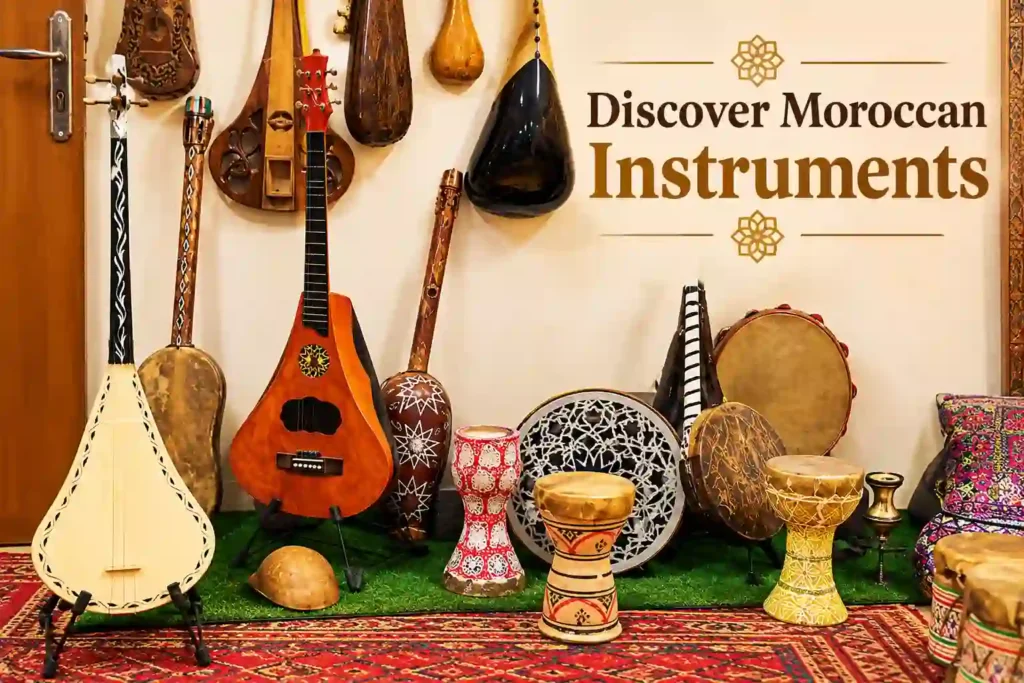
Morocco doesn’t just look different depending on where you are, it sounds different too. Wander through Essaouira at night and you’ll catch the metallic clang of iron castanets drifting from a doorway. Sit around a fire in the Sahara and you might hear the low, hypnotic pulse of a three-stringed lute. Pass through a wedding in the Atlas Mountains and drums seem to appear from nowhere, driving the dancing late into the night. Every region, every tradition, and honestly every mood in Morocco has its own instrument attached to it, shaped by centuries of Amazigh, Arab, Andalusian, and Sub-Saharan African influence colliding in one place.
This guide walks through the instruments that actually define Moroccan music, what they sound like, where they came from, and where you’re most likely to hear them for yourself while traveling through the country.
Table of Contents
Why Moroccan Instruments Sound the Way They Do
Morocco’s position at the crossroads of Africa, Europe, and the Middle East shows up directly in its instruments. Stringed instruments like the oud trace their lineage back to the sophisticated court music of Arab-Andalusian Spain. Percussion instruments, particularly iron castanets and deep bass lutes, reflect ritual traditions carried north by Sub-Saharan communities. Amazigh, or Berber, communities in the mountains contributed their own flutes and frame drums, built for pastoral, village life rather than court performance. The result is a musical landscape that doesn’t really exist anywhere else, several distinct traditions, each with their own instruments, sharing the same country and often the same stage.
The Guembri (Sintir): Heartbeat of Gnawa Music
If one instrument defines Morocco’s most hypnotic musical tradition, it’s the guembri, also called the sintir or hajhouj. This three-stringed lute, carved from a single piece of wood with a camel-skin soundboard, produces a deep, buzzing bass tone that anchors Gnawa music, the spiritual, trance-inducing tradition brought to Morocco generations ago by descendants of Sub-Saharan communities. Played by a maâlem, or master musician, the guembri serves as both the rhythmic backbone and melodic core of an all-night ceremony called a lila, used traditionally for healing and spiritual release. Its sound is unmistakable, low, percussive, and almost hypnotic once a rhythm locks in.
Qraqeb: The Sound of Essaouira's Streets
Paired almost inseparably with the guembri, qraqeb are large iron castanets that produce a sharp, rapid, metallic clicking sound, said to echo the clang of chains once carried by enslaved ancestors, a sound that’s become central to Gnawa’s call-and-response rhythms. Walk through Essaouira, especially during its famous Gnaoua World Music Festival in June, and you’ll hear qraqeb rhythms spilling out from doorways and street corners constantly. They’re deceptively simple to look at, just two pairs of metal cymbals held in each hand, but mastering their rapid, layered patterns takes years.
The Bendir: Morocco's Frame Drum
The bendir is a large, shallow frame drum, often fitted with a snare made of gut strings stretched across the inside of the skin, giving it a distinctive buzzing resonance alongside its deep, warm tone. It shows up across nearly every Moroccan musical tradition, Amazigh village music, Sufi devotional chanting, and popular Chaabi celebrations alike, making it one of the most versatile and widely recognized instruments in the country. Its simple design belies real rhythmic complexity, and skilled players can produce a surprising range of tones from a single drumhead.
The Oud: Morocco's Andalusian Lute
Often called the king of Arabic instruments, the oud is a pear-shaped, fretless lute with a short neck, prized for its warm, resonant tone and its capacity for intricate melodic improvisation. It plays a central role in Andalusian classical music, the sophisticated orchestral tradition that traces directly back to Moorish Spain and still thrives today in cities like Fes and Tetouan. Unlike Western guitars, the oud has no frets, which lets skilled players slide smoothly between microtonal pitches that give Arabic and Andalusian music its distinctive, emotive character.
The Rebab: An Ancient Bowed Instrument
The rebab is one of Morocco’s oldest stringed instruments, a small, bowed instrument with ancient roots that produces a haunting, nasal tone often used in storytelling and devotional music. Historically significant, the rebab is considered an ancestor of the medieval European rebec, which itself eventually influenced the development of the violin. In Moroccan folk and devotional contexts, its sound carries a particularly emotional, almost mournful quality that suits the poetic, narrative style of the music it typically accompanies.
The Loutar: Voice of the Amazigh Mountains
Popular among Amazigh musicians in the High Atlas and Sous Valley, the loutar is a rustic, four-stringed lute that accompanies poetry and oral storytelling traditions in Morocco’s rural, mountain regions. Its sound is simpler and more percussive than the oud’s, built for accompanying voice and rhythm in village gatherings rather than formal court performance. If you spend time in a Berber village during your travels, particularly in the Atlas Mountains, there’s a good chance you’ll hear a loutar accompanying local songs passed down through generations.
The Ghaita: Morocco's Powerful Double-Reed Horn
The ghaita is a loud, piercing double-reed wind instrument, similar to a shawm, typically paired with large drums during public celebrations, moussem festivals, and processions. Its bright, cutting tone is designed to carry over crowds and open spaces, making it the traditional instrument of choice for announcing celebrations and leading festive processions through town squares and village gatherings.
The Nay: Morocco's Traditional Reed Flute
The nay is a simple reed flute, breathy and warm in tone, used across various Moroccan musical traditions to add a soft, melodic layer against the more percussive elements of an ensemble. Its sound carries an almost meditative quality, and it’s frequently used in more intimate, acoustic settings compared to the louder, more festive ghaita.
The Derbouka (Tarija): Morocco's Goblet Drum
The derbouka, also known locally as the tarija, is a goblet-shaped hand drum, traditionally made from skin stretched over pottery or metal, held under the arm and played with quick, intricate finger and palm strikes. Its sharp, resonant tone drives the rhythm in Chaabi, wedding music, and countless other popular styles, and it’s one of the more accessible instruments for visitors to try their hand at during a cultural workshop.
The Naqqara: Paired Ceremonial Drums
Naqqara are small, paired kettle drums, traditionally played together to create layered, interlocking rhythms during ceremonial and festive occasions. Alongside the ghaita, naqqara drums are a traditional feature of Moroccan public celebrations, their sharp, resonant beats helping set the pace for processions and communal dancing.
The Moroccan Violin: A Familiar Instrument, Played Differently
Morocco also uses the standard Western violin, but with a distinctly local playing style, rested vertically on the knee rather than tucked under the chin, closer in posture to how a viola da gamba is played. This adaptation gives Moroccan violin playing a different feel and technique than its European counterpart, and it’s a common feature in both Andalusian classical ensembles and modern Chaabi bands.
How These Instruments Come Together in Morocco's Musical Traditions
Morocco’s instruments rarely exist in isolation, they’re defined by the specific traditions they serve:
- Gnawa relies almost entirely on the guembri and qraqeb, built around trance, spirituality, and healing ceremonies
- Andalusian classical music centers on the oud, violin, and rebab, performed by structured orchestras in cities like Fes and Tetouan
- Amazigh village music, including styles like Ahidous and Ahwash, leans on the bendir, loutar, and communal singing
- Chaabi, Morocco’s popular, danceable street music, blends the derbouka, bendir, and oud with modern instruments like keyboards and electric guitar
- Malhoun, sung poetry set to music, typically pairs the oud and violin with a more restrained, lyrical percussion style
Where to Hear Moroccan Instruments Live
Jemaa el-Fnaa in Marrakech is one of the easiest places in the country to stumble onto live traditional music any evening of the week, with Gnawa and Chaabi groups often performing well into the night. For a deeper, more immersive experience, the Gnaoua World Music Festival in Essaouira each June draws master musicians from across the country and blends traditional Gnawa sounds with jazz and global genres. The Fes Festival of World Sacred Music offers a more spiritually focused program, while Mawazine in Rabat brings a broader mix of Moroccan and international performers together each year.
For a genuinely different setting, a night at a desert camp during a Sahara excursion often includes live drumming and guembri music around the campfire, a fitting, atmospheric way to hear these instruments played the way they’ve traditionally been enjoyed for generations, under an open sky far from any city noise.
Bringing a Moroccan Instrument Home
Many travelers pick up a small instrument, a bendir, a set of qraqeb, or a simple derbouka, as a genuinely meaningful souvenir, and Marrakech and Fes both have shops within the medina specializing in handmade instruments. If you’re interested in buying one, it’s worth taking a moment to actually play it before purchasing, checking that the skin or strings are properly tensioned, and asking the seller for a quick demonstration of proper technique.
Moroccan Instruments You Can Actually Try Yourself
You don’t need years of training to get a feel for these instruments. A few are genuinely easy for beginners to pick up during a short visit:
- Derbouka (hand drum): Easy to hold and play with simple hand patterns. Many riads and cultural centers offer quick lessons.
- Qraqeb (metal castanets): Simple to hold, though getting the rhythm right takes a bit of practice. Fun to try even for just a few minutes.
- Bendir (frame drum): Beginner-friendly, with a natural, steady beat that’s easy to follow along with.
If you’re staying at a riad or joining a cultural evening, ask if a quick instrument demonstration is possible. Many hosts are happy to show visitors the basics.
Moroccan Instruments vs Western Instruments: What's Different
If you’re used to Western instruments like the guitar or drum kit, Moroccan instruments can feel surprisingly different in a few simple ways:
- No frets on the oud: Unlike a guitar, the oud has no frets, which lets players slide smoothly between notes for a more emotional, flowing sound.
- Instruments played by feel, not sheet music: Most traditional Moroccan music is passed down by ear, from master to student, rather than written notation.
- Rhythm comes first: Many Moroccan instruments, like the qraqeb and derbouka, focus more on rhythm and repetition than melody, which is part of what makes the music feel hypnotic.
How Moroccan Instruments Are Made
Most traditional instruments in Morocco are still handmade using methods passed down through generations. The guembri, for example, is carved from a single block of wood, with a camel-skin top stretched tightly over the body to create its deep bass sound. Drums like the bendir and derbouka use animal skin stretched over a wooden or clay frame, tuned by hand rather than with modern hardware. This handmade process is part of why each instrument has its own slightly unique sound, no two are ever exactly alike.
Best Cities in Morocco to Buy an Instrument
| City | What to Look For |
|---|---|
| Marrakech | Wide selection in the medina, easy to find drums and qraqeb |
| Fes | Higher-quality handmade ouds and string instruments |
| Essaouira | Guembris and Gnawa instruments, tied to the local music scene |
| Chefchaouen | Smaller shops with simple, affordable percussion instruments |
Wherever you buy, it’s worth asking the seller to play a quick demo so you can hear how the instrument actually sounds before deciding.
Moroccan Instruments in Modern Music Today
Traditional Moroccan instruments haven’t stayed stuck in the past. Many modern Moroccan bands now mix the guembri, qraqeb, and derbouka with electric guitars, keyboards, and even hip-hop beats, creating a fresh sound that still carries the country’s traditional roots. This blend is especially common in Chaabi music and at festivals like Essaouira’s Gnaoua World Music Festival, where local musicians often perform alongside international jazz and world music artists on the same stage.
Frequently Asked Questions About Moroccan Instruments
What is the most famous Moroccan instrument?
The guembri, also called the sintir, is arguably the most iconic, serving as the backbone of Gnawa music and instantly recognizable by its deep, buzzing bass tone.
What instruments are used in Gnawa music?
Gnawa music centers on the guembri, a three-stringed bass lute, paired with qraqeb, metal castanets that provide the sharp, rhythmic click heard throughout the tradition.
Is the oud a Moroccan instrument?
The oud is shared across the wider Arab and Andalusian musical world, but it plays a particularly central role in Morocco’s Andalusian classical tradition, especially in cities like Fes and Tetouan.
Where can I hear traditional Moroccan music while traveling?
Jemaa el-Fnaa in Marrakech offers live music most evenings, while festivals like the Gnaoua World Music Festival in Essaouira and the Fes Festival of World Sacred Music provide a deeper, more curated experience.
Can I buy Moroccan instruments as souvenirs?
Yes, instrument shops in the medinas of Marrakech and Fes sell handmade bendirs, qraqeb, derboukas, and guembris, often made by local craftsmen using traditional techniques.
What instrument would I likely hear during a desert camp?
The guembri and hand drums are commonly played around the campfire during a Sahara desert camp, offering a genuinely atmospheric way to experience Moroccan music firsthand.
Final Thoughts
Moroccan instruments carry centuries of history in every note, Gnawa’s hypnotic bass lines rooted in spiritual healing, Andalusian strings echoing the courts of Moorish Spain, and mountain drums and flutes that have accompanied Amazigh village life for generations. Hearing them in person, whether from a rooftop café in Marrakech, a festival stage in Essaouira, or around a fire in the Sahara, adds a layer to a Morocco trip that photos alone simply can’t capture.
If you are planning a Morocco trip and want to build in some of these musical experiences, whether that’s catching a festival, visiting an instrument workshop, or ending your day with music around a desert campfire, feel free to get in touch with us. We help travelers plan routes that go beyond the usual highlights, and we’re happy to help you fit in the sounds of Morocco alongside its sights.

I’m Lahcen Saadi from the Exploring Morocco Trips team. We are local guides dedicated to crafting authentic and exceptional Moroccan experiences.
Whether you are planning your first trip to Morocco and need expert advice, or you are a travel professional looking to collaborate on unique itineraries, we are ready to help.
- 2 Days Desert tours From Marrakech
- 3 Days Desert tour From Marrakech to Merzouga
- 3 Days Desert tour From Marrakech to Fes
- 4 Days Desert tour From Marrakech to Merzouga
- 4 Days Desert tour From Marrakech to Fes
- 5 Days Desert tour From Marrakech to Merzouga
- 5 Days Desert tour From Marrakech to Fes
- 6 Days Desert tour From Marrakech to Casablanca
- 7 Days Morocco tour from Marrakech
- 8 Days Morocco tour from Marrakech
- 8 Days Morocco tour from Marrakech with Imperial Cities
- 9 Days Morocco tour from Marrakech
- 10 Days Morocco tour from Marrakech
- 12 Days Morocco tour from Marrakech
- 14 Days Morocco tour from Marrakech
- 2 Days Desert tour From Fes to Merzouga
- 2 Days Desert tour From Fes to Marrakech
- 3 Days Desert tour From Fes to Merzouga
- 3 Days Desert tour From Fes to Marrakech
- 4 Days Desert tour From Fes to Marrakech
- 5 Days Desert tour From Fes to Marrakech
- 6 Days Desert tour From Fes to Marrakech
- 7 Days Morocco tour from Fes
- 4 Days Morocco tour from Casablanca
- 5 Days Morocco tour from Casablanca
- 6 Days Morocco tour from Casablanca
- 7 Days Morocco tour from Casablanca
- 8 Days Morocco tour from Casablanca
- 9 Days Morocco tour from Casablanca
- 10 Days Morocco tour from Casablanca
- 11 Days Morocco tour from Casablanca
- 12 Days Morocco tour from Casablanca
- 14 Days Morocco tour from Casablanca