
The Berber People of Morocco: The Complete Guide to Morocco's Indigenous Amazigh Culture
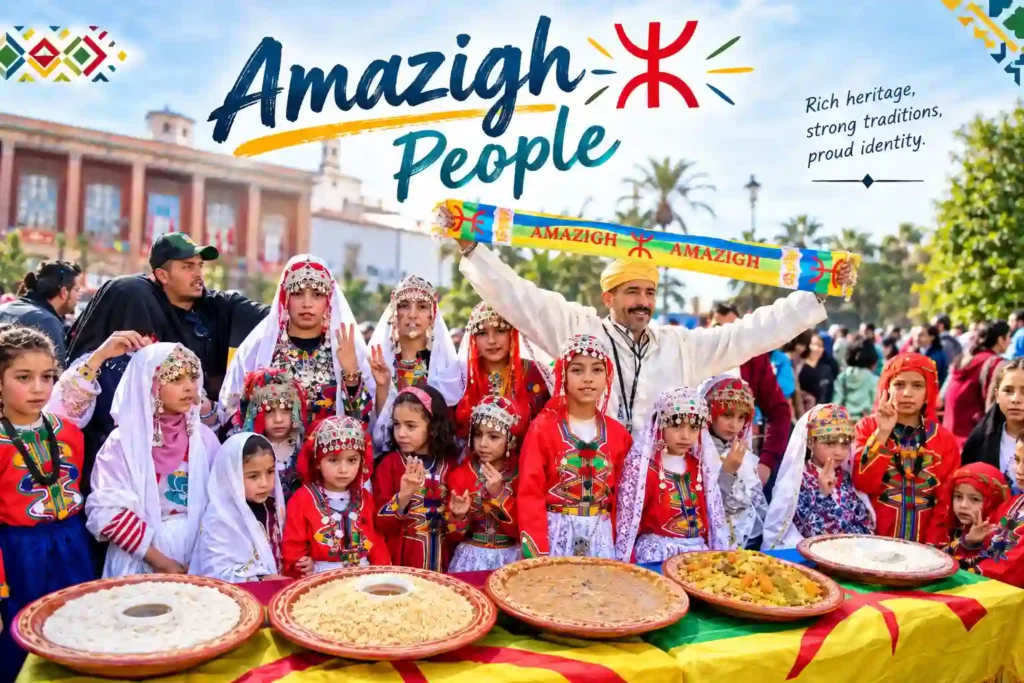
Long before Arabic was spoken in North Africa, before the Romans built roads through the Maghreb, and before Islam reached the region, there were the Berbers. In Morocco today, they’re not a historical footnote, they’re the country’s original inhabitants, and their language, symbols, and traditions are woven into daily life from the High Atlas villages to the streets of Marrakech. This guide goes beyond the surface-level facts most travel sites repeat and actually explains who the Berbers are, where the name comes from, how their history unfolded, what makes their culture distinct, and what you’re actually seeing and hearing when you encounter Amazigh culture on a trip through Morocco.
Table of Contents
Who are the Berbers, really?
The Berber people, sometimes called Amazigh or Imazighen, are the Indigenous peoples of North Africa, and they’ve lived across this vast stretch of the continent since prehistoric times, from Egypt in the east through Tunisia, Algeria, Libya, Mali, Niger, and Mauritania to Morocco in the west. Berber civilization predates the arrival of both Islam and the Arab people in North Africa, and their oldest known ancestors are believed to have migrated into the region around 3000 BCE or possibly earlier, gradually spreading westward until they settled most prominently in present-day Morocco.
Their roots in North and sub-Saharan Africa run remarkably deep, going back more than 20,000 years by some estimates, well before the Arab conquest reshaped the region’s language and religion. In Morocco specifically, Berber identity isn’t confined to remote villages or a single region, it’s foundational to the country as a whole. The Amazigh have traditionally formed the historical, cultural, and social foundations of Morocco itself across centuries, long before the country took the shape it has today.
What Does “Amazigh” Actually Mean, and Why Two Names?
If you have spent any time researching this topic, you’ve probably noticed the Berbers are referred to by two different names, and there’s a real story behind why.
The term “Berber” comes from the Greek word barbaros, the same root as the English word “barbarian,” which was originally used by Greeks to describe anyone who didn’t speak Greek, and was later adopted by Arab conquerors, in some cases with a similarly dismissive connotation. It’s an outsider’s label, not a name the people themselves ever thing.
“Amazigh,” by contrast, is what the people call themselves. The word Amazigh means “free people,” a name that reflects the community’s own sense of identity across centuries. Some scholars translate it slightly differently, as “noble people” rather than strictly “free people,” but the underlying sentiment, self-determination and dignity, comes through either way. Today, “Amazigh” (plural: Imazighen) has become the preferred term in Morocco, especially in official and cultural contexts, while “Berber” remains widely used internationally, including by many Amazigh people themselves when speaking English.
A Brief History: From Ancient Kingdoms to Modern Recognition
Berber history in Morocco doesn’t start with any single event, it’s a continuous presence that predates recorded history and has intersected with nearly every major civilization to pass through North Africa.
Long before modern borders existed, Berber tribes were already shaping the story of the Mediterranean, interacting with Egyptians, Phoenicians, and Romans, and their homeland historically stretched from Morocco’s Atlantic coast all the way to the Siwa Oasis in Egypt. Berber traders and travelers crisscrossed the Sahara and the southern Mediterranean basin for centuries, building political, economic, and cultural networks long before the concept of a nation-state existed in the region.
One especially notable figure from this era is Dihya, also known as Kahina, a Berber queen who led resistance against the Arab conquest in the 7th century, a moment still referenced today as a symbol of Berber independence and resilience.
In the centuries that followed, Berber dynasties didn’t just survive foreign influence, they built some of North Africa’s most significant empires. Berber tribes founded and led the Almoravid and Almohad empires, both of which stretched across Morocco and into Spain, leaving behind architecture, institutions, and cultural influence still visible today.
Despite this deep and powerful history, Berber identity faced real pressure in more recent centuries. Despite being the oldest inhabitants of North Africa, Berbers have had to fight to safeguard their identity, facing a long struggle for political and linguistic recognition, with the integration of Berber communities into modern Moroccan society being an ongoing process even after independence.
That struggle has produced real, measurable progress in recent decades. Morocco’s independence in 1956 brought significant political and social change that opened the door to recognizing Berber identity and culture, and a major milestone came with the constitutional reform of 2011, which officially recognized Tamazight as a national language of Morocco. In June 2019, Moroccan legislators unanimously approved a bill confirming Tamazight’s official status alongside Arabic, mandating its inclusion in education, media, and public life.
How Many Berbers Live in Morocco Today?
Morocco has the largest Berber population of any country in North Africa, and the numbers reflect just how central Amazigh identity is to the country as a whole.
Berbers in Morocco represent around 40 percent of the Kingdom’s population, the highest proportion of any country in the world. Roughly 40 percent of Moroccans identify primarily as Berber, amounting to approximately 15 million people, while more than 60 percent of the population has some degree of Berber ancestry. In practice, Berber identity in Morocco functions as both an ethnic and a cultural category, and many Moroccans move fluidly between Arab and Berber identity depending on context, family background, and region.
Overall, the picture is even larger. Worldwide, the Berber population is estimated at 30 to 40 million people, with Morocco and Algeria home to the largest concentrations.
Where Berber Communities Live in Morocco
Berber communities aren’t scattered randomly across Morocco, they’re concentrated in specific geographic zones that have historically offered a degree of natural separation and autonomy.
Berber populations are concentrated in the Atlas Mountains, spanning the High, Middle, and Anti-Atlas ranges, the Rif Mountains in the north, the Souss plain in the south, and the oasis regions of the southeast, including Tafilalet, the Draa Valley, and Dades. These aren’t incidental locations, mountains and desert oases historically offered protection from outside political control, which helped Berber language and culture persist relatively intact even through periods of significant outside influence elsewhere in the country.
The Many Tribes Within "Berber"
“Berber” isn’t a single, uniform group, it’s an umbrella term covering a genuinely large number of distinct tribes and tribal confederations, each with its own dialect, customs, and regional identity.
There are well over a hundred different Amazigh tribes and tribal groups inhabiting different regions throughout Morocco, though three dominant groups stand out: the Riffians, the Zayanes, and the Cheluh (also spelled Chleuh or Shilhah). Beyond Morocco’s borders, related Berber ethnic groups include the Kabyle and Zenet peoples of Algeria and the Tuareg of the Sahara, each maintaining a distinct identity while sharing common linguistic and cultural roots.
Broadly, these groups map onto Morocco’s geography: the Riffians (Rifain) are concentrated in the northern Rif Mountains, the Zayanes in the Middle Atlas, and the Chleuh across the High Atlas, Souss Valley, and Anti-Atlas in the south. Each group speaks its own variety of Tamazight and maintains distinct traditions in dress, music, and craft, so “Berber culture” looks noticeably different depending on which region you’re actually in.
Tamazight: The Language Behind the Culture
Language sits at the very center of Berber identity, arguably more than any other single marker of the culture.
Tamazight, the Amazigh macrolanguage, includes several major Moroccan varieties, Tarifit in the north, Tamazight proper in the Middle Atlas, and Tashelhit in the south, alongside numerous smaller regional dialects. These varieties are related but not always mutually intelligible, meaning a Berber speaker from the Rif and one from the Souss Valley may not fully understand each other’s dialect despite sharing the same broader linguistic family.
Tamazight also has its own writing system, one of the oldest scripts still in active use anywhere in the world. The standardized Tifinagh script is now part of Morocco’s school curriculum and increasingly visible on public signage across the country. If you’ve noticed unusual geometric characters alongside Arabic and French government on Moroccan road signs or buildings, that’s Tifinagh, a visible, everyday marker of the 2011 constitutional recognition of Tamazight.
Tamazight became an official language of Morocco in 2011, and the fight to have it taught in schools across the country succeeded more recently still, in 2016, a genuinely fast pace of institutional change for a language that had been excluded from formal education for generations.
Religion and Pre-Islamic Amazigh Traditions
Before the arrival of Islam, many Amazigh communities practiced animism, a belief system centered on the presence of spirit within living things and the land itself, and over the following centuries, Imazigh communities also intersected with Judaism and Christianity. Today, Sunni Islam predominates across Amazigh regions of Morocco, with local customs and seasonal festivals adding distinct regional layers to religious life.
This layered religious history is part of why Berber culture in Morocco often carries traces of older, pre-Islamic practice alongside mainstream Islamic observance, particularly in rural mountain communities where seasonal festivals, agricultural rituals, and local saint veneration sit comfortably alongside standard religious practice.
Berber Craftsmanship: Weaving, Pottery, and Jewelry
Few aspects of Amazigh culture are as visible to travelers as its craftsmanship, and for good reason, it’s one of the areas where Berber identity has most successfully adapted to the modern economy without losing its roots.
Craftsmanship, including weaving, pottery, and jewelry-making, has found a solid place in the modern Moroccan economy, with traditional crafts gaining international recognition and being actively sought after by tourists and collectors alike. By supporting local artisans directly, this modern market has provided real economic opportunities for Amazigh communities, alongside a platform to showcase their heritage to a global audience.
Berber rugs are probably the best-known example: hand-knotted, geometric, and often made by women in mountain villages using patterns passed down through families rather than written designs, with symbols that can carry meaning related to fertility, protection, or a specific tribal identity. Silver jewelry, particularly fibulae (traditional clasps) and large statement necklaces, follows a similar path, historically functional and symbolic, now also a significant part of Morocco’s craft export economy.
Berber Music, Dance, and Celebration
Music plays a central, active role in Amazigh cultural life rather than existing as a museum piece. Amazigh tribes, including the Zayanes, are known for performing traditional music and dance as a living part of community celebration, not simply as a performance for outsiders. Ahwash and ahidous, group dances performed in a circle with drumming, call-and-response singing, and rhythmic clapping, remain central to weddings, harvest celebrations, and community gatherings across Berber regions, especially in the Atlas Mountains.
One of the most striking cultural events tied to this tradition is the Imilchil Marriage Festival, an annual gathering in the Atlas Mountains where, according to local tradition, young men and women from Berber tribes have historically come together with the possibility of finding a marriage partner, alongside music, dance, and trading that draws visitors from across Morocco and beyond.

Berber Identity and Physical Diversity
One detail that surprises a lot of travelers, and that a lot of shallow blog content skips entirely, is how physically diverse Amazigh people actually are.
While the Amazigh identity is often visually associated with typical North African features, the reality is considerably more complex, and in certain regions of the Atlas and Rif Mountains, and among some Tuareg communities, it isn’t uncommon to find blue or green eyes, lighter skin tones, or even blonde hair. These traits aren’t anomalies, they reflect a history shaped by millennia of movement, interconnection, and cultural exchange with Phoenicians, Romans, Vandals, Byzantines, and Andalusians. What remains across this diversity isn’t a particular look, it’s a shared ancestral identity and connection to the land.
Meeting Berber Culture on a Morocco Trip
For most travelers, Berber culture isn’t something you have to seek out separately, it’s built into the experience of visiting Morocco, especially outside the biggest cities.
If you travel into the desert or the mountains, it’s more than likely that your Moroccan guide will be Berber, and the same is true for many of the families hosting overnight stays in mountain villages or running desert camps near Merzouga and Zagora. On many Morocco desert tours, the guides, camp hosts, and village families travelers meet along the way are Berber, making a Sahara excursion or an Atlas Mountains day trip one of the more direct ways to encounter Amazigh culture firsthand rather than through a museum display.
A few simple habits go a long way if this is part of your trip: learning a few words in Tamazight or Darija tend to open doors, asking before photographing people, homes, or sacred places is a basic courtesy, and buying authentic handmade crafts directly from artisans supports local economies far more directly than souvenir shops aimed purely at tourists. Traveling with guides who genuinely value community-based tourism and fair pay for local hosts also makes a meaningful difference to the communities you’re visiting.
Ongoing Challenges and the Path Forward
Berber recognition in Morocco has come a long way, but it isn’t a fully finished story. In spite of centuries of pressure, ongoing priorities for Amazigh communities include equitable access to services in Amazigh-speaking regions and sustainable management of the natural resources that rural livelihoods depend on. Language rights, economic opportunity in remote mountain and desert regions, and continued cultural preservation remain active areas of work rather than settled issues, even with the real institutional progress of the past two decades.
The Amazigh Flag and What Its Colors Mean
If you have traveled through Morocco’s Amazigh regions, you may have spotted a flag with three horizontal stripes, blue, green, and yellow, and a red symbol in the middle. This is the Amazigh flag, and every part of it carries meaning. The blue stripe stands for the sea, both the Mediterranean and the Atlantic. The green stripe represents the mountains, home to many Berber communities. The yellow stripe represents the desert, another key part of the traditional Amazigh homeland. In the center sits a red symbol called “yaz,” a letter from the ancient Tifinagh alphabet. Yaz represents the word “Amazigh” itself and stands for freedom, resistance, and the idea of a free, standing human being with open arms. The flag was designed in 1970 and officially adopted in 1997 at the first World Amazigh Congress. It doesn’t belong to any single country or government, it belongs to the Amazigh people as a whole, and today you’ll see it at cultural festivals, on clothing, and even as tattoos among people proud of their Amazigh identity.
Berber Food: What Amazigh Cooking Looks Like
Amazigh culture has shaped Moroccan food more than most travelers realize. Tagine, the slow-cooked stew named after the cone-shaped clay pot it’s cooked in, has deep roots in Berber cooking traditions, built around whatever meat, vegetables, and spices were available locally. Couscous, often considered Morocco’s national dish, is originally a Berber staple, traditionally steamed by hand over a pot of broth and served on Fridays as a family meal. In the mountains, simple, hearty dishes built around bread, olive oil, honey, and dairy from local herds remain common, food built for a farming and herding lifestyle rather than city cooking. If you stay with a Berber family in the Atlas Mountains or visit a rural market, the food you’re served is often a more traditional, less restaurant-adapted version of dishes you may already know from Moroccan menus.

The Role of Berber Women in Amazigh Culture
Berber women hold a central, visible role in Amazigh cultural life, often more so than is commonly assumed from the outside. Women are typically the ones who weave the region’s famous Berber rugs, choosing patterns and symbols passed down through generations rather than following a fixed template. In many mountain communities, women also play a leading role in preparing food, managing the household economy, and passing down language and oral traditions to children. Berber jewelry, large silver pieces, has particularly traditionally been worn by women as a visible marker of wealth, marital status, or tribal identity, and pieces were sometimes even used as a practical form of savings, wearable wealth that could be sold or traded if needed. In recent years, Amazigh women have also become more visible in cultural and political movements advocating for Berber language rights and recognition.
Yennayer: The Amazigh New Year
Yennayer is the Amazigh New Year, celebrated by Berber communities across Morocco and North Africa, and it’s based on an old agricultural calendar rather than the Islamic or Gregorian calendar. It usually falls around January 12th to 14th, marking the start of the agricultural year in Berber tradition. Families mark the occasion with special meals, often built around couscous, chicken, or a hearty stew, and in some regions people follow specific customs, like avoiding sharp tools on the day, thought to bring bad luck for the year ahead. Morocco officially recognized Yennayer as a national holiday in 2023, a significant, more recent milestone in the same long push for Amazigh cultural recognition that brought Tamazight into schools and public life.
Berbers vs. Tuareg: What's the Difference?
Travelers sometimes use “Berber” and “Tuareg” interchangeably, but they’re not quite the same thing. Tuareg people are actually a specific Berber ethnic group, historically nomadic traders and herders of the Sahara, found mainly in Mali, Niger, Algeria, and Libya rather than concentrated in Morocco. What sets the Tuareg apart within the broader Berber family is their traditional nomadic desert lifestyle, their distinct indigo-dyed clothing, and the fact that Tuareg men, unlike most Berber groups, traditionally wear a veil covering the face, a practice that has earned them the nickname “the blue men of the desert.” In Morocco specifically, most Berber communities are mountain or oasis-based rather than fully nomadic, so while Tuareg culture shares the same linguistic and ethnic roots, the day-to-day traditions look noticeably different from the Berber communities most travelers encounter in the Atlas Mountains or southern Morocco.
Frequently Asked Questions About the Berber People of Morocco
Are Berbers and Amazigh the same people?
Yes. “Berber” is the name historically given by outsiders, tracing back to the Greek word for “foreigner,” while “Amazigh” is the name the people use for themselves, meaning “free people.” Both terms refer to the same indigenous population of North Africa.
What percentage of Morocco's population is Berber?
Around 40 percent of Moroccans identify primarily as Berber, roughly 15 million people, while more than 60 percent of the population has some degree of Berber ancestry.
What language do Berbers speak?
Tamazight, an official language of Morocco since 2011, with major regional varieties including Tarifit (north), Tamazight proper (Middle Atlas), and Tashelhit (south), written in the Tifinagh script.
Where do most Berbers live in Morocco?
Mainly in the Atlas Mountains (High, Middle, and Anti-Atlas), the Rif Mountains in the north, the Souss plain in the south, and southeastern oasis regions like Tafilalet and the Draa Valley.
Are all Berbers Muslim?
The large majority practice Sunni Islam today, though pre-Islamic traditions, including animist beliefs, historically shaped Amazigh spiritual life, and traces of that layered history remain visible in some local customs and festivals.
Is Tifinagh still used today?
Yes, the standardized Tifinagh script is part of Morocco’s school curriculum and appears on public signage across the country alongside Arabic and French.
What are the main Berber tribes in Morocco?
The three dominant groups are the Riffians (Rif Mountains), the Zayanes (Middle Atlas), and the Chleuh (High Atlas, Souss Valley, and Anti-Atlas), though well over a hundred distinct tribes and sub-groups exist across the country.
Will I meet Berber people on a Morocco desert or mountain tour?
Almost certainly. Guides, camp hosts, and village families across the Atlas Mountains and Sahara regions are very often Berber, making these trips one of the most direct ways to experience Amazigh culture firsthand.
Final Thoughts
The Berber people aren’t a side note in Morocco’s story, they’re the foundation it was built on, and their presence is still very much alive rather than confined to history books. From the Tifinagh script on a road sign to the rhythm of an ahidous dance at a mountain wedding, from a hand-knotted rug to the Berber guide leading a trek through the Atlas, Amazigh culture shapes a huge amount of what makes traveling through Morocco feel distinct. Understanding who the Berbers are, and approaching their culture with genuine curiosity and respect, adds a layer of depth to a Morocco trip that a surface-level itinerary simply can’t offer on its own.
If you’re planning a trip through Morocco’s Atlas Mountains or Sahara Desert and want to experience authentic Berber culture along the way, whether that’s staying with a Berber family, visiting a traditional village, or simply having the context to appreciate what you’re seeing, feel free to get in touch with us. We build routes that go beyond the surface and connect travelers with the people and places that make Morocco’s Amazigh heritage so remarkable.

I’m Lahcen Saadi from the Exploring Morocco Trips team. We are local guides dedicated to crafting authentic and exceptional Moroccan experiences.
Whether you are planning your first trip to Morocco and need expert advice, or you are a travel professional looking to collaborate on unique itineraries, we are ready to help.
- 2 Days Desert tours From Marrakech
- 3 Days Desert tour From Marrakech to Merzouga
- 3 Days Desert tour From Marrakech to Fes
- 4 Days Desert tour From Marrakech to Merzouga
- 4 Days Desert tour From Marrakech to Fes
- 5 Days Desert tour From Marrakech to Merzouga
- 5 Days Desert tour From Marrakech to Fes
- 6 Days Desert tour From Marrakech to Casablanca
- 7 Days Morocco tour from Marrakech
- 8 Days Morocco tour from Marrakech
- 8 Days Morocco tour from Marrakech with Imperial Cities
- 9 Days Morocco tour from Marrakech
- 10 Days Morocco tour from Marrakech
- 12 Days Morocco tour from Marrakech
- 14 Days Morocco tour from Marrakech
- 2 Days Desert tour From Fes to Merzouga
- 2 Days Desert tour From Fes to Marrakech
- 3 Days Desert tour From Fes to Merzouga
- 3 Days Desert tour From Fes to Marrakech
- 4 Days Desert tour From Fes to Marrakech
- 5 Days Desert tour From Fes to Marrakech
- 6 Days Desert tour From Fes to Marrakech
- 7 Days Morocco tour from Fes
- 4 Days Morocco tour from Casablanca
- 5 Days Morocco tour from Casablanca
- 6 Days Morocco tour from Casablanca
- 7 Days Morocco tour from Casablanca
- 8 Days Morocco tour from Casablanca
- 9 Days Morocco tour from Casablanca
- 10 Days Morocco tour from Casablanca
- 11 Days Morocco tour from Casablanca
- 12 Days Morocco tour from Casablanca
- 14 Days Morocco tour from Casablanca