
Erfoud Fossils: Inside Morocco's 500-Million-Year-Old Desert Treasure Trove
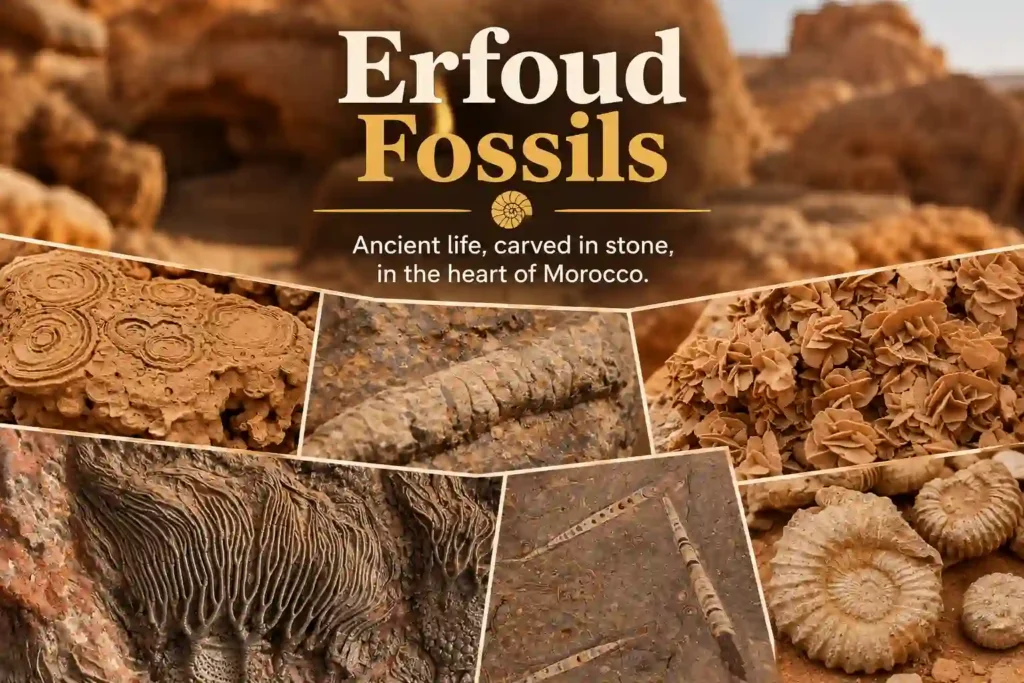
Long before the Sahara existed, the ground beneath Erfoud was seafloor. That single fact explains almost everything about why this small desert town in southeastern Morocco has become one of the most important fossil regions on Earth, and why “Erfoud fossils” has turned into a search term of its own, drawing geologists, collectors, and curious travelers from every continent. This guide covers what makes Erfoud’s fossils so significant, what you’ll actually find there, how the local fossil trade works, and what to know before you buy, hunt, or simply visit.
Table of Contents
From Ancient Ocean Floor to Desert Town
During the Devonian period of the Paleozoic Era, roughly 380 million years ago, the area around Erfoud and nearby Rissani sat at the bottom of an early proto-Mediterranean sea known as the Tethys Ocean. Across the wider Palaeozoic era, between about 540 and 250 million years ago, the entire Drâa-Tafilalt region was covered by a warm, shallow sea teeming with marine life.
As that sea gradually withdrew, the fish, marine plants, and countless other sea creatures that lived and died there were left behind, and over hundreds of millions of years they became fossilized in place. What makes the region so exceptional today is that it happens to sit in a geologically stable zone, which is a large part of why these fossils survived in such remarkable condition rather than being crushed, eroded, or scattered by tectonic activity elsewhere.
The result is a landscape where an ordinary-looking rock outcrop, roadcut, or quarry wall can be packed edge to edge with the remains of an ocean that disappeared before the first land animals existed.
Why Erfoud Became "Fossil Capital" of Morocco
The Moroccan fossil trade traces back to 1916, when French geologist Louis Gentil discovered trilobites near Casablanca, and the industry has grown steadily in the decades since. Erfoud, sitting at the edge of the Sahara in the Tafilalt region, turned out to have an unusually dense and well-preserved concentration of Paleozoic marine fossils close to the surface, and that geological accident eventually built an entire local economy.
Today the fossil trade genuinely runs the town, and Erfoud’s Saturday market functions as one of the largest informal fossil markets in the world, moving everything from Orthoceras tables and ammonite slabs to crates of bulk trilobites destined for wholesalers in Europe and Asia. Beyond the tourist appeal, this “trilobite economy” provides real employment in an otherwise economically difficult part of the country and adds meaningfully to national revenue each year.
The Fossils You'll Actually Find Around Erfoud
Erfoud isn’t a one-fossil town. Several distinct kinds of ancient marine life show up repeatedly in the local rock, each tied to a different slice of geological time.
Trilobites. These ancient marine arthropods thrived during the Paleozoic era and turn up in the Erfoud area in genuinely remarkable numbers, which is a big part of why the town became internationally known for them in the first place. Trilobites were among the very first marine arthropods, and remarkably, they were also the first animals known to have developed eyes; they’re distantly related to the horseshoe crabs still found today. Look closely at a well-preserved specimen and you can often make out a shield-like head, a ribbed, segmented body, and in some species, spines or even eye structures.
Ammonites and goniatites. These are the spiral-shelled cephalopods most people picture when they think “fossil,” and Erfoud’s Devonian limestone is thick with a related but straighter-shelled cousin called Orthoceras alongside true coiled ammonites and goniatites. Their appeal is partly aesthetic, the tight, ridged spiral is instantly recognizable and genuinely photogenic, and partly geological, since the mineral composition of the surrounding rock can tint the shells in unusual colors depending on where they formed.
Orthoceras. This straight-shelled cephalopod is especially dense in Erfoud’s Devonian-era limestones, often appearing in clusters that make for dramatic polished slabs once cut and finished.
Crinoids. Sometimes called “sea lilies,” crinoids are actually more closely related to starfish and sea urchins than to plants, and their fossils are frequently found preserved across large rock slabs rather than as isolated specimens.
Vertebrate and dinosaur fossils. Beyond marine invertebrates, the wider Erfoud region has also produced vertebrate fossils, including fish remains, shark teeth, and even dinosaur material. Some of this material has genuine scientific weight: paleontologist Nizar Ibrahim’s landmark discovery of a partial Spinosaurus skeleton was made possible after an Erfoud fossil hunter sold him a box of Spinosaurus bones.
Inside the Workshops: How Raw Rock Becomes a Finished Fossil Piece
In Erfoud, skilled workers take massive chunks of fossil-filled limestone and polish them into tabletops, sinks, and decorative art pieces, with finished surfaces that look almost like windows into the Paleozoic seafloor. The raw material comes from local mines and quarries where fossils are embedded directly in large boulders, and each quarry tends to have its own character in terms of the geological age, the type of rock, and the coloring of the fossils it produces.
A typical workshop visit walks through the full process: the history of the area, how different types of fossils are located and mined, and hands-on demonstrations of how raw stone is cut, polished, and shaped into finished pieces. Interactive displays in some workshops let visitors touch and hold real specimens rather than viewing everything behind glass, which makes the process considerably more engaging for families and casual visitors than a typical museum stop.
Where to See and Buy Fossils Near Erfoud
The Saturday and Sunday markets. Erfoud’s Saturday market is the larger of the two and functions as the world’s largest informal fossil trade, while Rissani, about 20 km south, hosts a smaller but often better Sunday market where local quarry workers sell fossils directly rather than through intermediaries. Prices in this region tend to run 30 to 60 percent below what comparable pieces cost in a Marrakech medina, and buyers can often ask to meet the preparator who actually worked on a given specimen, which is one of the more reliable ways to confirm a piece is genuine.
Tahiri Museum of Fossils and Minerals. Roughly 11 km from Erfoud along the Rissani road, this private museum, easily spotted from the road thanks to life-size dinosaur skeleton replicas out front, was built by Brahim Tahiri, whose contribution to raising awareness of Morocco’s geological heritage was recognized internationally when a trilobite species, Asteropyge tahiri, was named in his honor. The museum’s prize specimens aren’t for sale, but the attached boutique does offer rarer pieces alongside more affordable items studded with common trilobite and ammonite fossils.
Fossil workshops and showrooms. Several active workshops in and around Erfoud combine an outdoor area displaying fossils in their raw, unprocessed form with a guided walkthrough of the cutting and polishing process, followed by a showroom stocked with finished pieces across a range of price points.
How to Spot a Real Fossil vs. a Workshop Fake
Because Erfoud’s fossil trade is so large and so commercially driven, not every “fossil” on a shop shelf is entirely natural, and it’s worth knowing what to look for.
Natural ammonites typically show visible growth lines and a degree of realistic irregularity from one specimen to the next; if you want something closer to how it looked coming out of the ground, ask specifically for an unpolished or only lightly cleaned piece rather than a fully finished one. With trilobites specifically, a specimen that looks suspiciously perfect, or that looks nearly identical to another one on the same shelf, may have been heavily restored or, in some cases, substantially recreated rather than being a genuine natural fossil.
If authenticity matters to you, buying from a workshop where you can see the preparation process firsthand, or asking directly which parts of a piece are original versus restored, is generally more reliable than buying from a stall with no visible connection to an actual quarry or preparator.
The Ethics Behind Morocco's Fossil Trade
Even a resource as seemingly abundant as Morocco’s fossils is finite, and researchers and conservationists have raised real questions about whether the scale of the country’s commercial fossil trade is gradually eroding parts of a genuinely important scientific and historical record. Trilobites and ammonites that could inform paleontological research sometimes end up instead as countertops, sinks, or decorative art, a trade-off between economic opportunity for local communities and long-term preservation of scientifically significant material.
At the same time, the trade provides real employment in economically underserved parts of Morocco and contributes meaningfully to the national economy each year. Travelers who want to engage thoughtfully with this tension can look for workshops and sellers who are transparent about where specimens come from, avoid buying anything explicitly marketed as rare or scientifically significant without provenance, and treat truly exceptional finds as things to photograph and appreciate rather than necessarily purchase.
Fossil Hunting Around Erfoud: What to Expect
Guided fossil-hunting tours in the areas around Erfoud let visitors explore active fossil beds and search for their own specimens rather than only buying finished pieces from a shop. Fossiliferous rock exposures spanning more than half a billion years of Earth’s history are accessible across the region in river beds, roadcuts, hamada (rocky desert plateau), and quarries, and in many spots fossils are plentiful, well preserved, and genuinely easy to spot once you know what you’re looking for.
A typical guided outing combines a short introduction to the local geology and time periods represented in the rock with hands-on searching, and most guides are well practiced at helping first-timers, including children, tell a genuine fossil from an ordinary rock.
Erfoud's Fossils Beyond Morocco
Erfoud’s specimens don’t stay local. Moroccan fossils, including material sourced from the Erfoud region, have made their way into major natural history museums such as the Smithsonian and institutions in London, alongside a global online market that sells fossils from this region to buyers anywhere in the world. It’s a strange kind of geological journey: rock that formed at the bottom of a vanished sea, exposed by desert erosion, extracted by hand in the Sahara, and eventually displayed behind museum glass or set into a countertop thousands of miles away.
Where Erfoud Fits Among Morocco's Other Fossil Regions
Erfoud is Morocco’s best-known fossil hub, but it isn’t the only one, and the fossils found elsewhere in the country come from very different periods of geological time.
The Devonian-age limestones around Erfoud, roughly 419 to 359 million years old, are especially dense with Orthoceras and goniatite ammonites, while the Middle and High Atlas mountain ranges hold a separate belt of Jurassic ammonites, around 200 to 145 million years old, including the distinctive striped Boulemane ammonite found in the region between Sefrou and Midelt. Further afield, the Atlantic coast near Agadir produces large, sometimes striking Late Cretaceous ammonites, including unusual uncoiled or semi-coiled varieties known as heteromorphs.
For a traveler mapping out a Morocco fossil trip, that spread matters: Erfoud covers the oldest end of the timeline, the Atlas ranges cover the Jurassic middle, and the Atlantic coast fills in the Cretaceous, each with visibly different fossil types shaped by the conditions of a different ancient sea.
How to Get to Erfoud
Erfoud sits in southeastern Morocco, close to the edge of the Sahara, and it’s typically reached as part of a longer desert route rather than as a standalone destination. From Marrakech, the most common approach crosses the High Atlas Mountains via the Tizi n’Tichka pass before continuing through Ouarzazate and the Dades and Todra gorges on the way to Erfoud, a route that usually takes a full day of driving and is often broken into an overnight stop along the way. From Fes, the drive runs through the Middle Atlas via Azrou and Midelt, generally a somewhat shorter and more direct trip. Erfoud also has its own small airport with limited domestic connections, though most visitors arrive overland as part of a multi-day desert itinerary that continues on to the nearby Erg Chebbi dunes and Merzouga.
Best Time of Year to Visit Erfoud for Fossils
Erfoud sits at the edge of the Sahara, so its climate runs hotter and drier than cities further north like Marrakech or Fes, and that matters for anyone planning to spend time outdoors at a quarry, market stall, or fossil bed. Spring (March to May) and autumn (late September to November) offer the most comfortable conditions for a workshop visit or a guided fossil hunt, with daytime temperatures warm but manageable. Summer (June to August) brings intense heat, often well above 40°C at midday, which makes early morning or late afternoon the only realistic windows for outdoor fossil hunting. Winter days are generally mild and pleasant for visiting markets and workshops, though desert nights can turn surprisingly cold, so layers are worth packing regardless of season.
Fossils as Souvenirs: What Actually Travels Well
Not every fossil piece is practical to bring home, and it’s worth thinking about size and fragility before buying. Small, individually mounted specimens, single trilobites, small ammonites, or polished Orthoceras slices, pack easily and survive airline luggage without much risk. Larger items like fossil tabletops, sinks, or big display slabs are heavy, fragile, and often impractical to carry as luggage; reputable workshops that sell these larger pieces typically offer international shipping, so it’s worth asking about shipping costs and export documentation before committing to a large purchase rather than after. It’s also worth checking your home country’s customs rules on fossil or mineral imports in advance, since a small number of countries restrict or tax these items differently from ordinary souvenirs.

A Quick Geological Timeline of Erfoud's Fossils
| Period | Approximate Age | What Formed |
|---|---|---|
| Cambrian–Ordovician | ~540–440 million years ago | Earliest trilobite species |
| Silurian | ~440–419 million years ago | Continued marine arthropod and cephalopod diversity |
| Devonian | ~419–359 million years ago | Peak Orthoceras and goniatite ammonite formation in Erfoud’s limestone |
| Carboniferous–Permian | ~359–252 million years ago | Later trilobite species before their extinction |
This timeline is part of why Erfoud specimens vary so much in appearance from one shop or quarry to the next: a trilobite and an Orthoceras slab found a short drive apart can still represent tens of millions of years of difference in age.
Frequently Asked Questions About Erfoud Fossils
Why is Erfoud so famous for fossils?
The area sits on what used to be the floor of an ancient sea during the Paleozoic era, and its geologically stable ground preserved an unusually dense concentration of marine fossils close to the surface, which local workshops and markets have built into a major regional industry.
What is the most common fossil found near Erfoud?
Trilobites are the fossil most associated with Erfoud internationally, though Orthoceras, ammonites, goniatites, and crinoids are all extremely common in the surrounding Devonian limestone as well.
Are Erfoud's fossils real?
Many are entirely genuine, but because the trade is so large, some pieces sold as souvenirs are partially or heavily restored, and a small number are outright reproductions. Buying from a workshop with visible quarry-to-shop transparency, or asking for unpolished specimens, reduces the risk of buying something inauthentic.
Can you go fossil hunting yourself near Erfoud?
Yes. Guided fossil-hunting tours are available in the areas around the town, letting visitors search active beds themselves rather than only buying finished pieces.
Is it ethical to buy fossils in Erfoud?
It’s a genuinely mixed picture. The trade supports real local employment and national income, but some conservationists worry that scientifically valuable specimens are being sold as decorative items rather than preserved for research. Buying thoughtfully, and avoiding pieces marketed as rare finds without clear provenance, is a reasonable middle ground.
How old are the fossils found around Erfoud?
Most date to the Devonian period of the Paleozoic era, roughly 359 to 419 million years old, though the wider region’s fossil record spans more than half a billion years.
What's the difference between the Erfoud market and the Rissani market?
Erfoud’s Saturday market is larger and functions as a major international trade hub, while Rissani’s Sunday market, about 20 km south, is smaller but often considered better for buying directly from the quarry workers themselves, typically at lower prices.
Final Thoughts
Erfoud’s fossils are a rare case where deep geological time is genuinely part of everyday life in a place, not locked away in a museum but sitting on market tables, embedded in workshop countertops, and buried just beneath the desert surface waiting to be found. Whether you’re drawn there for the science, the shopping, or simply the strange thrill of holding something that was alive hundreds of millions of years before the Sahara existed, Erfoud remains one of the most genuinely unique stops on a southern Morocco itinerary.
If a Merzouga or Sahara desert trip is part of your Morocco plans, a stop in Erfoud or Rissani to explore the fossil workshops and markets is an easy and worthwhile addition. And if you’re looking to book a fossil-focused tour in Morocco, or need help sourcing a specific fossil piece, feel free to contact us, we’re happy to help build it into your route.

I’m Lahcen Saadi from the Exploring Morocco Trips team. We are local guides dedicated to crafting authentic and exceptional Moroccan experiences.
Whether you are planning your first trip to Morocco and need expert advice, or you are a travel professional looking to collaborate on unique itineraries, we are ready to help.
- 2 Days Desert tours From Marrakech
- 3 Days Desert tour From Marrakech to Merzouga
- 3 Days Desert tour From Marrakech to Fes
- 4 Days Desert tour From Marrakech to Merzouga
- 4 Days Desert tour From Marrakech to Fes
- 5 Days Desert tour From Marrakech to Merzouga
- 5 Days Desert tour From Marrakech to Fes
- 6 Days Desert tour From Marrakech to Casablanca
- 7 Days Morocco tour from Marrakech
- 8 Days Morocco tour from Marrakech
- 8 Days Morocco tour from Marrakech with Imperial Cities
- 9 Days Morocco tour from Marrakech
- 10 Days Morocco tour from Marrakech
- 12 Days Morocco tour from Marrakech
- 14 Days Morocco tour from Marrakech
- 2 Days Desert tour From Fes to Merzouga
- 2 Days Desert tour From Fes to Marrakech
- 3 Days Desert tour From Fes to Merzouga
- 3 Days Desert tour From Fes to Marrakech
- 4 Days Desert tour From Fes to Marrakech
- 5 Days Desert tour From Fes to Marrakech
- 6 Days Desert tour From Fes to Marrakech
- 7 Days Morocco tour from Fes
- 4 Days Morocco tour from Casablanca
- 5 Days Morocco tour from Casablanca
- 6 Days Morocco tour from Casablanca
- 7 Days Morocco tour from Casablanca
- 8 Days Morocco tour from Casablanca
- 9 Days Morocco tour from Casablanca
- 10 Days Morocco tour from Casablanca
- 11 Days Morocco tour from Casablanca
- 12 Days Morocco tour from Casablanca
- 14 Days Morocco tour from Casablanca