
Khamlia: The Sahara Village Where Music Carries Centuries of History
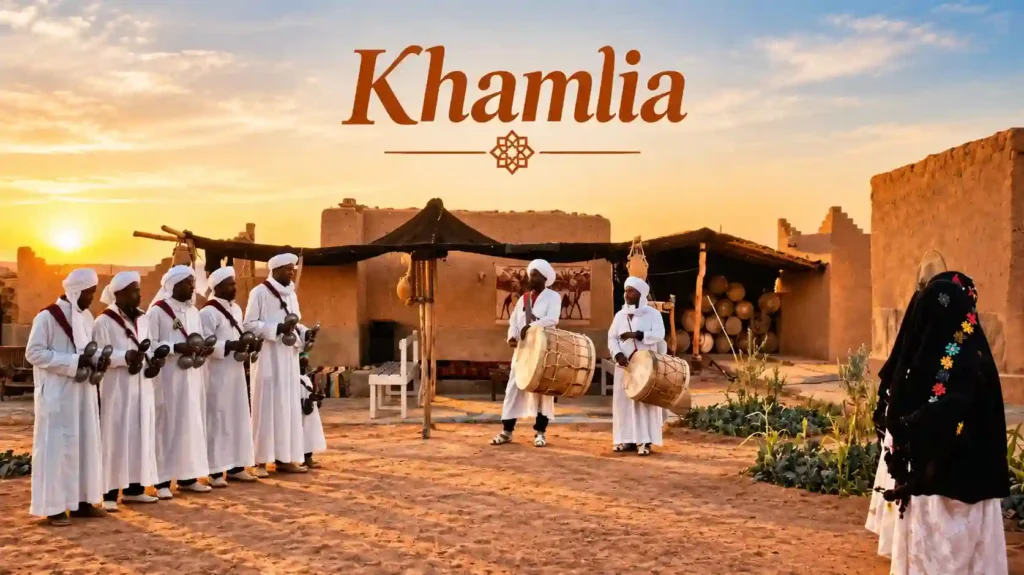
A few kilometers past Merzouga, right at the edge of the Erg Chebbi dunes, sits a small village that most travelers speeding toward the Sahara never stop to notice. Khamlia doesn’t have towering dunes of its own or a famous kasbah, what it has is music, a living tradition carried by a community whose story stretches back across the Sahara itself. This guide covers where Khamlia is, who its people are, why their music matters, and what to actually expect if you stop there on your way into the desert.
Table of Contents
Where is Khamlia located?
Khamlia sits in southeastern Morocco, roughly 6-7 km south of Merzouga, right at the edge of the Erg Chebbi dunes and close to the Algerian border. It falls within the Drâa-Tafilalet region, surrounded by arid plains, fossil-rich terrain, and the towering, color-shifting dunes the area is famous for. Locally, Khamlia is sometimes referred to as the “southern gateway to the Sahara,” since it sits right where Morocco’s desert landscape genuinely begins. Despite its proximity to one of Morocco’s most visited desert hubs, the village itself has remained small and largely untouched by the kind of tourism infrastructure found in Merzouga proper, and a paved road only reached the village in 2004, which is part of why it stayed off most maps for so long.
Who Are the People of Khamlia?
Khamlia’s population is entirely Black African in origin, and their presence in this specific corner of the Sahara isn’t accidental, it’s the direct result of one of the region’s oldest and darkest historical threads.
For centuries, sub-Saharan Africans from countries like Mali, Sudan, Niger, and Senegal were forcibly moved north across the Sahara as part of the trans-Saharan slave trade, following ancient caravan routes that once passed through Timbuktu, then the capital of the Ghana Empire. Locally, the community is sometimes known as “Isemkhane,” an Amazigh term referring to their skin color, and remarkably, despite their sub-Saharan African ancestry, the community became linguistically and culturally Berberized over generations, so many residents today speak Berber (Tamazight) as their mother tongue rather than a sub-Saharan African language.
Rather than settling permanently right away, the community originally lived a nomadic life across the Erg Chebbi and wider Sahara before establishing Khamlia as a fixed village sometime in the 20th century. Today, the village is home to a few hundred residents, a small, tightly knit community built around family, faith, and a musical tradition that has survived for generations without any written record.
Gnawa Music: Khamlia's Living Heritage
If Khamlia is known for one thing, it’s Gnawa music, a spiritual and musical tradition that traces directly back to the community’s origins.
The word “Gnawa” itself is widely believed to derive from an old Berber expression, akal-n-iguinaouen, meaning roughly “land of the Black people,” a phonetic root also linked to the origins of the words “Guinea” and “Ghana.” Gnawa music grew out of the experience of enslaved sub-Saharan Africans, and its rhythms and chants were originally a way to soothe pain and hold onto identity during forced marches across the desert in chains. What began as a survival mechanism evolved over centuries into a full spiritual and musical tradition, blending West African rhythms with Moroccan Sufi and Amazigh influence, built around ritual trance ceremonies believed to have healing and spiritual power.
Musically, Gnawa performances center on a small set of traditional instruments: the guembri, a three-stringed bass lute with a deep, resonant tone, and the krakebs, large iron castanets that provide the sharp, rhythmic backbone of the sound. Performances often build gradually in intensity, with call-and-response vocals, hand clapping, and rhythmic dancing that can shift into a trance-like state for participants steeped in the tradition. Gnawa music has since become recognized well beyond Khamlia, UNESCO added Gnawa culture to its Intangible Cultural Heritage list in 2019, and cities like Essaouira host major annual Gnawa music festivals, though Khamlia remains one of the most intimate, authentic places to experience it close to its roots.
What to Expect on a Visit to Khamlia
Most travelers experience Khamlia as a short, informal stop on a wider Merzouga or Sahara desert tour rather than a full day trip on its own. A typical visit involves being welcomed into a local home or a small music house, often called a Dar Gnaoua, where residents serve traditional mint tea before a small group of local musicians performs live. There are traditionally a few different Gnawa music groups within the village, and performances usually involve a mix of drumming, call-and-response singing, and the metallic clatter of krakebs, sometimes building into a livelier, dance-driven finish. It’s an informal, close-up setting rather than a staged tourist show, part of what makes it feel genuinely different from a scheduled cultural performance elsewhere in Morocco.
Because the community has historically relied on this kind of informal hospitality and small donations for income, tipping the musicians or buying a small handmade item is generally appreciated and forms a real part of how tourism supports the village today.
Why Khamlia Is Worth the Stop
It’s easy to drive straight past Khamlia on the way to a Merzouga camel trek or an Erg Chebbi sunset, and plenty of travelers do exactly that. But the village offers something a desert dune or a kasbah can’t: a direct, living connection to a specific, often overlooked thread of Moroccan history, the story of sub-Saharan African communities who were brought to Morocco by force, and who transformed that history into a musical tradition that not only survived but became recognized as a genuine part of Morocco’s cultural heritage. Visiting Khamlia isn’t about scenery, it’s about listening to a story that’s been passed down for generations without ever being written down, told through rhythm rather than words.
Gnawa Instruments Explained Simply
If you’ve never heard Gnawa music before, the sound can feel unfamiliar at first, so it helps to know what you’re actually looking at and listening to. The guembri is the deep, bass-like instrument played by the lead musician, made from a hollowed piece of wood with camel skin stretched over it and three thick strings. It gives Gnawa music its low, hypnotic pulse, almost like a heartbeat running under the whole performance. The krakebs are the metal castanets, usually played in pairs by other members of the group, and they add a sharp, clicking rhythm that speeds up and slows down as the music builds. Together, these two instruments, plus clapping and group singing, are really all it takes to create the layered, trance-like sound Gnawa music is known for.
How Tourism Has Changed Khamlia
Khamlia looked very different before a paved road reached the village in 2004. Before that, it was barely marked on maps, and few outsiders passed through at all. Once desert tours from Merzouga started including a stop here, tourism slowly became a real part of how the village earns a living, alongside farming and small trade. This shift hasn’t been entirely smooth. In 2011, tension arose within the community when a visiting imam argued that Gnawa music conflicted with strict religious teaching, creating a divide between residents who wanted to continue the tradition and those who felt pressure to step away from it. Even with that tension, Gnawa music has remained central to the village’s identity, and it continues to be one of the main reasons travelers make the short detour off the main Merzouga road.
Best Time to Visit Khamlia
Since Khamlia sits right at the edge of the Sahara, its weather follows the same pattern as Merzouga and the surrounding desert. Spring (March to May) and autumn (October to November) are the most comfortable times to visit, with warm days and cool evenings that make sitting through a music performance genuinely pleasant. Summer (June to August) gets extremely hot in this part of Morocco, often well above 40°C during the day, so an evening visit works far better than an afternoon stop if your trip falls during these months. Winter days stay mild and sunny, though desert nights can turn cold, so a warm layer is worth having if you’re visiting after sunset.
Khamlia vs. Essaouira: Two Different Sides of Gnawa Culture
Travelers who’ve heard of Gnawa music before arriving in Morocco often know it through Essaouira, home to the large annual Gnaoua World Music Festival. Khamlia and Essaouira represent two very different ways of experiencing the same tradition. Essaouira’s festival is a big, modern, internationally attended event, with stages, crowds, and musicians from multiple countries performing over several days. Khamlia, by contrast, offers something smaller and more personal: a handful of local musicians performing in a small room or courtyard, often for a group of just a few travelers at a time. Neither version is more “authentic” than the other, they’re simply different windows into the same musical heritage, one built for a festival crowd, and one that’s simply part of everyday life in a small desert village.
Frequently Asked Questions About Khamlia Morocco
Where exactly is Khamlia located?
Khamlia sits about 6-7 km south of Merzouga, at the edge of the Erg Chebbi dunes in southeastern Morocco, close to the Algerian border.
What is Khamlia known for?
Khamlia is best known as a center of Gnawa music, performed by a community descended from sub-Saharan Africans historically brought to Morocco through the trans-Saharan slave trade.
Who are the people of Khamlia?
The village’s residents are entirely Black African in origin, with roots in Mali, Sudan, Niger, and Senegal, though the community became culturally Berberized over generations and now largely speaks Tamazight.
What is Gnawa music?
A spiritual and musical tradition built around the guembri (a three-stringed lute) and krakebs (iron castanets), blending West African rhythms with Moroccan Sufi and Amazigh influence, historically tied to ritual trance and healing.
Can tourists visit Khamlia?
Yes. Khamlia is commonly included as a short stop on Merzouga and Sahara desert tours, where visitors can enjoy tea and a live Gnawa music performance in an informal, local setting.
Is Khamlia the same as Merzouga?
No, they’re separate but very close, Khamlia is a small, distinct village about 6-7 km south of Merzouga, with a very different atmosphere and cultural focus.
Final Thoughts
Khamlia doesn’t try to compete with the Sahara’s dunes for attention, and it doesn’t need to. What makes this small village worth a stop isn’t its size or its scenery, it’s the fact that a community shaped by displacement and hardship turned their history into something that’s still alive today, carried forward through rhythm, voice, and hospitality rather than monuments or written records. A short visit here, tea in hand, listening to the guembri and krakebs echo through a small room at the edge of the Sahara, is one of the most quietly memorable stops on a Morocco desert trip.
If a Merzouga or Sahara desert tour is part of your Morocco itinerary and you would like a stop in Khamlia built into your route, feel free to get in touch, we are happy to help you plan a trip that includes this kind of authentic, off-the-main-path cultural experience.

I’m Lahcen Saadi from the Exploring Morocco Trips team. We are local guides dedicated to crafting authentic and exceptional Moroccan experiences.
Whether you are planning your first trip to Morocco and need expert advice, or you are a travel professional looking to collaborate on unique itineraries, we are ready to help.
- 2 Days Desert tours From Marrakech
- 3 Days Desert tour From Marrakech to Merzouga
- 3 Days Desert tour From Marrakech to Fes
- 4 Days Desert tour From Marrakech to Merzouga
- 4 Days Desert tour From Marrakech to Fes
- 5 Days Desert tour From Marrakech to Merzouga
- 5 Days Desert tour From Marrakech to Fes
- 6 Days Desert tour From Marrakech to Casablanca
- 7 Days Morocco tour from Marrakech
- 8 Days Morocco tour from Marrakech
- 8 Days Morocco tour from Marrakech with Imperial Cities
- 9 Days Morocco tour from Marrakech
- 10 Days Morocco tour from Marrakech
- 12 Days Morocco tour from Marrakech
- 14 Days Morocco tour from Marrakech
- 2 Days Desert tour From Fes to Merzouga
- 2 Days Desert tour From Fes to Marrakech
- 3 Days Desert tour From Fes to Merzouga
- 3 Days Desert tour From Fes to Marrakech
- 4 Days Desert tour From Fes to Marrakech
- 5 Days Desert tour From Fes to Marrakech
- 6 Days Desert tour From Fes to Marrakech
- 7 Days Morocco tour from Fes
- 4 Days Morocco tour from Casablanca
- 5 Days Morocco tour from Casablanca
- 6 Days Morocco tour from Casablanca
- 7 Days Morocco tour from Casablanca
- 8 Days Morocco tour from Casablanca
- 9 Days Morocco tour from Casablanca
- 10 Days Morocco tour from Casablanca
- 11 Days Morocco tour from Casablanca
- 12 Days Morocco tour from Casablanca
- 14 Days Morocco tour from Casablanca