
Morocco: Things to See and Do (A Guide That Actually Helps You Plan)
There’s a moment that happens to almost everyone on their first trip to Morocco, usually somewhere around day two, when you realize the country isn’t going to fit neatly into your expectations. Maybe it’s standing in the middle of Jemaa el-Fnaa at dusk as the food stalls light up and the drummers start, or maybe it’s the first time you see the Sahara’s dunes actually turn orange at sunset instead of just looking orange in a photo. Whatever the moment is, Morocco has a way of being bigger, older, and more layered than most people expect going in.
This guide isn’t a rushed top-10 list. It’s a proper walk through what Morocco actually has to offer, city by city, landscape by landscape, with enough honesty about what each place is really like that you can build a trip around what you actually want, not just what shows up first in a search result.
Marrakech: Chaos, Color, and the Country’s Beating Heart
Marrakech is where most Morocco trips start, and it earns that role. The medina here is a genuine sensory overload in the best possible way, narrow alleys packed with spice stalls, leather workshops, lantern makers, and carpet sellers who will absolutely try to get you into their shop for tea (say yes at least once; it’s part of the experience).
Jemaa el-Fnaa , the main square, is worth visiting twice, once during the day when it’s relatively calm with orange juice carts and snake charmers, and once at night when it transforms entirely into an open-air food market with dozens of stalls, storytellers, musicians, and enough smoke from the grills to see from blocks away.
Jardin Majorelle , the cobalt-blue garden once owned by Yves Saint Laurent, is a genuinely peaceful escape from the medina’s intensity, small enough to see in an hour but photogenic enough that you’ll want to linger. The Bahia Palace and El Badi Palace show off a different side of the city, Moroccan architecture at its most ornate, with carved cedar ceilings and zellige tilework that took master craftsmen years to complete. And if you only do one hammam experience in Morocco, do it in Marrakech, a proper scrub-down at a traditional bathhouse is somewhere between a spa treatment and a mild existential experience, in a good way.
Fes: The City That Feels Like Time Travel
If Marrakech is Morocco’s showman, Fes is its scholar. This is the country’s oldest imperial city, and its medina, Fes el Bali, is the largest car-free urban area in the world, which means the only way through its 9,000-plus alleyways is on foot, by donkey cart, or by getting pleasantly lost.
The Chouara Tannery is the postcard image most people associate with Fes, dozens of stone vats filled with dye and lime, workers treating leather by hand exactly as it’s been done for centuries. You’ll be handed a sprig of mint at the entrance for a reason, the smell is genuinely intense, but the view from the surrounding terraces is one of the most striking sights in the country. The Al Quaraouiyine University , founded in 859 AD, is recognized as one of the oldest continuously operating universities in the world, and while non-Muslims can’t enter the mosque itself, you can admire its stunning gates from outside. Fes is also simply a better place than Marrakech to buy authentic crafts directly from artisans, since more of the actual production still happens here rather than in tourist-facing showrooms.
Chefchaouen: The Blue City That Photos Don’t Do Justice
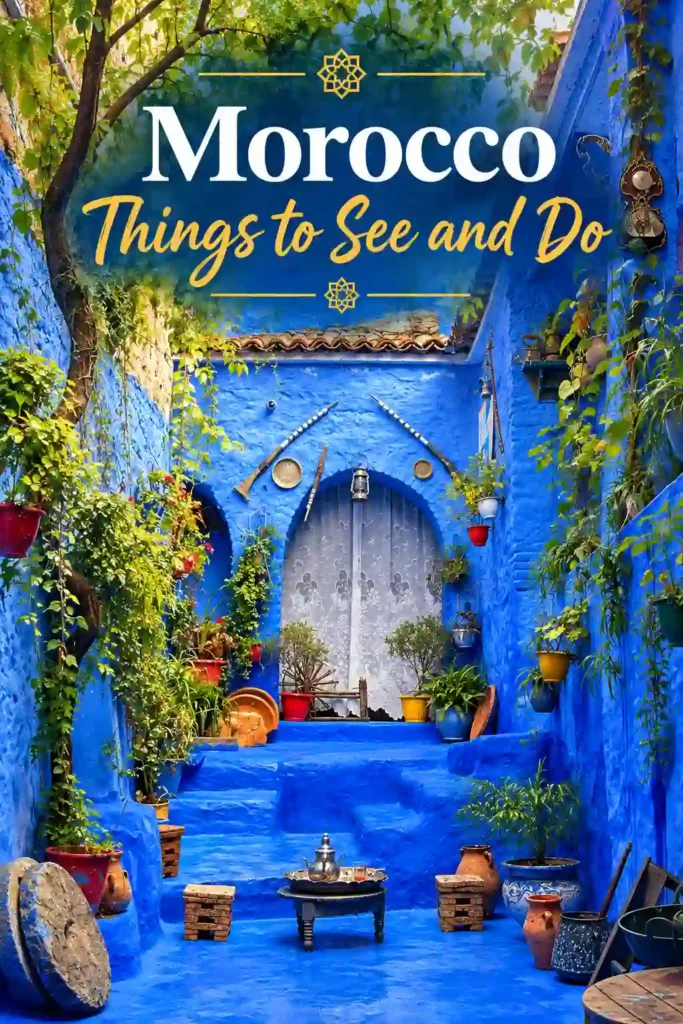
Tucked into the Rif Mountains in northern Morocco, Chefchaouen is the town where everything, walls, doors, stairs, entire buildings, is painted in shades of blue. Nobody fully agrees on why (theories range from a symbolic connection to the sky and heaven, to a practical way of repelling mosquitoes, to it simply looking beautiful), but the effect is genuinely unlike anywhere else in the country. It’s a smaller, slower town than Marrakech or Fes, with fewer big “sights” and more just wandering, stopping for mint tea on a blue staircase, browsing small shops selling handwoven textiles, and hiking up to the Spanish Mosque for a sunset view over the entire blue town below. If your Morocco trip has room for one place that isn’t about ticking off monuments, make it Chefchaouen.
The Sahara Desert: The Trip Within the Trip
For a huge number of travelers, this is the actual reason they booked a Morocco trip in the first place, and it genuinely lives up to the hype. Most desert routes head toward Merzouga and the Erg Chebbi dunes , some of the tallest and most accessible dunes in the country, reachable via an unforgettable multi-day drive through the High Atlas Mountains, past kasbahs and gorges that would be the highlight of most other trips.
The classic experience: a camel trek out to a desert camp timed for sunset, watching the dunes shift from gold to deep orange to almost purple as the light fades, a dinner under a genuinely staggering number of stars, and if you’re lucky, live music around a fire before falling asleep in a Berber tent. Waking up early enough to catch sunrise back over the dunes is, without exaggeration, one of the most talked-about moments from nearly every Morocco trip we’ve ever heard about.
Along the way to the desert, don’t rush past Ait Ben Haddou , a UNESCO-listed fortified village of earthen kasbahs that’s appeared in more films and TV shows than almost any other location in Africa (Gladiator and Game of Thrones among them), or the Todra and Dades Gorges , dramatic canyons that are worth a proper stop, not just a photo through the car window.
Essaouira: Windswept, Laid-Back, and Completely Different
If Marrakech leaves you needing a breather, Essaouira is the antidote. This fortified Atlantic port city, about 2.5-3 hours from Marrakech, trades the heat and intensity of the interior for sea breeze, fresh seafood, and a noticeably slower pace of life. Its whitewashed, blue-shuttered medina is a UNESCO World Heritage site in its own right, and walking the old ramparts at the Skala de la Ville, past rows of old cannons pointed out at the Atlantic, is one of the most atmospheric walks in the country. Essaouira has also long attracted musicians and artists, Jimi Hendrix reportedly spent time here in the late 1960s, and the city’s Gnawa music tradition is still very much alive, especially during the annual Gnaoua World Music Festival.
The Atlas Mountains: Morocco’s Quiet, Dramatic Backbone
The High Atlas Mountains cut across the country and offer some of Morocco’s best outdoor adventure, often overlooked by travelers sticking strictly to a city-hopping itinerary. The Ourika Valley, less than an hour from Marrakech, makes an easy half-day trip with waterfalls, Berber villages, and mountain scenery without needing to commit to a multi-day trek. For something more ambitious, Mount Toubkal, North Africa’s highest peak, is climbable by reasonably fit hikers over two days with a guide; no technical climbing experience required, just a decent level of fitness and proper layers for the cold nights. Staying overnight in a Berber guesthouse in one of the smaller mountain villages, sharing a meal cooked over a wood fire, is often remembered as fondly as any famous monument.
Casablanca: Morocco’s Modern Face
Casablanca doesn’t get the romantic reputation of Marrakech or Fes, and honestly, that’s fair, it’s a large, modern, business-driven city rather than a place built around historic charm. But it has one truly unmissable sight: the Hassan II Mosque , one of the largest mosques in the world, built partly over the Atlantic Ocean with a retractable roof and a minaret that’s among the tallest religious structures on the planet. It’s also one of the only mosques in Morocco that non-Muslims can tour inside, which makes it a rare opportunity if you want to see the interior of a working Moroccan mosque up close.
Rabat: The Capital Most Tourists Skip (and Shouldn’t Entirely)
Rabat doesn’t headline many Morocco itineraries, but as the country’s political capital, it offers a calm, more orderly counterpoint to the chaos of Marrakech or Fes. The Kasbah des Oudaias, a fortress overlooking the Atlantic with an Andalusian garden inside, and the unfinished Hassan Tower alongside the Mausoleum of Mohammed V, are both genuinely worth an afternoon if your route passes through, particularly if you’re traveling between Casablanca and the north.
Ouzoud Falls: Morocco’s Most Underrated Day Trip
About 2.5-3 hours from Marrakech, the Ouzoud Falls plunge roughly 110 meters down a series of terraces into the El-Abid River gorge, and on a clear day you’ll often see rainbows forming in the mist at the base. Wild Barbary macaques, one of the few monkey species native to North Africa, live in the trees around the falls and are genuinely fun to watch (although feeding them isn’t recommended). Boat rides to the base of the falls, small local restaurants perched on the cliffside, and the walk down through olive groves make this one of the best value day trips from Marrakech, and it’s far less crowded than most of the city’s other major attractions.
Food: An Activity in Its Own Right
Honestly, eating in Morocco deserves its own category on any “things to do” list. Tagine, the slow-cooked stew named after its cone-shaped clay pot, comes in dozens of regional variations: lamb with prunes and almonds, chicken with preserved lemon and olives, vegetable versions built around whatever’s in season. Couscous, traditionally served on Fridays, is a genuine national institution rather than a side dish. Street food in cities like Marrakech and Fes- grilled meats, msemen (a flaky layered flatbread), and fresh orange juice sold from carts for pennies- is some of the best value eating you’ll find anywhere in your trip. And Moroccan mint tea, poured theatrically from height into small glasses, isn’t just a drink; it’s practically a social ritual you’ll be offered constantly, in shops, in homes, and at the end of nearly every meal.
A Few Honest Notes Before You Go
Not everything about Morocco travel is postcard-perfect, and it’s worth knowing a few practical realities. Bargaining is expected in medina souks, not a sign of rudeness; it’s simply how prices work there, and getting comfortable with it (or bringing a guide who handles it for you) makes shopping far less stressful. Persistent vendors and unofficial “guides” offering directions in the medina are common, particularly in Marrakech and Fes; a polite but firm “no thank you” usually works fine. And distances in Morocco are genuinely bigger than they look on a map; the drive from Marrakech to the Sahara, for instance, takes a full day, so building realistic travel time into your itinerary matters more here than in a lot of smaller destinations.
Volubilis and Meknes: The Roman Ruins Most Itineraries Skip
Sandwiched between Fes and the Rif Mountains, this pairing gets skipped far more often than it should. Volubilis is a genuinely impressive Roman archaeological site, once the capital of the Kingdom of Mauretania, with mosaic floors that have survived nearly 2,000 years remarkably intact, still visible in situ rather than locked away in a museum. Wandering the old triumphal arch and the outlines of what were once grand villas, with storks nesting on top of ancient columns, feels a bit surreal, especially given how few crowds you’ll be sharing it with compared to Morocco’s more famous stops. Nearby Meknes, another of Morocco’s four imperial cities, is often called the most underrated, with a monumental Bab Mansour gate, a genuinely walkable medina, and none of the crowd pressure of Fes just down the road. If your route runs through this part of the country anyway, it’s a shame to drive past both.
Agadir and the Southern Coast: Beach Time Without the Crowds
If your idea of ”things to do” occasionally includes doing absolutely nothing on a beach, Agadir and the surrounding coastline deliver that in a way the rest of Morocco’s more historic cities don’t really try to. Rebuilt after a devastating 1960 earthquake, modern Agadir is more resort town than ancient medina, with a long sandy beach, a lively marina, and a genuinely good surf scene. Just north, Taghazout has become one of North Africa’s most popular surf towns, drawing beginners and experienced surfers alike to its consistent Atlantic breaks, while Paradise Valley, a short drive inland, offers natural rock pools and swimming holes shaded by palm trees, a genuinely refreshing stop if you’re road-tripping through the region in summer heat.
The Draa Valley and Zagora: Morocco’s “Other” Desert Route
Most travelers head to the Sahara via Merzouga, but the Draa Valley, Morocco’s longest river valley, offers a quieter, equally striking alternative route toward Zagora and the dunes near M’Hamid. The drive south from Ouarzazate follows one of the country’s most dramatic palm groves, a genuine green ribbon cutting through otherwise stark, rocky desert, passing through kasbahs and small Berber villages that see a fraction of the tour buses that pass through Merzouga. It’s a good option if you want a Sahara experience with a slightly more remote, off-the-main-path feel, or if your route is naturally built around Marrakech and Ouarzazate rather than Fes.
Akchour Waterfalls: Chefchaouen’s Best Kept Secret
If you’ve made it to Chefchaouen, it’s genuinely worth the extra half-day to visit Akchour, a set of waterfalls in the Rif Mountains about 45 minutes outside the blue city. A moderate hike along the river leads to the smaller Akchour falls first, with the option to continue further to “God’s Bridge,” a striking natural rock arch formed over the river. The water here runs a clear, almost impossible turquoise, and small riverside cafés along the trail sell fresh-squeezed juice and grilled fish, making it an easy full or half-day addition for anyone spending more than a single night in Chefchaouen.
Adventure Activities: Beyond Sightseeing
Not every “thing to do” in Morocco involves standing and admiring something; plenty of the country’s appeal is genuinely active. Sandboarding down the dunes near Merzouga or Zagora is an easy, low-skill way to add some adrenaline to a desert stop, and most camps rent boards right on site. Quad biking across the desert plains around Merzouga is another popular add-on, letting you cover more ground than walking or camel trekking alone. In winter, Oukaimeden, in the High Atlas about an hour from Marrakech, becomes one of Africa’s only functioning ski resorts, a genuinely strange and fun novelty if your trip happens to fall between December and March. And for a calm pace, hot air ballooning over the Marrakech palm groves and Atlas foothills at sunrise has become an increasingly popular way to see the region from above before the day’s heat sets in.
Festivals Worth Timing Your Trip Around
If your travel dates are flexible, a few recurring festivals can genuinely elevate a Morocco trip from great to unforgettable. The Gnaoua World Music Festival in Essaouira, usually held in June, draws musicians and fans from around the world for several days of live performances tied to the region’s spiritual Gnawa musical tradition. The Marrakech International Film Festival , typically in late autumn, brings a different kind of energy to the city, with international stars and outdoor screenings. In the Middle Atlas, the Imilchil Marriage Festival offers a genuinely unique glimpse into Berber tribal tradition, historically tied to matchmaking between local communities, alongside music, dancing, and trading. None of these are essential to a good trip, but if the dates line up, they add a layer most visitors never get to see.
Shopping in Morocco: More Than Just Souvenirs
Shopping in Morocco is arguably its own activity rather than a side wander, especially in the souks of Marrakech and Fes. Beyond the usual leather bags and spices, look out for Berber rugs, hand-knotted with geometric patterns that vary by region and tribe, genuinely worth the investment if you have room in your luggage (or the willingness to arrange shipping). Argan oil , produced almost exclusively in the region around Essaouira and Agadir, makes for a lightweight, practical souvenir, and buying directly from a women’s cooperative supports the local economy more directly than a generic tourist shop. Ceramics from Fes and Safi, silver Berber jewelry, and hand-carved cedar wood items from the Atlas Mountains round out the list of things genuinely worth bargaining hard for, and taking home.
Taroudant and Tafraoute: The South’s Best-Kept Secrets
Tucked south of the High Atlas, Taroudant is often nicknamed “Little Marrakech,” and for good reason: it has its own red mudbrick ramparts, a genuinely lively souk, and a fraction of the tourist crowds. It makes an easy, relaxed stop if you’re heading toward Agadir or looping back from the desert without wanting another big city. Further into the Anti-Atlas, Tafraoute sits in a valley of pink granite boulders and almond trees that bloom a striking white and pink each February, plus the curious Painted Rocks, a set of massive boulders painted blue by a Belgian artist in the 1980s that have somehow become a genuine local landmark. Neither town is a “must-see” in the way Marrakech or Fes is, but both reward travelers who have an extra day or two and want to see a side of Morocco most itineraries never reach.
Asilah: The North’s Quiet Answer to Chefchaouen
Up on the Atlantic coast near Tangier, Asilah is a small, whitewashed fortified town that gets a fraction of the attention Chefchaouen does, despite a genuinely similar charm. Its old medina walls, built by the Portuguese in the 15th century, enclose narrow streets covered in murals and street art, refreshed every summer as part of an international arts festival that’s been running since the 1970s. It’s an easy, low-key day trip from Tangier, and a good option if your route runs through the north and you want a coastal alternative to the blue city further inland.
Legzira Beach and the Southern Atlantic Coast
South of Agadir, near the small town of Sidi Ifni, Legzira Beach is known for its dramatic natural rock arches rising directly out of the sand, sculpted by decades of Atlantic wave erosion (one of the two original arches collapsed in 2016, but the remaining one is still a striking sight, especially at sunset). It’s a considerably quieter stretch of coast than Agadir or Essaouira, popular mostly with independent travelers road-tripping the southern coastal route rather than organized tour groups, and it pairs well with a stop in Sidi Ifni itself, a small town with a distinct Spanish colonial architectural style left over from its time as a Spanish enclave until 1969.
The Hammam Experience, Explained Properly
Since it comes up so often on “things to do” lists without much real explanation, it’s worth walking through what an actual hammam visit involves. A traditional hammam is a communal steam bath, and the process typically starts with sitting in a hot, humid room to soften the skin, followed by a full-body scrub using a rough exfoliating glove called a kessa, which removes a genuinely surprising amount of dead skin (don’t be alarmed, this is normal and part of the point). Many hammams follow this with a black soap treatment made from olives, then a rinse and sometimes a rose water or argan oil finish. Tourist-oriented hammams in riads and spas tend to be a gentler, more Instagram-friendly version of the experience, while local neighborhood hammams, which Moroccans use regularly as part of everyday hygiene and social life, are more no-frills but arguably more authentic if you’re comfortable with a more communal, less polished setting.
Frequently Asked Questions About Things to See and Do in Morocco
How many days do you need to see the main highlights of Morocco? A solid introduction, covering Marrakech, a Sahara desert excursion, and one or two additional stops like Essaouira or the Atlas Mountains, generally takes 7 to 10 days. Shorter trips of 4-5 days can still work well if focused on just one or two regions.
Is the Sahara Desert trip worth the long drive? For the vast majority of travelers, yes. The drive itself passes through genuinely spectacular scenery, the Atlas Mountains, kasbahs, and gorges, and the overnight camp experience is consistently one of the most memorable parts of a Morocco trip.
What’s the best city to start a Morocco trip from? Marrakech is the most common starting point thanks to flight connections and its central location relative to the desert and mountains, though Fes and Casablanca both work well too, particularly for routes heading north or combining with a Sahara loop.
Can you see Morocco’s highlights without a guide? Yes, though a guide (at least for city medinas and the desert route) genuinely adds value, both for navigation in maze-like medinas and for the cultural context you’d otherwise miss entirely.
Is Morocco walkable, or do you need a car for everything? City medinas are entirely walkable, in fact cars usually can’t enter them. Between cities and for desert or mountain routes, you’ll want a car, driver, or organized tour, since public transport, while available, is considerably slower.
Final Thoughts
Morocco doesn’t really have a single “best” thing to see; that’s kind of the point. It’s a country where a 12th-century medina, a mountain village, a windswept Atlantic port, and an actual sea of sand dunes are all realistically reachable within the same trip, often within the same week. The places that end up meaning the most to people aren’t always the ones on every list either; sometimes it’s the unplanned tea with a shopkeeper, the sunrise nobody photographed well enough to do it justice, or the quiet moment in a mountain village that never makes it into a travel brochure. Plan around the big names, but leave room for Morocco to surprise you a little too.
Ready to Start Planning?
If reading through all of this has you wanting to actually build a trip rather than just dream about one, we can help put together an itinerary around exactly the places that matter most to you.
- Morocco desert tours covering the full range of routes and experiences across the country.
- Marrakech desert tours for travelers starting in Marrakech.
- Fes desert tours for a route through the imperial cities and beyond.
- Ouarzazate desert tours for a shorter path into the south.
- Tangier desert tours for trips starting in the north.
Not sure where to begin? Check our Morocco itineraries page for ready-made routes, or contact us directly and we’ll help you build a trip around the things you actually want to see and do.