
Requirements to Travel to Morocco from USA: The Ultimate Guide to a Flawless Journey
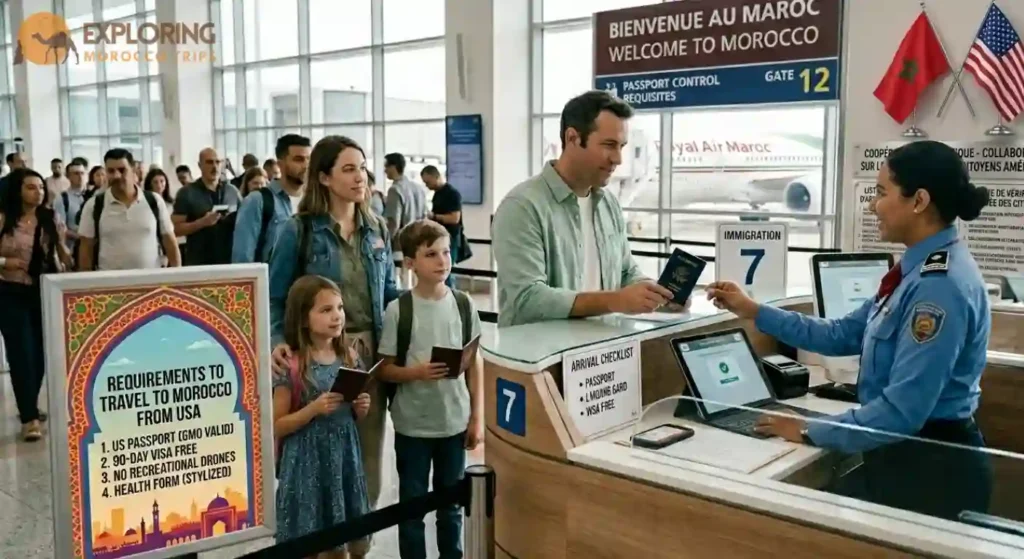
For many American travelers, the kingdom of Morocco feels like an exotic, far-off dream. From the labyrinthine alleys of the ancient imperial medinas to the pristine, silent dunes of the Sahara Desert, it is a destination that sits at the very top of countless bucket lists.
However, crossing the Atlantic requires more than just booking a flight and packing a suitcase. To ensure your dream vacation doesn’t turn into a logistical nightmare at the boarding gate, you need to understand the official entry regulations.
Fortunately, traveling to Morocco from the United States is incredibly straightforward, provided you know the exact paperwork and border rules required for American passport holders. Let’s break down the essential steps to get you from the US to the gateway of North Africa without a single hitch.
Table of Contents: Requirements to Travel to Morocco from USA
Passport Validity and Visa-Exempt Rules
One of the greatest advantages for American travelers is the warm diplomatic relationship and streamlined border agreements between the United States and Morocco. If you hold a standard, valid United States passport, you do not need to apply for a tourist visa before your trip.
However, “visa-free” does not mean unconditional entry. There are strict passport rules enforced at airline check-in counters and Moroccan border control that you must satisfy.
The Strict 6-Month Passport Rule
The single most common mistake American tourists make happens long before they reach immigration. Your U.S. passport must have a minimum of 6 months of validity remaining from your exact date of entry into Morocco.
Even if your passport is legal and unexpired by U.S. standards, airline staff are legally required to deny you boarding at the gate if your expiration date falls within that six-month window. Always check your passport’s expiration date before booking transatlantic flights, and allow ample time for a renewal if you are cutting it close.
Blank Pages & Entry Stamps
When you land at major hubs like Casablanca’s Mohammed V International Airport (CMN) or Marrakech Menara Airport (RAK), you will bypass the visa lanes and head straight to the regular immigration lines.
To enter, your passport must contain at least one completely blank page for the official entry stamp. The immigration officer will stamp your passport with a unique entry number and the arrival date. Make sure this stamp is clearly visible before leaving the desk, as it serves as your official legal record of entry.
The 90-Day Tourist Limit
As a U.S. citizen traveling for tourism or business, you are legally permitted to remain in Morocco for a maximum of 90 days per visit. This 90-day window is strictly monitored.
If you plan to stay longer, whether you are a digital nomad, a long-term traveler, or looking to immerse yourself deeply in Moroccan culture, you cannot simply let the time roll over. Staying even one day past the 90-day limit without authorization means you will have to appear before a local judge, face official immigration hearings, and pay monetary fines before you are permitted to clear airport security and board a flight back to the United States.
Return Tickets, Proof of Funds, and Customs Realities
Landing at a Moroccan airport is an exhilarating moment, but clearing customs and immigration smoothly requires you to show that you are a well-prepared tourist who respects the country’s local laws. Moroccan border officials are thorough, and there are specific practical requirements you must satisfy before grabbing your bags and headlining your adventure.
The Return or Onward Ticket Rule
When you approach the immigration counter, the officer’s primary goal is to ensure you do not plan to overstay your 90-day tourist privilege. While it is rare for an officer to ask for a printed itinerary from every single traveler, having proof of a confirmed return flight to the United States or an onward ticket to your next destination is a strict legal requirement. In fact, you are more likely to be asked for this by your airline at your US departure gate (such as JFK, IAD, or MIA) before you even board your transatlantic flight.
If you are planning an open-ended journey or a long-term backpacking trip through North Africa and Europe, do not risk traveling on a one-way ticket without a flexible, changeable, or fully refundable return fare already locked into your airline’s system.
Proof of Financial Sufficiency
By law, border officials can ask you to demonstrate that you possess sufficient financial means to support yourself, cover your accommodations, and fund your transport during your stay in Morocco.
For American travelers, you do not need to carry stacks of physical paperwork or printed bank statements. Showing a valid international credit or debit card, a confirmed hotel or luxury riad reservation, or a vetted tour agency voucher is more than enough to satisfy this requirement. A good local rule of thumb for independent travelers is to have access to the equivalent of roughly $75 to $100 per day of planned travel, though a premium pre-booked itinerary takes care of this automatically.
The Strict Cash and Closed Currency Regulations
Morocco operates under a strict monetary system overseen by the Office des Changes. The Moroccan Dirham (MAD) is a closed currency, meaning it cannot be legally bought, sold, or exchanged outside of Morocco.
-
Bringing Foreign Currency In: You can bring as much US Cash (USD) into the country as you like. However, if you are carrying physical cash, traveler’s checks, or negotiable instruments equivalent to 100,000 MAD or more (roughly $10,000 USD depending on exchange rates), you are legally obligated to fill out an official customs declaration form at the airport on arrival. Do not skip this step; keeping this stamped declaration form is the only legal way to prove the origin of your cash when you attempt to exit the country with those funds.
-
Taking Local Currency Out: Because the Dirham is a closed currency, it is strictly illegal to leave Morocco with a significant amount of local cash. Travelers are permitted a absolute maximum buffer of just 2,000 MAD (around $200 USD) in cash to keep as souvenirs or for immediate airport expenses. Anything beyond this must be converted back into US Dollars or Euros at an airport exchange booth before you pass through final exit security.

Medication, Strict Drone Bans, and Traveling with Minors
When organizing logistics for American travelers, smooth border entry often comes down to what is hidden inside your luggage. Morocco enforces incredibly strict regulations regarding specific tech equipment, prescription drugs, and child safety. Knowing these distinct boundaries beforehand prevents stressful encounters with airport security.
The Absolute Ban on Recreational Drones
This is the single most critical tech rule for American content creators, videographers, and hobbyists: Do not pack a drone in your luggage. Morocco treats unmanned aerial vehicles (UAVs) as highly sensitive national security items.
-
The Reality: Every single piece of luggage, both checked bags and carry-ons, passes through high-resolution X-ray scanners immediately upon landing at Moroccan customs. If security personnel spot a drone (even a tiny, sub-250g model like a DJI Mavic Mini), it will be immediately confiscated on the spot.
-
The Consequences: Attempting to sneak a drone through customs without a pre-approved, commercial filming license from the Moroccan Cinematographic Center (CCM) can result in heavy financial fines and intense legal questioning. If your drone is seized, you will receive an official warehouse receipt to reclaim it when you exit the country. However, this requires you to depart from the exact same airport you landed in, and navigating the airport customs storage office during a hectic departure can cause you to miss your transatlantic flight. Leave the drone at home.
Navigating Medical Customs: Prescriptions and Pill Containers
Morocco is highly proactive about keeping narcotics and controlled substances outside its borders. While standard American over-the-counter medications (like Ibuprofen, Tylenol, or allergy tablets) are perfectly fine and easily found in local neighborhood pharmacies (Pharmacies marked by a green neon cross), prescription layout is heavily scrutinized.
-
Keep It Original: Never transfer your prescription pills into generic daily plastic organizers before a flight. All medications must remain in their original, pharmacy-issued bottles with the official label clearly displaying your full legal name, the dosage, and the doctor’s name.
-
The Authority Proof: If you are traveling with highly controlled psychiatric medications, strong pain management opioids, or ADHD treatments (such as Adderall or Ritalin), you must carry a signed, dated doctor’s letter on official medical letterhead. This letter should explain your medical condition and outline your exact regimen. As an extra local safety tip, keep a printed copy of your original prescription alongside your passport.
Cross-Border Regulations for Traveling with Minors
To combat international parental child abduction, Moroccan border control takes the entry and exit of underage travelers very seriously. If you are traveling across the Atlantic with children, the paperwork required depends heavily on who is accompanying them.
-
Both Parents Present: If a child under 18 is traveling with both legal parents, standard valid passports are all that is required.
-
One Parent or a Guardian: If an American minor is traveling with only one parent, a relative, or as part of a school/tour group, Moroccan customs officers frequently request legal proof of consent. You must bring a signed, notarized Child Travel Consent Form from the non-traveling parent (or both parents, if traveling with a guardian). This document must explicitly state that the child has full permission to travel to Morocco for the specific tour dates. Lacking this simple notarized letter can result in being held at the airport immigration wing until local authorities can verify family ties.

Medical Insurance, Smart Registration, and Your Final Checklist
To wrap up your pre-trip planning from the United States to Morocco, you need to think about how to protect your health and your identity while on the ground. Once these final details are in place, you are ready to clear customs smoothly and begin your journey.
The Reality of Travel Medical Insurance
A common question asked by American travelers is whether medical insurance is a mandatory entry requirement at Moroccan border checkpoints. The short answer is no; Moroccan customs officials do not legally require you to present proof of health insurance to enter the country.
However, traveling without a dedicated international travel medical policy is a massive financial risk. Standard US domestic health insurance plans (including Medicare, Medicaid, and private employer network insurance like Blue Cross, Aetna, or UnitedHealthcare) do not provide coverage once you cross international borders.
While Moroccan urban centers boast excellent, state-of-the-art private clinics, complex emergencies in remote areas, like the High Atlas Mountains or deep in the Saharan dunes—can require expensive medical evacuation. Investing in a comprehensive travel insurance policy that explicitly includes emergency medical repatriation ensures you face zero out-of-pocket stress if an unforeseen illness or injury occurs.
Registering with the STEP Program
For maximum safety and peace of mind, the US Department of State highly recommends that every American traveler registers their trip via the Smart Traveler Enrollment Program (STEP) before departing from the United States.
This is a completely free, secure government service that connects your travel itinerary directly with the US Embassy in Rabat and the US Consulate General in Casablanca. By taking two minutes to input your dates and destination cities, you gain two massive advantages:
-
You will receive real-time, localized safety, security, and weather updates directly to your email.
-
If an unexpected natural disaster, political protest, or personal family emergency happens back home, the embassy can instantly locate and assist you or coordinate emergency evacuation logistics.
The Ultimate US-to-Morocco Entry Checklist
Before heading to the airport for your transatlantic flight, review this final practical summary to make sure you have everything perfectly prepared:
-
[ ] Passport Validity: Valid for at least 6 months past your arrival date.
-
[ ] Blank Pages: At least one completely blank page for the entry stamp.
-
[ ] Visa-Free Rule: Plan to stay for a maximum of 90 days.
-
[ ] Return Ticket: Printed or digital proof of your return flight to the US or onward journey.
-
[ ] Cash Limits: Declaring any currency worth 100,000 MAD (~$10,000 USD) or more upon arrival. No more than 2,000 MAD carried out of the country.
-
[ ] Drones: Left at home in the US to prevent immediate airport confiscation.
-
[ ] Medication: Stored in original pharmacy bottles with professional labels, along with a doctor’s signed letter for controlled substances.
-
[ ] Minors: Notarized Child Travel Consent Forms on hand if traveling with only one parent or guardian.
-
[ ] Embassy Alerts: Enrolled in the free STEP program for real-time safety updates.
By crossing these simple logistical items off your list, you ensure that your transition from the United States to the colorful streets and majestic landscapes of Morocco is completely flawless, secure, and professional.

Your Local Experts
I’m Lahcen Saadi from the Exploring Morocco Trips team. We are local guides dedicated to crafting authentic and exceptional Moroccan experiences.
Whether you are planning your first trip to Morocco and need expert advice, or you are a travel professional looking to collaborate on unique itineraries, we are ready to help.
Plan Your Trip: Click any destination to see more
Best Morocco tours
- 3 Days Desert tour From Marrakech to Merzouga
- 3 Days Desert tour From Marrakech to Fes
- 3 Days Desert tour From Fes to Marrakech
- 4 Days Desert tour From Marrakech to Merzouga
- 4 Days Desert tour From Marrakech to Fes
- 4 Days Desert tour From Fes to Marrakech
- 5 Days Desert tour From Marrakech to Merzouga
- 5 Days Desert tour From Fes to Marrakech
Grand Morocco tours
- 7 Days Morocco tour from Marrakech
- 7 Days Morocco tour from Fes
- 7 Days Morocco tour from Casablanca
- 8 Days Morocco tour from Marrakech
- 8 Days Morocco tour from Casablanca
- 9 Days Morocco tour from Marrakech
- 9 Days Morocco tour from Casablanca
- 10 Days Morocco tour from Casablanca
- 12 Days Morocco tour from Casablanca
- 14 Days Morocco tour from Casablanca