
The Ultimate Guide to the Sahara Desert in Morocco
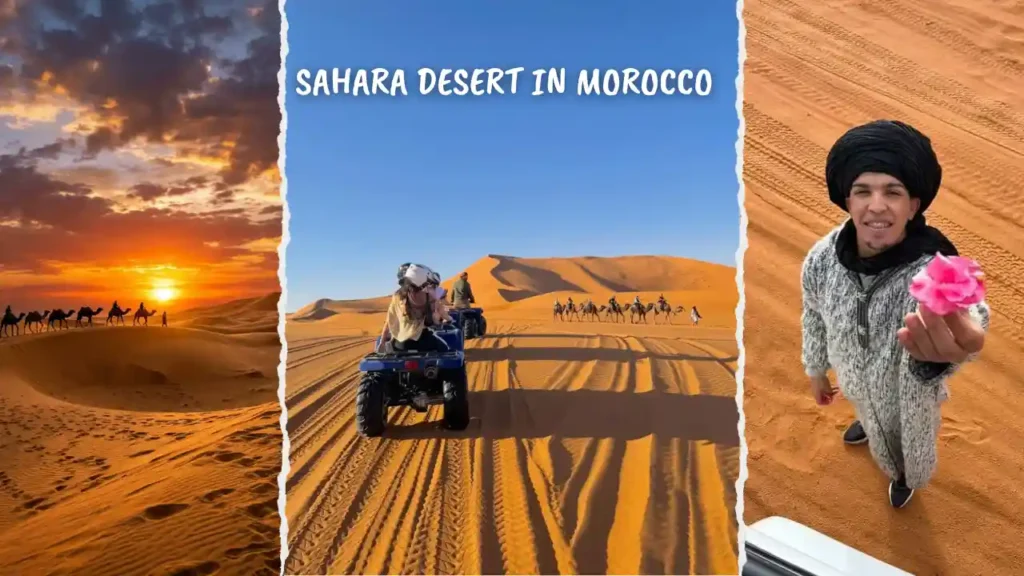
The Sahara Desert in Morocco is more than just a destination; it is a bucket-list experience that defines the North African landscape. From the towering golden dunes of Erg Chebbi to the ancient nomadic traditions of the south, the Moroccan Sahara offers a breathtaking gateway into the world’s largest hot desert.
Whether you are dreaming of a night in the Sahara Desert Morocco, under a blanket of stars, seeking the rhythm of Sahara music, or planning a trek across the vast hamada, this guide covers everything you need to know.
From the logistics of how to get to the Sahara to the secrets of desert survival and culture, step inside to discover the soul of the dunes.
Table of Contents: The Sahara Desert in Morocco
Is the Sahara Desert in Morocco?
A common question travelers ask is: Is there Sahara Desert in Morocco? The answer is a resounding yes. While the Sahara spans across several North African nations, the Moroccan portion is world-famous for its accessibility and the dramatic height of its dunes, particularly in regions like Erg Chebbi and Erg Chigaga.
Where is the Sahara Desert in Morocco?
If you are looking at a Sahara Desert in Morocco map, you will find it located in the southeastern part of the country, bordering Algeria. What city in Morocco is closest to the Sahara Desert? The most popular “gateway” towns are:
- Merzouga: The most famous entry point, sitting right at the edge of the Erg Chebbi dunes.
- Erfoud: Known as the “Gate to the Sahara,” famous for its fossils and as a base for 4×4 excursions.
- M’Hamid: Further south, this is the starting point for those heading to the wilder Erg Chigaga dunes.
How big is the Sahara Desert in Morocco?
The Sahara itself covers 9.2 million square kilometers, making it nearly as large as the United States. In Morocco, the desert covers a significant portion of the eastern and southern territory. While the rocky plateaus (hamadas) make up much of the landscape, the “sand seas” or ergs are what most visitors envision.
How to get to the Sahara Desert in Morocco
Knowing how to visit the Sahara Desert in Morocco is key, as it requires a bit of travel time from the major cities:
- From Marrakesh: A drive typically takes about 9 to 10 hours. Most travelers break this up with a night in the Dades Valley or Ouarzazate.
- From Fes: This is a direct south-bound route taking roughly 7 to 8 hours through the Middle Atlas Mountains and the Ziz Valley.
- Transport Options: You can reach the desert via a rented car, a public CTM bus, or through Sahara desert trips in Morocco organized by professional tour operators using 4×4 vehicles.
Experiences and Adventures in the Moroccan Sands
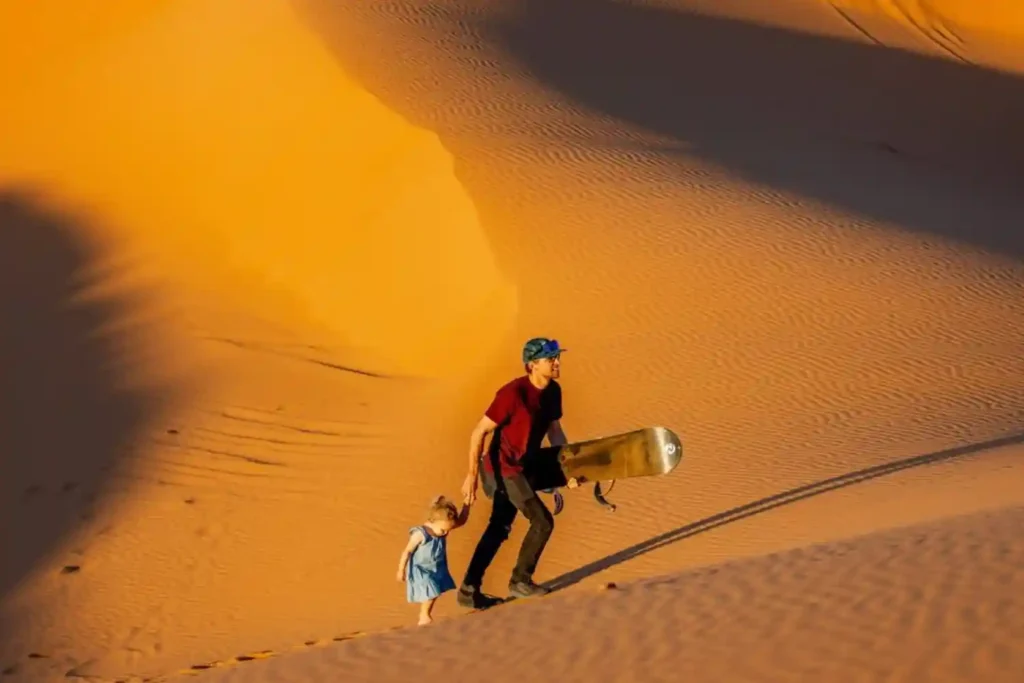
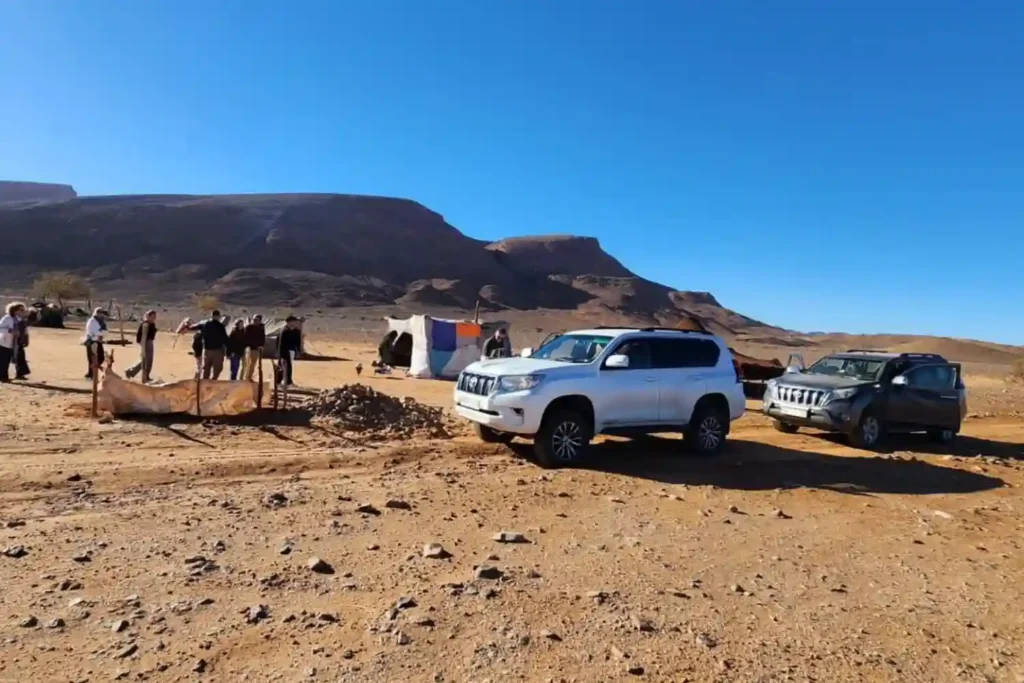
To truly understand is Sahara Desert in Morocco worth the journey, you have to look beyond the sand and into the activities that define the Saharan soul. From the rhythm of the drums to the slow pace of a caravan, here is what awaits you.
Things to do in Sahara Desert Morocco
The desert is far from a static landscape; it is a playground for adventure and a sanctuary for peace. Popular activities include:
- Sandboarding: Sliding down the massive dunes of Erg Chebbi on a board is a must for thrill-seekers.
- 4×4 Off-Roading: Exploring the “hamada” (black stone desert) and visiting nomadic families or old mines.
- Stargazing: With zero light pollution, the night in the Sahara Desert Morocco reveals a Milky Way so bright it feels close enough to touch.
Camel riding in the Moroccan Sahara Desert
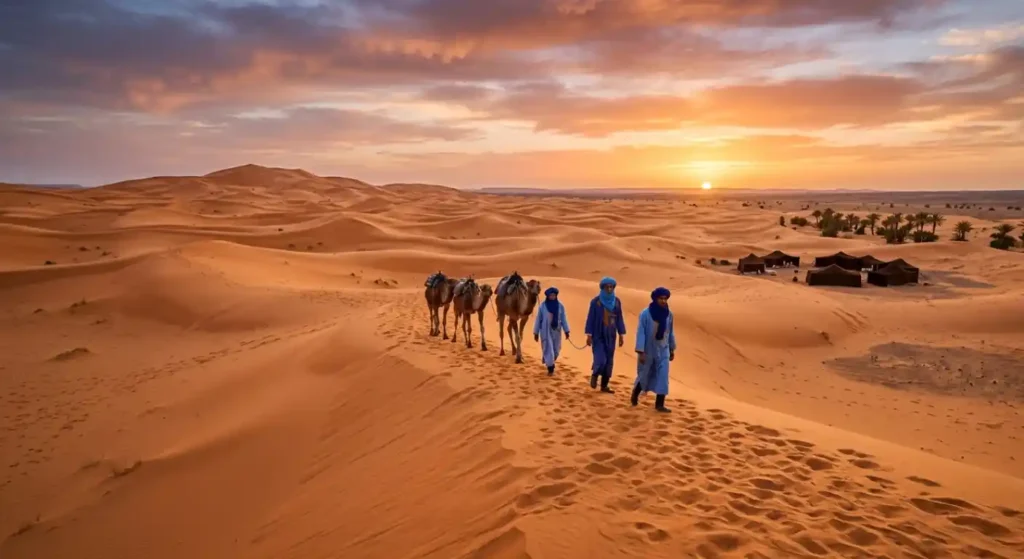
No trip is complete without camel riding in the Moroccan Desert. Often called “ships of the desert,” camels are the traditional way to reach remote camps. Most treks take place at golden hour, allowing you to watch the sunset from the crest of a dune, a silent, rhythmic experience that connects you to centuries of nomadic history.
Sahara music in Morocco desert
One of the most profound cultural elements is the Sahara music in Morocco desert. In the village of Khamlia near Merzouga, you can hear Gnawa music, a spiritual and rhythmic genre brought to Morocco by people from sub-Saharan Africa. At night, around the campfire, the sound of the hajhuj (lute) and the heavy beat of the tbel (drum) create a hypnotic atmosphere that echoes through the dunes.
Best hotels and camping in the Sahara Desert Morocco
Where you stay defines your experience. There are two main ways to spend your night:
- Hotels in Sahara Desert Morocco: Many “Kasbah-style” hotels are located right on the edge of the dunes in Merzouga. These offer swimming pools with views of the sand, perfect for those who want comfort after a long drive.
- Camping in Sahara Desert Morocco: For a more immersive feel, camping in the Sahara Desert Morocco is the way to go. You can choose between:
- Standard Camps: Traditional Berber tents with shared facilities, focusing on authenticity.
- Luxury Sahara Desert Tours in Morocco: High-end glamping sites with en-suite bathrooms, king-sized beds, and gourmet Moroccan dining under the stars.
Survival and Nature: Planning for the Elements
The weather in Sahara Desert Morocco is a force of nature that dictates every aspect of your journey. Being prepared ensures your trip remains a dream rather than a challenge.
What to wear in the Sahara Desert Morocco
Dressing for the desert is about layers and protection. Because the weather in the Sahara Desert Morocco fluctuates wildly between day and night, follow these tips:
- Daytime: Wear loose, breathable fabrics like linen or light cotton. Long sleeves and pants protect you from the intense sun and wind-blown sand.
- The “Cheche”: A traditional Berber turban (scarf) is the best way to protect your face and hair from the sun and sandstorms.
- Nighttime: Even in summer, the temperature drops significantly. In winter, it can reach freezing. Bring a warm jacket or a thermal layer for your night in the Sahara Desert Morocco.
- Footwear: Sturdy sandals are great for the camp, but closed-toe shoes are better for hiking dunes or camel trekking.
Animals in Sahara Desert Morocco
The dunes are far from empty. If you look closely at the sand in the early morning, you will see the “newspaper” of the desert, tracks left by the local residents.
- Common Sightings: You will likely see the Fennec Fox (with its iconic large ears), dung beetles, and small lizards.
- Birdlife: Despite the dry heat, several species of birds, including the desert sparrow, thrive here.
- The Gentle Giants: Dromedary camels are the most visible animals in Sahara Desert Morocco, mostly owned by local families and nomads.
Snakes in Sahara Desert Morocco
A common concern for travelers is the presence of snakes in Sahara Desert Morocco. While the Saharan Horned Viper and cobras do live in the region, they are nocturnal and extremely shy. They avoid the noise of camps and human activity. If you are camping in Sahara Desert Morocco, the activity around the tents usually keeps them far away. It is always wise to watch where you step at night and use a flashlight.
Is the Sahara Desert in Morocco safe?
When people ask, “Is the Sahara Desert in Morocco safe?”, the answer is yes, provided you respect the environment.
- Navigation: Never venture deep into the dunes without a local guide. The landscape changes with the wind, and it is easy to lose your bearings.
- Hydration: The dry air siphons moisture from your body quickly. Drink more water than you think you need.
- Political Safety: The tourist regions of Merzouga and M’Hamid are peaceful and well-monitored by local authorities, making them very safe for international travelers.
The Architecture of the Sand: Erg vs. Hamada
When looking at a Sahara Desert in Morocco map, most people only focus on the orange dunes. However, the Moroccan Sahara is actually a mix of two distinct landscapes:
- The Erg: These are the massive “seas” of shifting sand dunes, like Erg Chebbi (near Merzouga) and Erg Chigaga.
- The Hamada: This is the “Black Desert”, vast, flat plateaus of volcanic rock and stone. While less famous, the Hamada is where you truly feel the scale of the desert and where you often find ancient marine fossils, reminding us that this entire area was once an ocean floor millions of years ago.
The Lifeblood: The Ziz Valley and Oases
You cannot talk about how to get to the Sahara Desert in Morocco without mentioning the Oases. As you descend from the Atlas Mountains toward the dunes, you pass through the Ziz Valley. This is one of the world’s largest date palm groves. These oases are essential ecosystems that allow life to exist at the desert’s edge, acting as a natural buffer between the harsh heat of the sand and the local villages.
Desert Kitchen: Tasting the Dunes
Beyond the standard tajine, the Sahara Desert in Morocco has its own culinary specialty that you won’t find easily in the coastal cities:
- Madfouna (Berber Pizza): This is a traditional nomadic dish. It is a stuffed bread filled with meat, onions, eggs, and a blend of Saharan spices, traditionally baked in a sand oven or a clay fire-pit. It was designed to be a hearty meal for nomads traveling long distances.
The “Blue People” and Desert Culture
The Sahara is home to the Tuareg and Berber (Amazigh) tribes. You will often see men wearing deep indigo-blue robes and turbans. Over time, the dye from these clothes would stain their skin, leading to the nickname “The Blue Men of the Sahara.” Their culture is built on hospitality; in the desert, offering tea is not just a gesture, it is a formal welcome that involves three specific pours, each representing a different stage of life and friendship.
Logistics: The “Gate of the Desert”
While Merzouga is the star, the town of Erfoud serves as the vital logistical hub. This is where most luxury Sahara desert tours in Morocco organize their final supply runs. It is also the fossil capital of the world. Because the Sahara was once underwater, the limestone in this region is filled with trilobites and ammonites. Many “best hotels in Sahara desert Morocco” are actually built using this fossilized stone, giving the architecture a unique, prehistoric shimmer.
The Wind and the “Calm”
One thing travelers rarely expect is the sound. In the heart of the dunes, when the wind stops, the silence is so absolute it has a physical weight. However, when the “Sirocco” wind picks up, the desert transforms. This is why the best hotels in Sahara desert Morocco are designed with thick walls and specific orientations, to stay cool and protected when the sands begin to shift.
This is Part 4 of your blog. In this section, we move beyond the general descriptions and provide a clear, easy-to-read comparison and a seasonal guide using tables. This helps your readers make a quick decision on where and when to visit.
Comparing the Dunes: Erg Chebbi vs. Erg Chigaga
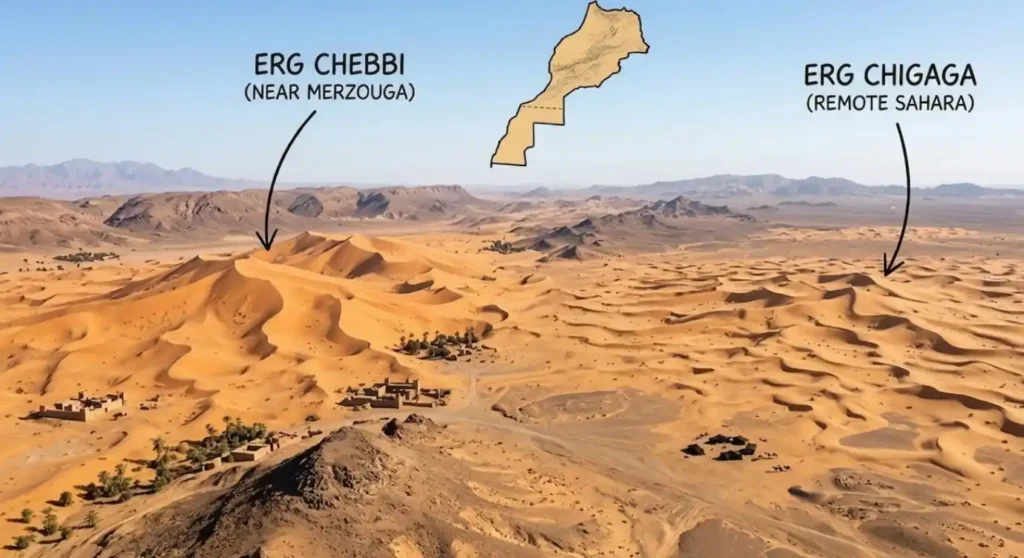
When looking at a Sahara desert in Morocco map, you will notice two primary dune fields. While they both offer the “Sahara experience,” the atmosphere of each is very different. This table breaks down the key differences to help you choose.
| Feature | Erg Chebbi (Merzouga) | Erg Chigaga (M’Hamid) |
| Dune Height | Very tall (up to 150m); dramatic peaks. | Lower, rolling dunes (up to 60m). |
| Accessibility | How to get to the Sahara desert in Morocco is easy here; paved roads go to the edge. | Requires 2+ hours of off-road 4×4 driving from M’Hamid. |
| Vibe | Social, well-developed, and “iconic.” | Wild, remote, and adventurous. |
| Solitude | You will see other camps and many travelers. | Rare to see other groups; deep silence. |
| Best For | First-timers, families, and luxury seekers. | Off-roaders, solo trekkers, and “slow” travelers. |
Seasonal Guide: Weather in Sahara Desert Morocco
The desert is a land of extremes. Use the table below to understand the weather in Sahara desert Morocco throughout the year so you can pack correctly.
| Season | Months | Daytime Feel | Nighttime Feel | Why Visit? |
| Spring | Mar – May | Pleasant (25°C – 30°C) | Mild & Comfortable | Best for camel riding in Morocco Sahara desert. |
| Summer | Jun – Aug | Extreme Heat (45°C+) | Very Warm | Only for the brave; many camps close in August. |
| Autumn | Sep – Nov | Golden & Warm (28°C) | Cool & Fresh | Perfect for photography and long Sahara desert trips in Morocco. |
| Winter | Dec – Feb | Bright & Sunny (18°C) | Freezing (0°C – 5°C) | Incredible blue skies; requires heavy layers at night. |
The Hidden Logistics: Getting There Safely
Most people worry about how to visit the Sahara desert in Morocco without getting lost. Because the terrain changes from paved roads to “pisté” (unmarked tracks), the vehicle you choose is vital.
- The Route of 1000 Kasbahs: This is the most scenic way to reach the desert from Marrakesh. You pass through the High Atlas Mountains and the Dadès Gorges.
- The 4×4 Necessity: While you can drive a standard car to the edge of Merzouga, reaching luxury Sahara desert tours in Morocco deeper in the dunes or visiting Erg Chigaga requires a 4×4. The sand is soft, and standard tires will deflate or get stuck easily.
- Navigation: In the desert, GPS often fails because tracks are blown away by the wind. Local drivers navigate by looking at the “landmarks” in the mountains or the position of the sun.
Ancient Wisdom and Desert Secrets
The Sahara Desert in Morocco is not just a landscape; it is a living history book. Beyond the dunes, there are layers of culture and science that have allowed life to thrive in one of the world’s most extreme environments.
The “Silent” Technology: The Khettaras
One of the most fascinating things to see when you are learning how to visit the Sahara Desert in Morocco is the ancient irrigation system known as Khettaras. These are long lines of conical mounds you can see from the air or the road near Erfoud. They are vertical shafts connected to deep underground tunnels that carry water from the mountains to the oases using only gravity. This “archaeology of water” is what keeps the palm groves green and the desert communities alive today.
Nomadic Hospitality: The Ritual of Tea
In the desert, time is measured by the pouring of tea. If you take one of the Sahara desert trips in Morocco, you will likely be invited into a nomad’s tent. The ceremony is a cornerstone of Saharan safety and respect.
| The Three Cups of Tea | Meaning and Significance |
| The First Cup | “Bitter as Life” – Strong, dark tea to awaken the senses. |
| The Second Cup | “Sweet as Love” – Added sugar and mint to represent friendship. |
| The Third Cup | “Soft as Death” – Light and aromatic, representing the end of the journey. |
The “Floating” Fossils
A secret about the Sahara Desert in Morocco map is that much of it was once a prehistoric seabed. In the region between Erfoud and the dunes, you can find “Erfoud Marble.” This is not actually marble, but fossilized limestone filled with creatures from 350 million years ago, like Orthoceras and Ammonites. Many of the best hotels in Sahara desert Morocco use this stone for their sinks and tables, meaning you can wash your hands in a piece of Earth’s ancient history.
Safety and Ethics: Responsible Desert Travel
As the desert grows in popularity, staying safe and respectful is vital. While is the Sahara Desert in Morocco safe for tourists? Yes, but the environment is fragile.
- Water Conservation: Every drop of water in a desert camp is brought in by truck or pumped from deep, limited wells. Use it sparingly, even in luxury Sahara Desert tours in Morocco.
- Leave No Trace: The wind will cover your tracks, but it won’t dissolve plastic. Always take your trash back to the gateway cities.
- Support Local: When looking for things to do in Sahara Desert Morocco, choose guides from the local Berber or Sahrawi tribes. They possess the “desert eye”, the ability to read the sand and ensure your safety in a way no GPS can.
The “Singing” Dunes
In certain parts of the Moroccan Sahara, if the wind is right and the sand is dry, the dunes “sing.” It is a low-frequency hum caused by the friction of sand grains sliding against each other. It sounds like a distant choir or a low cello note. It is one of the rarest sounds on Earth, often heard during a quiet night in the Sahara Desert Morocco.
The Hidden Science of the Sands
Beyond the golden views, the Sahara Desert in Morocco is a laboratory of extreme evolution and ancient astronomy. While most visitors focus on the camels, there is a miniature world and a celestial map that nomads have used for centuries to navigate this “ocean of sand.”
Desert Architecture: The Master Builders
The dunes are constantly moving, yet certain creatures have mastered the art of living beneath them. The engineering found in the animals in Sahara Desert Morocco is far more advanced than any human tent.
| Creature | Survival “Technology” | Human Equivalent |
| Fennec Fox | Massive ears act as “radiators” to dump body heat. | Air Conditioning |
| Sand Fish (Lizard) | “Swims” through sand grains to avoid surface heat. | Submarine Navigation |
| Desert Ant | Uses the sun’s position and “step-counting” to find its nest. | GPS Tracking |
| Jerboa | Extracts 100% of its water from dry seeds; never needs to drink. | Desalination Plant |
Reading the Sky: The Nomad’s Compass
When you spend a night in the Sahara Desert Morocco, you aren’t just looking at stars; you are looking at a map. Without landmarks, nomads developed a deep knowledge of the “Celestial Sahara.”
- The Wind Direction: Nomads don’t just feel the wind; they smell it. A wind from the East (the Chergui) brings dry, scorching heat from the deep Sahara, while a North wind might signal a rare moisture change from the Atlas Mountains.
- The Moon’s “Halo”: Local elders often predict the weather in Sahara desert Morocco by observing the ring around the moon. A wide, bright halo often suggests a change in atmospheric pressure, warning of an incoming sandstorm.
- Star Paths: To move at night (when it is cooler), caravans follow specific constellations. The North Star remains the anchor, but the rising of certain planets tells them exactly how many hours of darkness remain before the heat of the sun returns.
The “Fossilized” Rain
One of the most incredible facts about where is the Sahara Desert in Morocco is what lies beneath the sand. Deep under the Erg Chebbi dunes are massive aquifers of “fossil water.” This is water that fell as rain thousands of years ago when the Sahara was green and lush. Today, it is this ancient water that feeds the palm groves of the Tafilalt region and allows hotels in Sahara Desert Morocco to provide gardens and pools in the middle of the arid landscape.
Desert Etiquette: The “No-Trace” Fire
If you are camping in Sahara Desert Morocco, you might notice that traditional Berber fires are small and contained. Nomads never waste wood, as it is a precious resource. They often bury the coals in the sand after cooking, this not only puts the fire out but creates a “natural heater” in the sand where they can sit to stay warm during the freezing desert nights.
Is the Sahara Growing?
A question often asked is How big is the Sahara Desert in Morocco. While the desert is vast, it is also “alive.” The dunes can move up to 20 meters a year. Morocco is currently one of the leaders in fighting “desertification” by planting belts of hardy trees (like the Argan and Acacia) to act as a wall, protecting the Oases from being swallowed by the shifting sands.
The Invisible Landscape: Beyond the Sand
Most travelers believe the Sahara Desert in Morocco is an endless sea of dunes. In reality, the “sand sea” (Erg) is only a small portion of the desert. To truly understand is Sahara desert in Morocco as diverse as people say, you have to look at the three distinct faces of the landscape.
| Landscape Type | Local Name | Characteristics | Best Activity |
| Dune Fields | Erg | Massive, shifting mountains of fine orange sand. | Camel riding in Morocco Sahara desert at sunset. |
| Gravel Plains | Reg | Flat, vast expanses of smooth pebbles and ancient riverbeds. | High-speed 4×4 crossings and fossil hunting. |
| Stone Plateaus | Hamada | Elevated, rocky “black” desert with dramatic cliffs. | Stargazing and finding prehistoric cave paintings. |
The “Symphony” of the Dunes
A rare phenomenon you might encounter during a night in the Sahara desert Morocco is the “Singing Sands.” This isn’t a myth; it is a physical event where the friction between sand grains creates a low-frequency hum that can sound like a distant aircraft or a low-tuned bass guitar. It only happens when the sand is perfectly dry and the wind moves at a specific speed, creating a natural “musical” performance.
Navigation Without Technology
If you ever wonder how to get to the Sahara desert in Morocco without a GPS, look at the guides. They don’t use maps; they use the “Desert Eye.”
- The Compass in the Grass: In the Reg (stony desert), the rare desert shrubs usually lean away from the prevailing winds, giving a constant indicator of North and South.
- The Shadow Stick: By placing a stick in the sand and marking the shadow’s tip twice over 15 minutes, nomads can draw a perfect East-West line.
- The Ripple Effect: Sand ripples on the dunes are sculpted by the wind. If you know which way the seasonal winds blow, the ground beneath your feet becomes a permanent compass.
The Great Green History
When you look at a Sahara Desert in Morocco map, it’s hard to imagine it was once green. However, geological evidence proves that every 20,000 years, the Earth’s tilt shifts, and the Sahara turns into a lush savanna with lakes and rivers. This is why you find animals in Sahara Desert Morocco like the desert crocodile (now extremely rare and found only in remote water pockets) or fossils of ancient whales and sea monsters in the middle of the dry heat.
Desert Etiquette: The Tea and the Tent
The luxury Sahara desert tours in Morocco offer high-end comfort, but the true spirit lies in the nomadic code.
- The Open Tent: A traditional nomadic tent is never “locked.” If a traveler is lost or in need of water, the law of the desert allows them to enter a tent for shade and sustenance, even if the owner is away.
- The Third Pour: As mentioned before, the tea is served three times. To leave before the third cup is considered a sign of rushing or disrespect. In the desert, time is the only thing you have in abundance; use it.
Final Thoughts: Why the Sahara Matters
The Sahara Desert in Morocco is a place of transformation. It strips away the noise of modern life and replaces it with the rhythm of nature. Whether you are seeking the best hotels in Sahara desert Morocco for a romantic getaway or a rugged trek to find snakes in the Sahara Desert Morocco, the desert will give you exactly what you need: a moment of absolute, perfect clarity.
Frequently Asked Questions About the Sahara Desert in Morocco
Is there Sahara Desert in Morocco that is easy to visit?
Yes, the Moroccan Sahara is considered one of the most accessible parts of the entire desert. While the Sahara spans 11 countries, Morocco offers the best infrastructure for travelers. You can drive on paved roads to the very edge of the Erg Chebbi dunes in Merzouga, making it possible for families and seniors to experience the high dunes without a week-long expedition.
Is the Sahara Desert in Morocco safe for solo travelers?
The desert regions of Merzouga and M’Hamid are exceptionally safe. Because the local economy relies heavily on tourism, there is a strong community-led focus on hospitality and safety. However, the desert is a harsh environment; it is only safe if you travel with a local guide who understands the shifting sands and weather patterns. Avoid wandering into the dunes alone at night.
What city in Morocco is closest to the Sahara Desert?
If you are heading to the famous Erg Chebbi dunes, the closest town is Merzouga. If you are looking for the “wilder” Erg Chigaga dunes, the gateway is M’Hamid El Ghizlane. For logistics, flights, and major supplies, the city of Errachidia (near Merzouga) and Zagora (near M’Hamid) are the primary regional hubs.
What is the best time for weather in Sahara Desert Morocco?
The “Golden Window” is from October to April. During these months, the daytime temperatures are warm and perfect for trekking, while the nights are crisp and clear for stargazing.
Warning: From June to August, temperatures can exceed 45°C (113°F), making most activities dangerous during the day.
Are there many snakes in Sahara Desert Morocco?
While the Saharan Horned Viper and various scorpions live in the desert, they are nocturnal and shy. They prefer the deep, quiet dunes away from human camps. During the day, they stay buried deep in the cool sand. If you stay at a reputable camp and follow your guide’s advice, such as not reaching into rocky crevices and using a light at night, your risk is nearly zero.
How to get to the Sahara Desert in Morocco from Marrakesh?
It is a long but beautiful journey. You can take a 4×4 private tour (approx. 9 hours), a public CTM bus (approx. 12 hours), or fly from Marrakesh to Errachidia or Zagora to skip the long drive through the Atlas Mountains. Most people choose a 3-day trip to stop at the Ait Ben Haddou Kasbah along the way.
What to wear in the Sahara Desert Morocco?
Forget fashion, think about protection.
Day: Loose, long-sleeved linen or cotton clothing to block the sun.
Night: A heavy fleece or windbreaker is essential, as the temperature can drop by 20 degrees once the sun sets.
Headwear: A traditional cotton scarf (Shesh) is the best way to keep sand out of your hair and face during a breeze.
Is the Sahara Desert in Morocco safe to visit right now?
Morocco remains one of the most stable countries in Africa. The tourism routes to the Sahara are well-patrolled and peaceful. However, always check your local travel advisory for any specific border restrictions near the Algerian frontier, which is a strictly militarized zone. Stick to the established dunes of Merzouga and Chigaga for the best experience.
Can I see animals in Sahara Desert Morocco?
Absolutely! While you won’t see lions or giraffes, you will see dromedary camels, fennec foxes, desert hedgehogs, and “sand fish” (a type of lizard). The desert is also a paradise for birdwatchers who want to see rare species like the Desert Sparrow.
How big is the Sahara Desert in Morocco?
The Moroccan portion of the Sahara covers a vast area of the south and east, but the actual “sand dunes” (Ergs) are smaller pockets. Erg Chebbi is about 28 kilometers long and 7 kilometers wide, while Erg Chigaga is much larger and more spread out. The rest of the “desert” is made up of rocky plains and beautiful oases.
Is the sand in the Sahara always hot?
Actually, the sand is an incredible insulator. During the day, the top layer can be scorching, but if you dig just a few inches down, the sand is surprisingly cool. This is why many animals in Sahara desert morocco bury themselves during the heat of the day. Conversely, at night, the sand loses heat rapidly, which is why your night in the sahara desert morocco requires a thick mattress or a raised bed to keep the ground-chill away.
Can you hear the “Singing Dunes” everywhere?
No, the “Singing Dunes” are a rare phenomenon found only in specific parts of Erg Chebbi or Erg Chigaga. It happens when the sand has a specific silica content and the moisture levels are near zero. When the wind moves the sand, or when you slide down a dune, it creates a low-frequency hum that sounds like a drone or a cello. It is one of the most haunting and beautiful sounds of the sahara music in morocco desert.
Why do nomads wear indigo blue?
You will often see the “Blue Men” of the Sahara. Traditionally, their robes were dyed with natural indigo. Because water is scarce, the dye wasn’t always “fixed” with chemicals, so it would rub off on their skin. This wasn’t just for fashion; indigo is believed to protect the skin from the sun and act as a natural coolant. When looking for luxury sahara desert tours in morocco, you’ll see this iconic blue reflected in the staff’s traditional dress.
What is the “Desert Eye” and do I need it?
The “Desert Eye” is the ability of local guides to read the sand like a map. To an untrained traveler, every dune looks the same. To a guide, the ripples in the sand, the color of the pebbles on the hamada (rocky desert), and the way the wind leans the desert shrubs are all directional markers. This is why How to visit the Sahara Desert in Morocco safely always involves a local guide. GPS can fail, but the “Desert Eye” does not.
Is there a “right” way to drink tea in the desert?
Yes. If you are invited for tea during sahara desert trips in morocco, notice the height of the pour. The tea is poured from high above the glass to create a “crown” of foam (froth). This foam isn’t just for show; it traps the fine dust and sand at the top, allowing you to drink the clean tea underneath. It also aerates the tea, cooling it down instantly for the first sip.
Do I need to worry about the “Chergui” wind?
The Chergui is a powerful, hot easterly wind that comes from deep within the Sahara. If you are camping in sahara desert morocco when the Chergui blows, the temperature can rise by 10 degrees in an hour. Experienced guides will know it’s coming by the color of the horizon. During a Chergui, it is best to stay inside your tent or Kasbah and wait. These winds usually last for a few hours and are part of the raw weather in sahara desert morocco experience.
Why is the sky so much brighter in the Sahara?
It isn’t just the lack of city lights. The desert air has almost zero humidity, meaning there are no water droplets in the atmosphere to blur the light from the stars. When you spend a night in the Sahara Desert, Morocco, you are seeing the stars through a “vacuum-clean” atmosphere. You can often see the shadow cast by the Milky Way, a sight that is impossible in almost any other part of the world.
Is the desert “growing” or “shrinking”?
The Sahara is dynamic. While the global desert is expanding, the specific sahara desert in morocco map shows that the dunes move. A massive dune you see today might be 20 meters to the west in a few years. Morocco has been a world leader in “greening” the edges of the desert, using hardy trees to protect the Oases from being buried by this “slow-motion” migration of sand.
Conclusion: Why the Sahara in Morocco is Calling You
The Sahara Desert in Morocco is far more than a simple entry on a travel itinerary; it is a profound journey into the heart of the natural world. From the towering orange peaks of the Merzouga Sahara Desert to the wild, untouched rolling sands of an Erg Chegaga Desert Tour, this landscape offers a rare opportunity to disconnect from the modern world and reconnect with yourself.
As we have explored in this guide, the “soul of the dunes” is found in the details: the hypnotic rhythm of Sahara music, the ancient wisdom of the “Desert Eye,” and the simple, sacred ritual of a third cup of tea. Whether you choose the luxury of a high-end desert camp or the rugged adventure of a 4×4 expedition across the hamada, the desert promises a moment of absolute, perfect clarity that stays with you long after the sand has been shaken from your boots.
Morocco remains the world’s most accessible gateway to this vast wilderness. By respecting the environment, supporting local Berber communities, and preparing for the elements, you ensure that your night in the Sahara Desert Morocco is not just a visit, but a transformation.
The dunes are shifting, the stars are waiting, and the silence is calling. Are you ready to answer?
Ready to start your Morocco Sahara Desert Trip?
If you found this guide helpful, share it with your fellow travelers or check out our other deep dives into Moroccan culture and logistics. The desert is waiting for you!