
What Language Do They Speak in Morocco? A Travel Guide
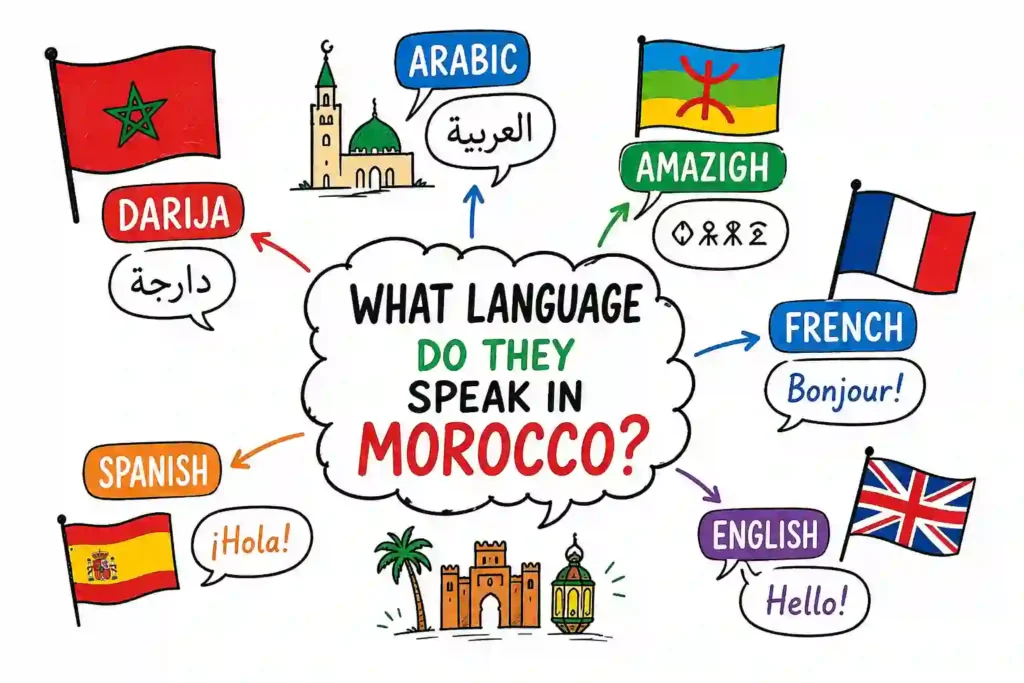
Morocco is a vibrant, deeply multilingual society where the language you hear shifts dramatically depending on whether you are stepping into a corporate office in Casablanca, a bustling souk in Marrakech, or a remote village in the Atlas Mountains. At its core, the country balances rich historical roots with widespread linguistic adaptability, reinforced by specialized national institutions like the Royal Institute for the Culture of Amazigh (IRCAM), which actively standardizes and promotes the indigenous Amazigh script and heritage. Furthermore, the Moroccan National Tourist Office frequently highlights this linguistic diversity to welcome international travelers. While official documents and formal schooling rely on specific standards, daily interactions involve a colorful mix of native tongues and colonial legacies. For travelers, understanding this linguistic landscape means navigating Arabic, Amazigh, Moroccan Arabic, French, Spanish, and an increasingly prominent layer of English without ever feeling entirely lost.
Table of Contents
What Are the Official Languages of Morocco?
The official languages of Morocco are Standard Arabic and Amazigh (Berber), a dual status enshrined in the country’s constitution to reflect its core demographic and historical identity.
-
Arabic represents the historic ties to the broader Arab and Islamic world, anchoring the nation’s literary, legal, and religious frameworks.
-
Amazigh (Berber) honors the heritage of North Africa’s indigenous populations, whose roots predate the arrival of Islam and Arabization by millennia.
Both official languages hold profound importance in shaping Moroccan culture, national identity, and social cohesion. Cultural institutions, public archives, and traditional community life, such as the historical Habous endowments that manage religious and cultural properties, rely heavily on preserving this dual heritage. While official governance uses both languages on paper, the spoken reality of the street is far more dynamic.
Do People in Morocco Speak Arabic?
Modern Standard Arabic and spoken Arabic function as two entirely different entities in daily life. Modern Standard Arabic is the prestige written language used across formal domains, including government legislation, news broadcasting, the judiciary, religious sermons, and academic instruction in schools. Children learn to read and write Standard Arabic in the classroom, making it universally understood across the literate population. However, native speakers do not use Standard Arabic for casual conversations, street greetings, or bargaining in the markets.
What Is Darija? The Moroccan Arabic Language
Darija is the spoken vernacular of Morocco and serves as the beating heart of everyday communication.
-
What Darija Means: Darija translates to “colloquial” or “dialect,” functioning as the native mother tongue for the vast majority of Moroccans.
-
Everyday Use: From family dinners at home to lively negotiations in the vegetable market, Moroccans switch naturally to Darija because it is fast, expressive, and deeply embedded in local culture.
-
Linguistic Divergence: Unlike Modern Standard Arabic, which follows rigid classical grammar and syntax, Darija incorporates a heavily modified vocabulary with distinct pronunciation that often renders it mutually unintelligible to speakers from the Middle East.
-
Multi-Layered Roots: The language has evolved by absorbing foundational Amazigh sentence structures alongside significant loanwords from Classical Arabic, French, and Spanish due to historical trade, colonization, and geographic proximity to Europe.
-
Key Vocabulary: Common expressions include Salam (Hello), Chokran (Thank you), Marhaba (Welcome), Ah (Yes), La (No), Labas? (How are you?), Beslama (Goodbye), Bchhal? (How much?), Afak (Please), and Fin kayn…? (Where is…?).
What Is Amazigh (Berber)?
Amazigh refers to the indigenous language family of North Africa, representing a vital pillar of Moroccan identity and heritage. Spoken natively by millions of Moroccans, it is written using the distinct geometric characters of the Tifinagh alphabet, which has seen a major revival in public signage, schools, and cultural media supported by specialized organizations like IRCAM.
The language is divided into three main regional varieties across the country:
-
Tashelhit: Predominantly spoken in the Souss Valley, the High Atlas, and the Anti-Atlas regions, including cities like Agadir and Taroudant.
-
Central Atlas Tamazight: Widely used across the Middle Atlas mountains and surrounding central provinces.
-
Tarifit: Spoken primarily by communities in the mountainous Rif region across northern Morocco.
Travelers trekking through mountain villages or exploring rural markets are most likely to hear these distinct Amazigh varieties echoing through daily community life, beautifully reflecting the deep-rooted cultural fabric of the nation.
Is French Spoken in Morocco?
French holds no official constitutional status in the country, yet it operates as an unwritten second language of power, commerce, and higher education. It is widely understood and spoken across urban centers, functioning as the primary language for banking, large-scale business, science, engineering, and government administration.
Travelers will encounter French seamlessly integrated into restaurant menus, road signs, hotel receptions, and museum guides. Knowing a few basic French phrases can be exceptionally useful when navigating transportation systems, reading official notices, or communicating with professionals in major cities.
Do They Speak Spanish in Morocco?
Spanish maintains a distinct, localized footprint rooted in colonial history and geographic proximity to the Iberian Peninsula, particularly across northern Morocco.
-
Tangier: A historical international zone where Spanish cultural influences remain visible in local commerce and architecture.
-
Tetouan: A city deeply shaped by historical ties to southern Spain, where older residents often speak fluent Spanish.
-
Chefchaouen: The iconic blue city where Spanish is frequently spoken by merchants and guides alongside French and Arabic.
-
Southern Provinces: Certain desert regions near the Sahara also retain linguistic crossovers due to historical Spanish protectorate boundaries.
Do People in Morocco Speak English?
English is expanding rapidly as the preferred international language among younger generations, urban youth, and tourism professionals. While older generations or rural shopkeepers may have limited exposure to English, the hospitality sector is well-adapted to international visitors.
Travelers can easily navigate luxury hotels, boutique riads, licensed tour operators, modern restaurants, and major tourist attractions using English alone. The language barrier is virtually non-existent in tourist-heavy hubs, though venturing off the beaten path will still require reliance on French, Darija, or translation apps.
What Language Is Spoken in Marrakech?
Marrakech operates as a dynamic linguistic melting pot driven by international tourism and regional migration.
-
Darija: The dominant street language used by locals for all daily interactions, commerce, and social life.
-
Amazigh / Tashelhit: Frequently spoken by merchants, hospitality workers, and families who migrated to the red city from the surrounding High Atlas mountains.
-
French: Widely used in upscale restaurants, Gueliz boutiques, hotel chains, and administrative interactions.
-
English: Extensively spoken by tour guides, riad hosts, museum staff, and vendors inside the Medina.
What Language Is Spoken in Fes?
As Morocco’s spiritual and intellectual capital, Fes presents a traditional linguistic environment heavily rooted in classical urban culture.
-
Darija: Spoken with the distinctive, melodic Fassi accent by local residents across the ancient medina.
-
Modern Standard Arabic & Literary Roots: Given the city’s status as home to the world’s oldest university (Al Quaraouiyine), formal Arabic carries deep historical prestige here.
-
French: Essential for commerce, higher education, and administration within the modern Ville Nouvelle district.
-
English: Readily available across tourist riads, historical monuments, and guided cultural tours.
-
Amazigh: Spoken by minority communities and migrants from nearby mountainous hinterlands.
What Language Is Spoken in the Moroccan Sahara and Merzouga?
The dramatic desert dunes of Merzouga and the surrounding Sahara region feature a unique, desert-adapted linguistic blend shaped by nomadic heritage, ancient trade routes, and modern adventure tourism.
-
Darija: Functions as the primary common denominator for inter-regional communication, daily trade, and dealing with tourism providers across the desert gateway towns.
-
Hassaniya Arabic: The distinct regional Bedouin dialect spoken by nomadic and Sahrawi communities across the deep southern provinces, carrying a melodic cadence and vocabulary distinct from northern Moroccan speech.
-
Amazigh: Spoken natively by indigenous desert communities and families residing in nearby oasis settlements like Hassi Labied and Khamlia.
-
French and English: Widely utilized by desert camp operators, camel trekking guides, 4×4 drivers, and tourism professionals who cater to international adventurers arriving to experience the Erg Chebbi dunes.
What Languages Will You Hear During a Trip to Morocco?
| Language | Where and How You May Hear It |
|---|---|
| Darija | Everyday street conversations, markets, homes, and casual interactions |
| Modern Standard Arabic | Official government settings, news broadcasts, religious sermons, and education |
| Amazigh | Rural communities, mountain villages, and regional markets |
| French | Corporate business, upscale tourism, urban cafes, and administration |
| Spanish | Northern coastal towns, historical border regions, and local trade |
| English | International tourism hubs, modern hotels, riads, and younger urban speakers |
Useful Moroccan Arabic Words for Travelers
Mastering a few foundational expressions transforms interactions with local merchants and instantly earns warm smiles across the souks, with additional regional vocabulary frequently endorsed by the Moroccan National Tourist Office for visiting travelers.
-
Hello: Salam
-
Thank you: Chokran
-
Welcome: Marhaba
-
Yes: Ah
-
No: La
-
How are you?: Labas?
-
Goodbye: Beslama
-
How much?: Bchhal?
-
Please: Afak
-
Where is…?: Fin kayn…?
Can You Travel Around Morocco Without Speaking Arabic?
Exploring Morocco without speaking Arabic is entirely feasible for international visitors. Major tourist destinations function as multilingual hubs where language barriers rarely disrupt travel plans. While English handles most hotel, restaurant, and guided tour scenarios, pairing it with basic French covers any remaining gaps in transport or administration. Learning a handful of essential Darija terms elevates the entire journey, turning routine transactions into genuine cultural exchanges.
Multilingualism in Morocco: A Social Mosaic
The coexistence of multiple languages in Morocco is not merely a practical convenience; it is a defining feature of daily social life. It is entirely common to witness a street conversation or a business meeting smoothly transition between three or four languages—a linguistic phenomenon known as code-switching. A local merchant might greet a customer in Arabic, negotiate prices in French, exchange pleasantries in Amazigh, and welcome a backpacker in English, all within the span of a few minutes. This effortless fluidity reflects a deeply ingrained cultural openness and adaptability, offering travelers a fascinating window into a society where languages bridge diverse historical roots and modern global connections.
Frequently Asked Questions About Languages in Morocco
Is English enough for traveling in Morocco?
Yes, English is widely spoken in hotels, riads, restaurants, and tourist sites across major cities like Marrakech, Fes, and Chefchaouen, though learning a few words of French or Darija helps when venturing off the beaten path.
What is the difference between Arabic and Darija?
Modern Standard Arabic is the written, formal language used in government, media, and education, whereas Darija is the spoken Moroccan dialect used for daily conversation and street commerce.
Do I need to speak French in Morocco?
French is not strictly mandatory for tourists, but it remains an unwritten second language of commerce and administration, making it helpful for navigating transport, menus, and interactions outside major English-speaking hubs.
What language is spoken in the Atlas Mountains?
Amazigh (Berber) is the primary native language spoken by communities throughout the Atlas Mountains, alongside localized varieties of Darija.
Is Arabic difficult for tourists to understand in Morocco?
Moroccan Darija can be challenging for speakers of Middle Eastern Arabic because it blends classical roots with rapid cadence and unique loanwords, but locals are exceptionally patient and appreciative of any effort to use basic phrases.
What language are street signs written in?
Official road signs, government buildings, and street names feature both Arabic script and the Latin alphabet, and they are frequently accompanied by French to ensure easy navigation for international drivers.
Are menus and public transport schedules available in English?
Major tourist hubs, high-speed Al Boraq trains, and popular restaurants provide menus and transit information in French and English, though rural bus stations and local eateries often rely solely on Arabic and French.
Final Thoughts
Discovering the different languages in Morocco is one of the best parts of the trip. From the busy markets speaking Darija to the big Atlas Mountains speaking Amazigh, every chat helps you connect more with the country’s amazing culture. You do not need to know Arabic or French to feel the warm welcome of Moroccan people; just saying a simple hello and smiling will open doors wherever you go. Enjoy the different languages on the streets, travel with curiosity, and let every talk become a special part of your adventure.

I’m Lahcen Saadi from the Exploring Morocco Trips team. We are local guides dedicated to crafting authentic and exceptional Moroccan experiences.
Whether you are planning your first trip to Morocco and need expert advice, or you are a travel professional looking to collaborate on unique itineraries, we are ready to help.
- 2 Days Desert tours From Marrakech
- 3 Days Desert tour From Marrakech to Merzouga
- 3 Days Desert tour From Marrakech to Fes
- 4 Days Desert tour From Marrakech to Merzouga
- 4 Days Desert tour From Marrakech to Fes
- 5 Days Desert tour From Marrakech to Merzouga
- 5 Days Desert tour From Marrakech to Fes
- 6 Days Desert tour From Marrakech to Casablanca
- 7 Days Morocco tour from Marrakech
- 8 Days Morocco tour from Marrakech
- 8 Days Morocco tour from Marrakech with Imperial Cities
- 9 Days Morocco tour from Marrakech
- 10 Days Morocco tour from Marrakech
- 12 Days Morocco tour from Marrakech
- 14 Days Morocco tour from Marrakech
- 2 Days Desert tour From Fes to Merzouga
- 2 Days Desert tour From Fes to Marrakech
- 3 Days Desert tour From Fes to Merzouga
- 3 Days Desert tour From Fes to Marrakech
- 4 Days Desert tour From Fes to Marrakech
- 5 Days Desert tour From Fes to Marrakech
- 6 Days Desert tour From Fes to Marrakech
- 7 Days Morocco tour from Fes
- 4 Days Morocco tour from Casablanca
- 5 Days Morocco tour from Casablanca
- 6 Days Morocco tour from Casablanca
- 7 Days Morocco tour from Casablanca
- 8 Days Morocco tour from Casablanca
- 9 Days Morocco tour from Casablanca
- 10 Days Morocco tour from Casablanca
- 11 Days Morocco tour from Casablanca
- 12 Days Morocco tour from Casablanca
- 14 Days Morocco tour from Casablanca