
Where is Morocco in Africa? A Local Expert’s Guide
When travelers arrive in Morocco, the very first thing they notice is that this country defies simple definitions. It does not fit into a single box.
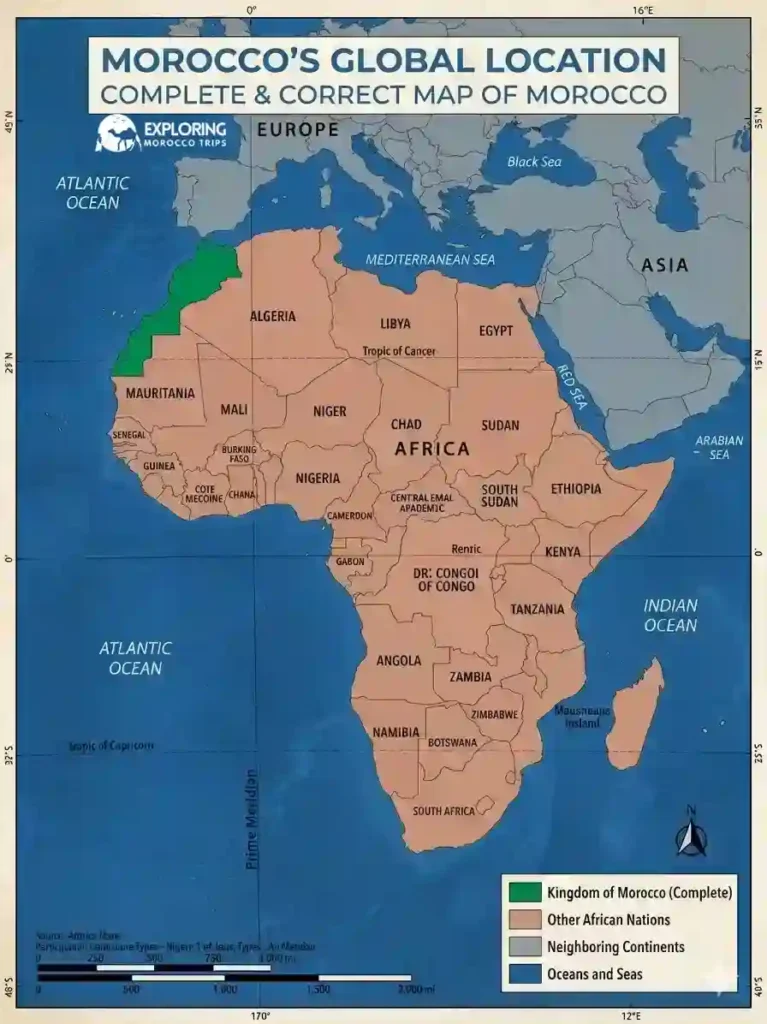
To answer the literal question: Morocco is located in the extreme northwest corner of the African continent.
Positioned in the North Africa region, it occupies a highly strategic geographic standpoint. It is the only African nation with extensive coastlines along both the Atlantic Ocean to the west and the Mediterranean Sea to the north.
Table of Contents
The Bridge Between Continents
One of the most common misconceptions people have before visiting is that Morocco is isolated deep within Africa or completely cut off by deserts. In reality, Morocco acts as the ultimate geographical and cultural bridge:
-
Proximity to Europe: At the narrowest point of the Strait of Gibraltar, Morocco is a mere 14 kilometers (about 9 miles) from Spain. On a clear day, you can stand on the northern coast and look directly across the water at another continent.
-
The Gateway to the Sahara: While the north looks toward the Mediterranean, the vast interior of the country rolls south and east, transitioning into the grand landscapes of the Sahara Desert.
Because of this exact coordinates on the map, Morocco isn’t just one thing. It is a crossroads where African roots, Amazigh (Berber) heritage, Arab traditions, and Mediterranean influences meet. When you travel here, you aren’t just visiting a country; you are experiencing a unique geographical intersection that shapes everything from our climate to our daily life.
The Borders and Surrounding Regions: A Land of Contrasts
Understanding Morocco’s position on the map requires looking closely at its immediate surroundings. Our borders define not just our political geography, but also the dramatic shifts in landscape that clients experience when traveling through the country.
Morocco shares its borders with three distinct natural and political boundaries:
To the East and Southeast: Morocco shares a long land border with Algeria.
To the South: The landscape extends into the Western Sahara, stretching all the way down to the border with Mauritania, which serves as our direct land link to West Africa.
- To the North (The Spanish Enclaves): In a unique geographical anomaly, Morocco shares a direct land border with Spain via the two autonomous Spanish port cities of Ceuta and Melilla, located right on our northern Mediterranean coast.
Click here to learn more about the countries close to Morocco.
The Reality of the Borders: Local Insights for Travelers
When planning a journey through North Africa, many travelers look at a map and assume they can easily cross between neighboring countries. Here is the reality on the ground that only a local operator can tell you:
Important Border Reality: The land border between Morocco and Algeria has been strictly closed for decades due to political disagreements. You cannot drive or walk across from Morocco into Algeria. If a regional tour itinerary promises a land crossing here, it is incorrect. All travel between these two nations must be done via international flights, usually connecting through a third country.
Conversely, the southern route through the Western Sahara down to Mauritania is open for trade and adventurous travelers, acting as a gateway for overland expeditions heading deep into the African continent. This unique layout means Morocco functions almost like a “geographic island”—highly accessible by sea and air from Europe, bounded by the Atlantic and Mediterranean, and securely anchored to the rest of Africa to the south.

The Landscape: Moving from the Coast to the Great Desert
The geography of Morocco is not uniform. Because of our specific location in the northwest of Africa, the country acts as a massive natural staircase that changes completely every few hours you drive.
When managing routes across the country, we divide Morocco into four distinct geographic zones that every traveler should understand:
-
The Coastal Plains: Along the Atlantic and Mediterranean, the terrain is relatively flat, fertile, and Mediterranean in climate. This is where major historical ports and imperial connection points sit.
-
The Mountain Ranges: The backbone of Morocco consists of the Rif Mountains in the north and the massive Atlas Mountains (divided into the High, Middle, and Anti-Atlas) slicing through the center. These peaks act as a giant weather barrier, trapping moisture from the ocean and protecting the interior from harsh weather.
-
The Imperial Valleys: Nestled between the mountains and the plains are the fertile plateaus and valleys where ancient agricultural traditions still thrive.
-
The Desert Interior: Once you cross over the High Atlas peaks heading south and east, the landscape drops sharply into the pre-Saharan steppes and finally into the sweeping dunes of the Sahara Desert, right where our home base sits.
Real Route Insights: How the Geography Affects Your Travel Time
Many travelers look at a standard map of Africa and think distances in Morocco look short. They plan itineraries assuming they can speed from one side of the country to the other. Here is the insider truth about navigating our geography:
The Mountain Factor: You cannot measure travel in Morocco by kilometers; you must measure it by hours. Crossing the Atlas Mountains via passes like the famous Tizi n’Tichka requires navigating tight, winding switchbacks and steep inclines. A distance that looks like a two-hour drive on a flat highway can easily take four to five hours in reality.
Understanding this geography is the secret to a successful trip. The mountains aren’t just scenery—they are a physical wall that separates the cool, breezy Atlantic coast from the dry, sun-baked expanses of the desert. Crossing them is a true transition from one world into another.
Accessibility: Arriving at the Northwest Gate of Africa
Because Morocco sits at the intersection of the Atlantic, the Mediterranean, and the Sahara, it is incredibly accessible from almost anywhere in the world. Its position in the northwest corner of Africa makes it a quick leap for travelers coming from Europe, the Americas, or the Middle East.
When planning your arrival, geography dictates your entry point. Here is how most travelers reach us:
-
By Air (International Gateways): The country is seamlessly connected by major international hubs. Casablanca (Mohammed V International Airport – CMN) is the primary gateway for long-haul flights coming from North America, Asia, and the Middle East. Meanwhile, hubs like Marrakech (RAK), Fes (FEZ), and Tangier (TNG) welcome a massive influx of direct, short-haul flights from across the UK and mainland Europe every single day.
-
By Sea (The Ferry Routes): If you want to experience the geographic closeness of the continents firsthand, you can cross the Strait of Gibraltar by boat. Regular passenger and vehicle ferries run between southern Spain (Tarifa and Algeciras) and northern Morocco (Tangier Ville and Tangier Med), with the shortest crossing taking just 35 to 45 minutes.
Time Zones and Daylight: Aligning Morocco on the Global Clock
When looking at where Morocco sits longitudinally on the globe, its position directly affects how travelers manage their time, jet lag, and daily schedules. Even though Morocco is physically located on the African continent, its economic and geographic ties mean its timekeeping aligns closely with western Europe.
Here is the exact breakdown of how time works here:
-
The Standard Time Zone: Morocco officially operates on Western European Time (WET), which is UTC+0 (the same as Greenwich Mean Time / GMT).
-
The Ramadan Shift: Unlike countries that change their clocks for summer and winter, Morocco has a highly unique approach to daylight saving time. The country remains on UTC+1 for most of the year. However, every year during the holy month of Ramadan, the clock is intentionally turned back by one hour to UTC+0 to make it easier for locals to break their daily fast at an earlier hour. As soon as Ramadan concludes, the clocks are moved forward by one hour back to UTC+1.
Local Insight: How the Sun Shapes the Desert and Coast Schedules
Because Morocco sits in the far west of its time zone region, the natural daylight hours can surprise travelers, particularly when moving inland toward the desert:
The Sunrise and Sunset Dynamic: In our home region in the eastern desert, the day starts and ends earlier than it does on the Atlantic coast in cities like Agadir or Essaouira. If you are booking a desert trek to catch the sunrise over the dunes, you must coordinate closely with your local guide on the exact morning timings, as a difference of just a few degrees longitude across the Atlas Mountains alters the perfect lighting window by several minutes.
Packing Realities: How Our Geographic Coordinates Impact Your Luggage
Because Morocco sits at a distinct geographic intersection—positioned in North Africa, bordered by cold ocean currents, and split by high altitude peaks—travelers often make the mistake of packing for only one type of weather. They assume North Africa means constant, unchanging heat.
The reality on the ground is dictated by our diverse topography, and packing correctly requires preparing for three separate microclimates:
-
The Coastlines (Humid and Breezy): In coastal areas along the Atlantic or Mediterranean, the maritime climate brings breezy, humid conditions. Even in the heat of summer, coastal evenings can feel surprisingly cool due to oceanic winds.
-
The High Altitudes (Alpine and Cold): If your route passes over the Atlas Mountains, you are entering an alpine environment. Passes like Tizi n’Tichka sit at over 2,200 meters above sea level. Here, temperatures drop significantly, and winter travel often means encountering snow-covered roads and freezing mountain air.
-
The Desert Interior (Extreme Thermic Amplitude): Moving south into the pre-Saharan steppes and the dunes of the Sahara presents a completely dry, continental climate. The most shocking element for travelers here is the extreme temperature shift between day and night, known as thermic amplitude.
Local Insight: The "Cold Country with a Hot Sun"
There is an old saying among locals that perfectly sums up our geography: “Morocco is a cold country where the sun is very hot.” Here is what that means for your daily travel prep:
The Desert Temperature Drop: In the dunes of the Sahara, the dry desert air and sand do not retain heat once the sun drops below the horizon. A scorching daytime temperature can plummet by 15°C to 20°C (30°F to 40°F) within a matter of hours. Even in late spring or early autumn, a lightweight summer outfit that felt perfect at 3:00 PM will leave you shivering by 8:00 PM.
To handle this geographic reality, the secret is layering. A breathable base layer keeps you comfortable during daytime sightseeing on the plains or in the dunes, while a high-quality windbreaker or warm jacket is essential the moment you cross the mountains or watch the stars in the desert evening.

Strategic Travel Hubs: Navigating Morocco by Its Main Logistic Nodes
Because Morocco sits at a geographical bottleneck between Europe and Africa, its infrastructure has evolved to move travelers quickly between distinct environments. When planning a tour based on our location, you have to look at the country through its major transit hubs and how they connect the map.
Here is the realistic layout of how Morocco’s location divides its travel logistics:
-
The Northern Maritime Gate (Tangier): This is the direct port of entry for travelers arriving via ferry from Spain or taking the high-speed Al Boraq train down the coast. It is the logical starting point if you want to explore the mountainous north before cutting south.
-
The Economic Hub (Casablanca): Home to the busiest international airport, this coastal city is the primary entry point for long-haul global flights. Logistically, it serves as the central starting point for deep country circuits heading toward the interior.
-
The Desert Launchpad (Marrakech): Located at the foothills of the High Atlas Mountains, Marrakech is the ultimate geographic stepping stone. It is perfectly positioned for travelers who want to land, explore the vibrant plains, and then immediately cross the mountain passes to reach the desert dunes of the southeast.
Local Route Advice: The North-to-South Flow
Many first-time visitors try to book disjointed itineraries that zig-zag unnecessarily across the mountains, causing them to spend more time inside a vehicle than exploring.
Here is how a professional local agency structures travel based on the country’s physical layout:
The Flow of the Map: The most seamless itineraries respect the natural north-to-south slant of Morocco’s geography. A highly efficient route begins in the north at Tangier, winds down through the cultural and historical centers, and continues southward toward the desert. This allows you to experience the gradual shift in culture, architecture, and climate without backtracking over the High Atlas multiple times.
By aligning your journey with these core logistical hubs and following the natural flow of the terrain, you minimize unnecessary driving hours and maximize the time spent on the ground experiencing the landscape.
Conclusion: The Unrivaled Magic of Africa’s Northwest Corner
Ultimately, answering “where is Morocco” is about far more than just looking at coordinates on a map. Standing proudly in the northwest corner of Africa, Morocco is a geographical masterpiece, a place where the Atlantic breeze meets the Mediterranean warmth, where snow-dusted alpine peaks look down over fertile valleys, and where the sweeping golden dunes of the Sahara Desert offer a profound, unforgettable silence.
Because of this exact position on the globe, a journey through Morocco doesn’t feel like visiting just one country. It feels like experiencing an entire collection of worlds, cultures, and landscapes seamlessly woven into a single, deeply welcoming nation.
Take the Leap: The Journey of a Lifetime Awaits
If you have been standing on the edge, looking at the map, and wondering whether to make the trip, have the courage to take the leap.
It is completely normal to feel a bit of hesitation when planning a trip to a new continent, but Morocco is one of the most stable, accessible, and deeply hospitable destinations in the world. The moment you step foot here, any doubts will vanish, replaced by the genuine warmth of the local people and the sheer beauty of the terrain.
Do not let the winding mountain passes or the vastness of the desert hold you back. Traveling here is safe, deeply rewarding, and guaranteed to shift your perspective on the world. Pack your layers, bring an open heart, and come experience the crossroads of Africa for yourself. The dunes are waiting, the mountains are calling, and an unforgettable adventure is ready whenever you are.

Your Local Experts
I’m Lahcen Saadi from the Exploring Morocco Trips team. We are local guides dedicated to crafting authentic and exceptional Moroccan experiences.
Whether you are planning your first trip to Morocco and need expert advice, or you are a travel professional looking to collaborate on unique itineraries, we are ready to help.
Plan Your Trip: Click any destination to see more
Best Morocco tours
- 3 Days Desert tour From Marrakech to Merzouga
- 3 Days Desert tour From Marrakech to Fes
- 3 Days Desert tour From Fes to Marrakech
- 4 Days Desert tour From Marrakech to Merzouga
- 4 Days Desert tour From Marrakech to Fes
- 4 Days Desert tour From Fes to Marrakech
- 5 Days Desert tour From Marrakech to Merzouga
- 5 Days Desert tour From Fes to Marrakech
Grand Morocco tours
- 7 Days Morocco tour from Marrakech
- 7 Days Morocco tour from Fes
- 7 Days Morocco tour from Casablanca
- 8 Days Morocco tour from Marrakech
- 8 Days Morocco tour from Casablanca
- 9 Days Morocco tour from Marrakech
- 9 Days Morocco tour from Casablanca
- 10 Days Morocco tour from Casablanca
- 12 Days Morocco tour from Casablanca
- 14 Days Morocco tour from Casablanca