
Morocco Electrical Plug: What Travelers Need to Know Before You Pack
It’s one of those small details that never crosses your mind until you’re standing in your hotel room with a dead phone and a charger that simply won’t fit the wall socket. Figuring out the Morocco electrical plug situation before you leave home takes about two minutes, but it can save you a genuinely frustrating first night in the country, especially if you’re arriving late and every shop nearby is already closed.
This guide covers everything you actually need to know about plugs, sockets, voltage, and adapters in Morocco, plus a few practical tips on what to pack and what to avoid, so your devices stay charged and you don’t waste a single day of your trip hunting down the right adapter.
Table of Contents
What Type of Plug Does Morocco Use?
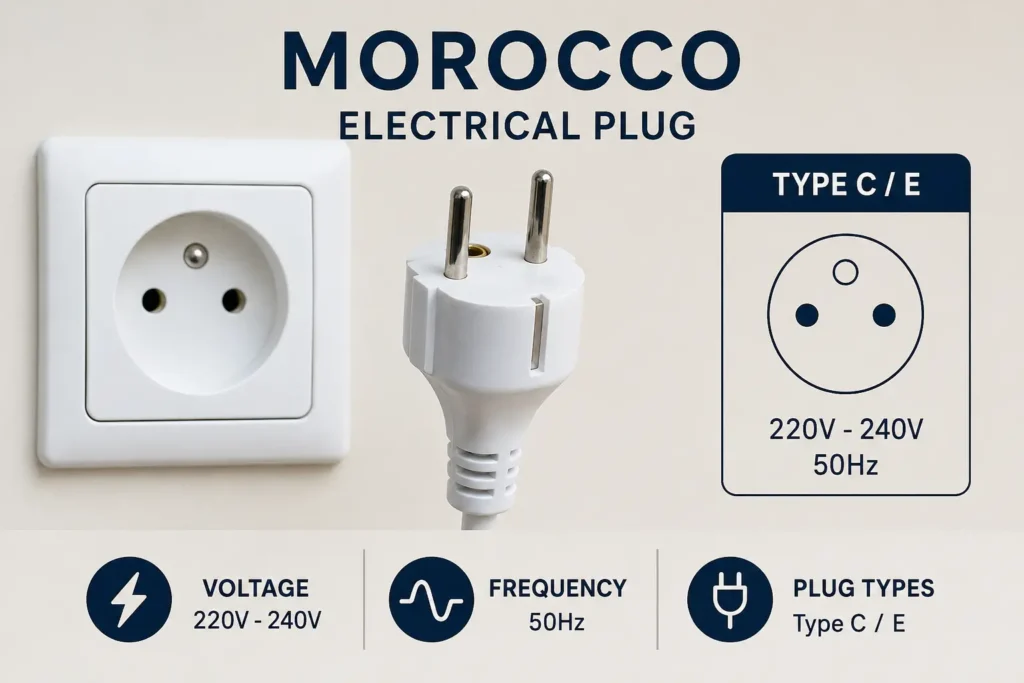
Morocco uses the Type C and Type E electrical plugs, the same two-round-pin style found throughout most of continental Europe and France in particular, which makes sense given the historical ties between the two countries. Type C is the simple two-pin plug without a grounding pin, while Type E has the same two round pins plus a hole that accommodates a grounding pin sticking out of the socket.
In practice, most sockets across hotels, riads, and homes in Morocco accept both Type C and Type E plugs without any issue, since the pin spacing is identical between the two. If your charger or device already uses a European-style two-pin plug, there’s a good chance it will simply plug straight in without needing an adapter at all.
What Voltage and Frequency Does Morocco Run On?
Morocco’s electrical system runs on 220 volts at 50 Hz, which lines up with most of Europe, Africa, and Asia. If you’re traveling from a country that also uses 220-240V, like the UK, most of Europe, Australia, or most of Asia and Africa, your devices will run just fine on Moroccan power without any conversion needed, beyond the plug shape itself.
If you’re coming from a country that runs on 110-120V, such as the United States, Canada, or parts of South America and Japan, this is the detail that actually matters more than the plug shape. Plugging a 110V-only device directly into a 220V Moroccan socket without a voltage converter can damage the device or, in some cases, create a genuine safety hazard.
Do You Need a Voltage Converter?
The good news is that most travel electronics people actually pack these days don’t need one. Phone chargers, laptop chargers, camera battery chargers, and most tablet chargers are what’s called dual voltage, meaning they’re built to automatically handle anything between 100V and 240V. You can usually confirm this by checking the small print on the charger brick itself, where it should list something like “INPUT: 100-240V” if you see that range, you only need a plug adapter, not a voltage converter.
Devices that are more likely to be single voltage and genuinely need a converter include hair dryers, hair straighteners, electric shavers, and other higher-wattage appliances not specifically designed for travel. If you’re not sure, it’s always worth checking the label before you plug anything in, since guessing wrong with these particular devices is where people actually run into trouble.
What Kind of Adapter Should You Bring?
For most travelers, a simple Type C or Type E plug adapter is all you need, and these are widely available, cheap, and small enough to toss in a day bag without noticing the extra weight. If you’re traveling from the UK, US, Canada, Australia, or anywhere else using a different plug shape, pick up your adapter before you leave, since finding the exact right one once you’ve landed can mean a slightly annoying scramble through unfamiliar pharmacies or convenience stores.
A universal travel adapter is often the most practical choice if you’re visiting multiple countries on the same trip, since it typically covers Type C, Type E, and most other plug types in a single compact device. Many also include USB ports built in, which is genuinely handy for charging phones and small devices without needing to plug in a separate charging brick at all.
Where to Buy a Plug Adapter in Morocco
If you land without one, don’t worry, you are not stuck. Adapters are sold at most airports, including Marrakech Menara and Casablanca Mohammed V, though airport prices tend to run a bit higher than you’d pay elsewhere. Larger supermarkets, electronics shops, and even some pharmacies in city centers carry basic adapters at more reasonable prices. Hotel and riad front desks are also worth asking, since many keep a small stock of spare adapters on hand specifically for guests who arrive without one.
Practical Tips for Charging Your Devices in Morocco
- Pack one adapter per person, or bring a couple of spares. Riads and hotels don’t always have enough outlets in a single room for a family or group traveling together.
- Bring a portable power bank, especially if your trip includes a desert excursion, since camps in more remote areas may have limited or no access to power outlets overnight.
- Double check hair tools before you plug them in. This is genuinely the one category where travelers most often run into trouble, since many hair dryers and straighteners are single voltage.
- Keep your adapter somewhere easy to find, like a small pouch in your daypack, rather than buried in checked luggage, especially for your first night when you’ll likely need to charge your phone.
- USB charging is increasingly common in newer hotels, riads, and even some private transport vehicles, which can reduce how much you actually need to rely on adapters for smaller devices.
Charging During a Desert Trip
If your Morocco itinerary includes a night in the Sahara, it’s worth planning your charging a little differently. Many desert camps run on generators or solar power, and while some offer charging stations in communal areas, availability can be limited once the sun goes down and everyone wants to charge a phone or camera at once. Packing a fully charged power bank before you head out is the simplest way to make sure you’re not stuck with a dead phone right when you want to photograph the sunrise over the dunes.
This is worth keeping in mind whether you’re heading out on Marrakech desert tours, Fes desert tours, Ouarzazate desert tours, or Tangier desert tours. Our Morocco desert tours team can also give you a heads-up on charging availability for your specific route and camp when you book.
Frequently Asked Questions About Morocco Electrical Plugs
What plug type is used in Morocco?
Morocco uses Type C and Type E plugs, the same two-round-pin style found across most of continental Europe, particularly France.
What voltage does Morocco use?
Morocco runs on 220 volts at 50 Hz, the same standard used across most of Europe, Africa, and Asia.
Do I need an adapter for Morocco if I'm from the US?
Yes. US plugs use a different pin shape, so you’ll need a Type C or Type E adapter. You will also want to check whether your device is dual voltage, since US power runs on 110-120V.
Do I need a voltage converter for Morocco?
Most modern electronics like phone and laptop chargers are dual voltage and only need a plug adapter. Higher-wattage devices like hair dryers or straighteners may need an actual voltage converter, so it’s worth checking the label first.
Can I buy a plug adapter in Morocco if I forget mine?
Yes, adapters are available at airports, supermarkets, electronics shops, and often at hotel or riad front desks, though prices can be a bit higher at the airport.
Will my UK or European plug work in Morocco?
Standard two-pin European plugs generally fit directly into Moroccan sockets without needing an adapter, since the pin spacing matches. UK plugs, which use three flat pins, will need an adapter.
Is it safe to charge my phone overnight in a desert camp?
Charging availability depends on the camp, since many run on generators or solar power with limited outlets. Bringing a charged power bank is the safest way to make sure you have battery for photos the next morning.
Final Thoughts
The Morocco electrical plug situation is honestly one of the easier parts of trip planning to sort out a quick check of your chargers, a Type C or E adapter tucked into your bag, and you’re set for the whole trip. It’s a small thing, but showing up prepared means one less thing to worry about once you land and want to focus on the medina, the mountains, or your first night under the stars in the Sahara.
If you’re still putting together your Morocco itinerary and want help figuring out logistics, routes, or a desert excursion that fits your trip, feel free to get in touch with us. We’re always happy to help travelers get every detail sorted before they land.

I’m Lahcen Saadi from the Exploring Morocco Trips team. We are local guides dedicated to crafting authentic and exceptional Moroccan experiences.
Whether you are planning your first trip to Morocco and need expert advice, or you are a travel professional looking to collaborate on unique itineraries, we are ready to help.
- 2 Days Desert tours From Marrakech
- 3 Days Desert tour From Marrakech to Merzouga
- 3 Days Desert tour From Marrakech to Fes
- 4 Days Desert tour From Marrakech to Merzouga
- 4 Days Desert tour From Marrakech to Fes
- 5 Days Desert tour From Marrakech to Merzouga
- 5 Days Desert tour From Marrakech to Fes
- 6 Days Desert tour From Marrakech to Casablanca
- 7 Days Morocco tour from Marrakech
- 8 Days Morocco tour from Marrakech
- 8 Days Morocco tour from Marrakech with Imperial Cities
- 9 Days Morocco tour from Marrakech
- 10 Days Morocco tour from Marrakech
- 12 Days Morocco tour from Marrakech
- 14 Days Morocco tour from Marrakech
- 2 Days Desert tour From Fes to Merzouga
- 2 Days Desert tour From Fes to Marrakech
- 3 Days Desert tour From Fes to Merzouga
- 3 Days Desert tour From Fes to Marrakech
- 4 Days Desert tour From Fes to Marrakech
- 5 Days Desert tour From Fes to Marrakech
- 6 Days Desert tour From Fes to Marrakech
- 7 Days Morocco tour from Fes
- 4 Days Morocco tour from Casablanca
- 5 Days Morocco tour from Casablanca
- 6 Days Morocco tour from Casablanca
- 7 Days Morocco tour from Casablanca
- 8 Days Morocco tour from Casablanca
- 9 Days Morocco tour from Casablanca
- 10 Days Morocco tour from Casablanca
- 11 Days Morocco tour from Casablanca
- 12 Days Morocco tour from Casablanca
- 14 Days Morocco tour from Casablanca