Morocco Language: What People Actually Speak, and Why It’s More Complicated Than You’d Think
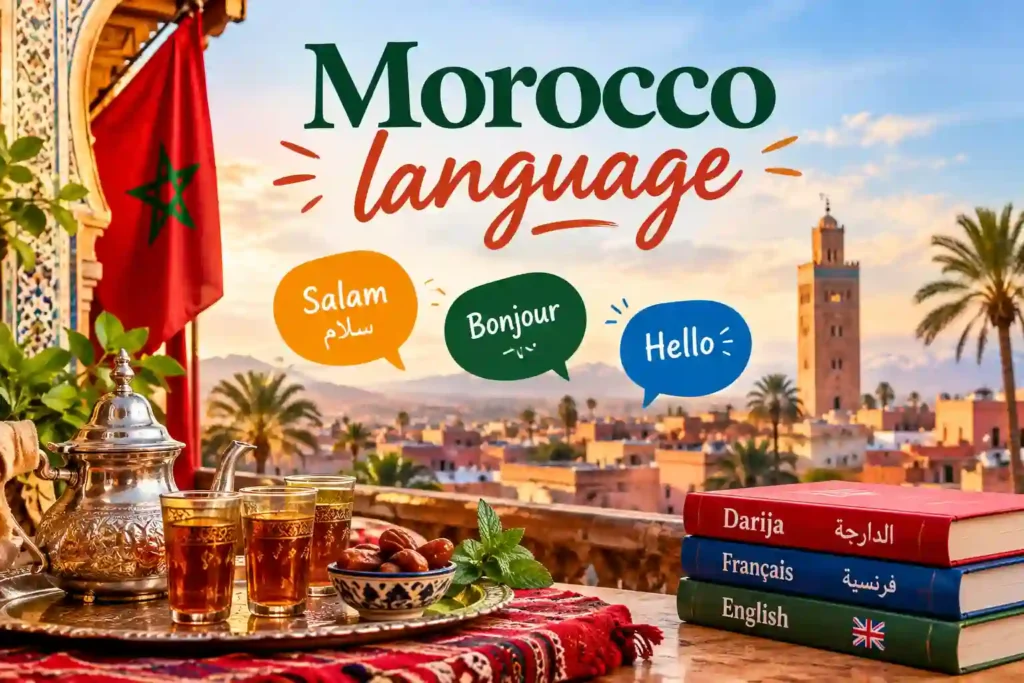
Ask someone what language they speak in Morocco and you’ll usually get “Arabic” as the quick answer. Spend even a day in Marrakech or Fes, though, and you’ll notice a shopkeeper sliding from Darija to French to a bit of English to a stray word of Spanish, sometimes all in the same sentence, without seeming to think about it at all. Morocco isn’t a one-language country pretending otherwise, it’s a genuinely layered, multilingual place shaped by Berber roots, Arab expansion, and decades of French and Spanish colonial presence. Here’s what’s actually going on, language by language.
Quick Facts About Language in Morocco
| Fact | Detail |
|---|---|
| Official languages | Arabic (Modern Standard Arabic) and Amazigh (Tamazight), both official since the 2011 constitution |
| Main everyday spoken language | Darija (Moroccan Arabic), used by roughly 92% of the population |
| Berber/Amazigh speakers | Around 25% of the population, across several regional varieties |
| Most useful foreign language | French, widely used in business, education, and government |
| Regional foreign language | Spanish, mainly in the north |
| Tourism language | English, increasingly common in major cities and with younger Moroccans |
| Amazigh writing system | Tifinagh script, now used on public signage and in schools |
Darija: The Language You’ll Actually Hear Everywhere
If you’re wondering what people are actually speaking around you on the street, in the souk, in a taxi, it’s almost certainly Darija, Moroccan Arabic. It’s the everyday spoken language for the vast majority of the population, and it’s genuinely distinct enough from Modern Standard Arabic that a Darija speaker and, say, an Egyptian or Lebanese Arabic speaker won’t always understand each other smoothly. Darija developed by blending Arabic with Amazigh vocabulary and grammar, then absorbing a steady stream of French and Spanish loanwords over the colonial period, so even a short conversation in Darija often contains words that would sound completely out of place in formal Arabic. It’s rarely written down formally (Modern Standard Arabic handles that job), which is part of why Darija can feel a bit like a secret handshake, a language most Moroccans grow up speaking at home but rarely see printed in a book.
Modern Standard Arabic: The Formal, Written Layer
Modern Standard Arabic (MSA) is one of Morocco’s two official languages, and it plays a very specific role, formal writing, government documents, news broadcasts, mosque sermons, and school instruction. It’s not really what people use to chat with friends or haggle in a market, but it’s the version of Arabic taught in schools and the one that connects Morocco to the wider Arabic-speaking world from Cairo to Riyadh. Most Moroccans grow up genuinely bilingual within Arabic itself, comfortable in Darija for daily life and MSA for anything formal or written, switching between the two without much conscious effort.
Amazigh (Berber): Morocco’s Indigenous Languages
Long before Arabic arrived in North Africa, Amazigh languages were already being spoken here, and they still are, by roughly a quarter of Morocco’s population today. Amazigh isn’t a single language so much as a family of related varieties, the main ones in Morocco being Tashelhit in the south, Central Atlas Tamazight in the High Atlas region, and Tarifit in the northern Rif. These varieties are related but not always mutually intelligible, so a Tashelhit speaker from the Souss Valley and a Tarifit speaker from the Rif might struggle to follow each other’s dialect despite both being “Amazigh.” Since the 2011 constitutional reform, Standard Moroccan Amazigh has been an official language alongside Arabic, and you’ll increasingly see it on road signs and government buildings written in Tifinagh, a distinctive geometric script that’s one of the oldest writing systems still in active use anywhere in the world. It’s also now part of the school curriculum, a genuinely significant shift for a language that was excluded from formal education for generations.
French: The Language of Business, Not the Government
French has no official status in Morocco, but don’t let that fool you, it’s everywhere. Introduced during the French Protectorate (1912-1956), French never really left, and today it remains the practical language of higher education, business, banking, medicine, and a large share of the media. A large portion of literate Moroccans can hold a conversation in French, and in professional settings, especially in cities like Casablanca and Rabat, French often ends up being the default working language even between two Moroccans. For travelers, French is genuinely the most useful second language to know a little of, more useful in practice than English in a lot of situations outside the biggest tourist zones.
Spanish: A Regional Legacy in the North
Spanish holds a smaller but real place in Morocco’s linguistic landscape, concentrated mainly in the north, cities like Tangier, Tetouan, and Chefchaouen, which were historically part of the Spanish protectorate zone rather than the French one. Spanish is taught in some schools in these regions and remains genuinely useful for older residents and business owners with ties to Spain, which sits close enough across the Strait of Gibraltar that the connection has never really faded. If your Morocco trip focuses on the north, a little Spanish can occasionally get you further than French.
English: Rising Fast, Especially Among Younger Moroccans
English doesn’t have deep historical roots in Morocco the way French and Spanish do, but it’s grown quickly, especially in tourism and among younger generations. In Marrakech, Fes, and other major tourist destinations, most people working in hotels, restaurants, and shops handle English comfortably, and it’s increasingly taught in schools and universities as Morocco’s international tourism and business ties expand. It won’t get you as far as French in formal or business settings, but for a standard Morocco trip, English is genuinely sufficient in most tourist-facing situations.
Hassaniya: The Language of the Sahara
In Morocco’s southern, Saharan regions, you’ll also encounter Hassaniya Arabic, a distinct dialect historically associated with the nomadic Sahrawi and Moorish populations of the Sahara and connected to communities across Mauritania and parts of Algeria and Mali as well. It’s a smaller presence numerically than Darija, but it’s a genuine, living part of the linguistic map in Morocco’s far south.
So, What Language Should You Actually Learn a Little Of?
If you’re planning a Morocco trip, you genuinely don’t need to worry about this too much, but a little goes a long way. A handful of Darija greetings and polite phrases, hello, thank you, please, will consistently earn warm reactions since so few tourists bother, even though they don’t need to lean on it for anything practical. French is the more broadly useful backup, since it works in restaurants, with drivers, and in most business interactions across the country. English works fine in major tourist cities and with most guides, so don’t feel like you need fluency in anything else to have a smooth trip, Morocco is used to hosting visitors from everywhere, and multilingual flexibility is basically a national skill at this point.
A Few Simple Phrases Worth Knowing
| English | Darija (Moroccan Arabic) |
|---|---|
| Hello | Salam / Ahlan |
| Thank you | Shukran |
| Please | Afak |
| Yes / No | Ih (or Na’am) / La |
| How much? | Bshhal? |
| Beautiful | Zwin / Mezyan |
| Goodbye | Bslama |
Why This Multilingual Mix Exists in the First Place
Morocco’s language layering isn’t random, it’s the direct result of centuries of history stacking on top of each other. Amazigh languages were spoken across the region for years before Arabic arrived with the Islamic expansion in the 7th century, gradually spreading Arabic across much of the population while Amazigh varieties held on strongly in rural, mountain, and desert regions less directly affected by that expansion. Centuries later, the French and Spanish protectorates (1912-1956) layered European languages on top of that existing Arabic-Amazigh mix, and both left institutional roots, French especially, that outlasted the colonial period itself by decades. What you hear on a Morocco trip today is really the accumulated result of all of that history happening at once, in the same conversation, sometimes in the same sentence.
Regional Accents: Darija Doesn’t Sound the Same Everywhere
Even within Darija itself, there’s noticeable regional variation, similar to how English sounds different in Glasgow versus Texas. Northern Darija, spoken around Tangier and Tetouan, carries more Spanish influence and a slightly different rhythm than the Darija you’ll hear in Marrakech or Casablanca. Southern and Saharan Darija picks up more vocabulary and cadence from Hassaniya Arabic and the Amazigh languages spoken in those regions. Fes’s Darija is often described by Moroccans themselves as particularly fast and distinct, sometimes even a little hard for other Moroccans to follow at full speed. None of this matters much for a traveler picking up a few basic phrases, but it’s a good reminder that “Moroccan Arabic” isn’t a single, uniform sound across the whole country.
Language by City: What You’ll Actually Encounter Where
Since language use shifts a fair amount by region, here’s a rough sense of what to expect depending on where your trip takes you.
| City/Region | What You’ll Mostly Hear |
|---|---|
| Marrakech | Darija everywhere, strong English and French in tourist areas |
| Fes | Darija (distinct local accent), French common in business, less English outside tourist zones |
| Casablanca | Darija and French heavily mixed, especially in business settings |
| Tangier / Tetouan / Chefchaouen | Darija with Spanish influence, Spanish still spoken by some, especially older residents |
| Atlas Mountains / rural south | Amazigh languages (Tashelhit or Tamazight) as the first language for many, Darija as a second language |
| Sahara / far south | Hassaniya Arabic alongside Darija and Amazigh varieties |
Common Moroccan Expressions You’ll Hear Constantly
A handful of expressions come up so often in daily conversation that you’ll likely recognize them within a day or two, even without studying any Darija beforehand. “Inshallah” (God willing) gets used constantly, attached to almost any future plan, from “see you tomorrow, inshallah” to a taxi’s estimated arrival time. “Yallah” (let’s go / come on) shows up everywhere, from hurrying a group along to encouraging a bit more urgency in general. “Bezaf” (a lot / too much) is a genuinely useful word for haggling, as in bargaining over a price that’s “bezaf,” too much. And “Mashi mushkil” (no problem) is the reassuring phrase you’ll hear constantly from shopkeepers, drivers, and guides alike, whether or not there was ever a problem to begin with.
Language and Moroccan Schools
Morocco’s education system reflects its layered linguistic reality directly. Arabic is the primary language of instruction in public schools, with French introduced early and used heavily for science and technical subjects as students progress, a structure that’s part of why so many educated Moroccans end up genuinely bilingual, or trilingual, by adulthood. Since the 2011 constitutional reform, Amazigh has also been progressively introduced into the curriculum, though rollout has varied by region and school, moving faster in some Amazigh-majority areas than in major Arabic-speaking cities. Private and international schools, increasingly common in cities like Casablanca and Rabat, often add English more heavily from an earlier age, reflecting the language’s growing importance for global business and higher education abroad.
Menus, Signs, and Practical Reading for Travelers
For practical purposes, most tourist-facing signage in Morocco’s major cities appears in Arabic and French, with English increasingly added in the biggest tourist zones like central Marrakech and parts of Fes and Tangier. Restaurant menus in tourist areas are very often available in French and English alongside Arabic, though smaller, more local spots may only have Arabic or French, in which case pointing, asking your guide, or using a translation app works just fine. Road signs generally include French alongside Arabic, and increasingly Tifinagh script for Amazigh, particularly in Amazigh-majority regions, so don’t be surprised to see three different scripts on the same road sign as you head toward the Atlas Mountains or the south.
Arabization and the Politics of Language in Morocco
Morocco’s language landscape today wasn’t shaped by accident, it’s also the product of deliberate policy decisions, and understanding a bit of that history adds real context. After independence in 1956, Morocco pursued a policy known as Arabization, gradually replacing French with Arabic in schools, government, and public life as a way of asserting national identity after decades of colonial rule. This shift was significant, but it also sidelined Amazigh languages for decades, despite them being spoken by roughly a quarter of the population and having a far longer history in the region than Arabic itself. French, meanwhile, never actually disappeared from business, science, and higher education, creating the somewhat unusual situation where a language with no official status remained deeply embedded in the country’s economic and academic life throughout the entire Arabization period.
The Amazigh Rights Movement: How Tamazight Became Official
The recognition of Amazigh as an official language in 2011 wasn’t simply granted, it was the result of a long, sustained cultural and political movement. Amazigh activists spent decades pushing for recognition of their language and cultural identity, arguing that centuries of Arabization policy had marginalized Morocco’s indigenous population and languages in their own homeland. The turning point came with the constitutional reforms following the 2011 Arab Spring protests across the region, when Morocco’s new constitution formally recognized Amazigh alongside Arabic for the first time in the country’s history. Since then, the push has continued into practical implementation, Amazigh in school curriculum (fully mandated in 2019), Tifinagh on public signage, and Amazigh-language content on state media, though activists and linguists note that full, equal implementation across the country is still very much a work in progress rather than a finished process.
Learning a Bit of Darija Before Your Trip
If you want to go beyond a phrasebook and actually pick up some functional Darija before you travel, a few resources make it considerably easier than it used to be. Language learning apps increasingly include dedicated Darija courses (rather than lumping it in with generic “Arabic”), which matters given how different Darija is from Modern Standard Arabic in everyday use. YouTube has a genuinely solid selection of Darija-for-travelers channels, often run by Moroccans specifically teaching the everyday phrases textbooks skip. If you’re the type who learns best from real conversation, some Moroccan tour operators and riads can arrange a short informal language session as part of a longer stay, a nice way to pick up a handful of useful phrases directly from a native speaker rather than an app.
Language Etiquette: A Few Things Worth Knowing
A little cultural awareness around language goes a long way in Morocco. Attempting a few words of Darija, even badly pronounced, is almost always received warmly rather than critically, Moroccans are generally delighted when visitors make the effort, and it’s seen as a sign of respect rather than something to be embarrassed about getting wrong. It’s worth knowing that assuming everyone speaks Modern Standard Arabic (the “textbook” Arabic taught in some language courses abroad) can actually create confusion, since it’s simply not how people talk day to day, Darija is the practical choice if you’re learning any Arabic specifically for a Morocco trip. Similarly, defaulting to French rather than English in more traditional or rural areas often gets a warmer, more fluent response, since French has simply been part of daily Moroccan life for longer and more universally than English has.
Frequently Asked Questions About Morocco Language
What language do most people speak in Morocco? Darija (Moroccan Arabic) is the everyday spoken language for the vast majority of the population, though Modern Standard Arabic and Amazigh are both official.
Is French or English more useful for tourists in Morocco? French is generally more widely understood across the country and more useful in business and everyday transactions, while English works well specifically in major tourist cities and with younger Moroccans.
Do Moroccans speak Berber or Arabic? Both, and often at the same time. About a quarter of the population speaks an Amazigh (Berber) language, and many Amazigh speakers are also fluent in Darija.
Is Darija the same as Arabic spoken elsewhere? No, not exactly. Darija is distinct enough from Modern Standard Arabic, and from other regional Arabic dialects, that speakers from different Arabic-speaking countries don’t always understand each other easily.
What is Tifinagh? Tifinagh is the traditional script used to write Amazigh languages, now used on public signage and taught in Moroccan schools following Amazigh’s recognition as an official language in 2011.
Can I get by in Morocco with only English? In major tourist cities and with most guides, yes. Outside those areas, especially in rural regions, a little French or a few Darija phrases go a long way.
Final Thoughts
Morocco’s linguistic mix isn’t a complication to work around; it’s genuinely one of the most fascinating parts of traveling there. Hearing a conversation slide seamlessly between Darija, French, and a bit of English in the space of a few sentences is a small, everyday reminder of just how many layers of history are baked into daily life here. You don’t need to speak any of it fluently to have a great trip, but picking up a few words of Darija and knowing when French might actually serve you better than English makes the experience feel just a little more connected to the place itself.
Ready to Experience Morocco’s Culture Firsthand?
Language is just one thread in Morocco’s much bigger cultural fabric, and the best way to really take it in is to actually be there.
- Morocco desert tours covering the full range of routes and experiences across the country.
- Marrakech desert tours for travelers starting in Marrakech.
- Fes desert tours for a route through the imperial cities and beyond.
- Ouarzazate desert tours for a shorter path into the south.
- Tangier desert tours for trips starting in the north.
Not sure how to build your route? Check our Morocco itineraries page, or contact us and we’ll help you plan a trip that lets you experience Morocco’s culture, language included, up close.