
Facts About Morocco: The Stuff Most Travel Guides Skip
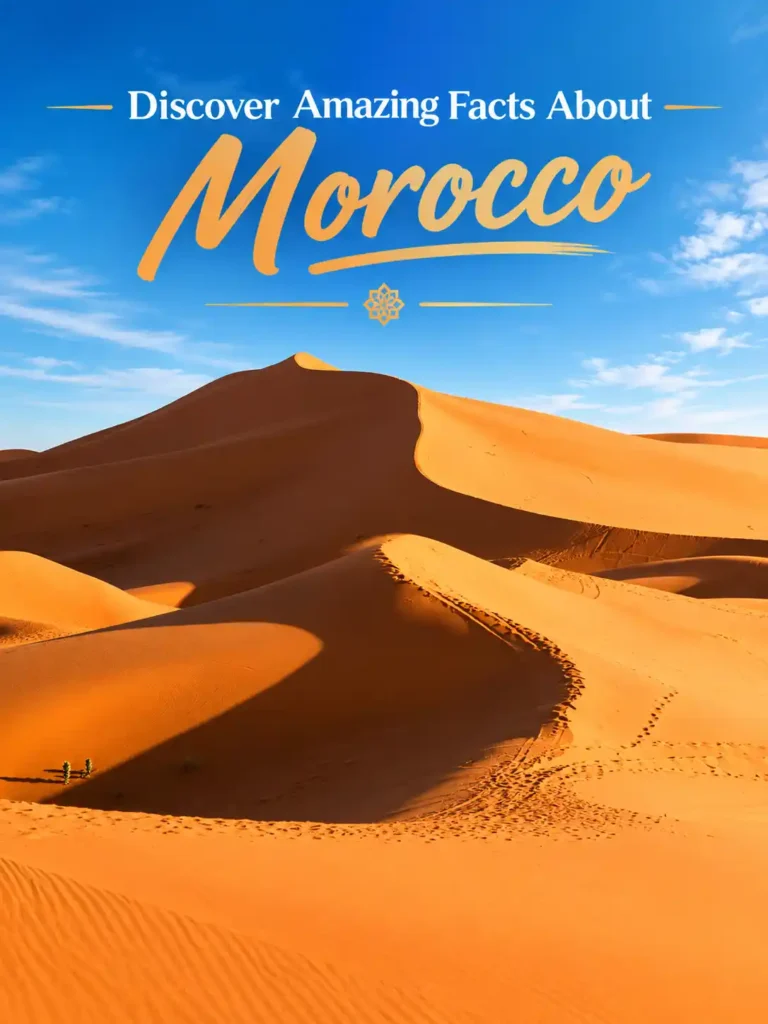
Everyone knows the postcard version of Morocco, souks, sand dunes, mint tea. But spend a little time actually digging into the country and you start running into facts that genuinely surprise people, things that don’t fit neatly into a travel brochure but explain a lot about why Morocco feels the way it does once you’re actually there. This is a collection of those facts, organized so you can either read straight through or jump to whatever category you’re curious about.
Quick Facts About Morocco
| Fact | Detail |
|---|---|
| Official name | Kingdom of Morocco |
| Population | Around 38.8 million (2026) |
| Capital | Rabat |
| Largest city | Casablanca |
| Land area | About 446,550 sq km, roughly the size of Sweden |
| Official languages | Arabic and Amazigh (Berber) |
| Government | Parliamentary constitutional monarchy |
| Currency | Moroccan Dirham (MAD) |
| Distance to Europe | As close as 14.2 km from Spain at the Strait of Gibraltar |
Geography: A Country of Genuine Extremes
Morocco packs an unusual range of landscapes into one country, and that variety is part of why it’s such a compelling place to travel through. It’s bordered by Algeria, Mauritania, and (via the small Spanish enclaves of Ceuta and Melilla) technically Spain, sitting at the northwestern tip of Africa where the Mediterranean meets the Atlantic. The country stretches from the snow-capped High Atlas Mountains, home to Jebel Toubkal, North Africa’s highest peak at 4,167 meters, all the way down to the genuine sand-dune Sahara in the south. At its closest point, Morocco sits just 14.2 kilometers from Spain across the Strait of Gibraltar, close enough that on a clear day you can actually see the European coastline from northern Morocco, a genuinely strange feeling for a country that otherwise feels worlds away from Europe.
People and Population: More Layered Than the Headline Numbers Suggested
Morocco is home to roughly 38.8 million people, and the demographic picture is more nuanced than most quick summaries captured. Officially, the population is classified as roughly 99% Arab-Berber, but that single figure hides real internal diversity, independent estimates suggest 35-40% of Moroccans identify as Berber (Amazigh) specifically by ethnicity, language, or cultural affiliation, concentrated heavily in the Atlas Mountains, the Rif, and southern oasis regions. More than half the population lives in urban centers, with Casablanca as the country’s largest city and economic engine, even though Rabat holds the political capital title. Morocco’s diaspora is also genuinely enormous relative to its population, representing roughly one Moroccan living abroad for every seven still living in the country, with France’s community of about 1.5 million the largest single group, a legacy of colonial-era ties and mid-20th-century labor migration.
History: A Country Shaped by Everyone Who Passed Through
Morocco’s history reads like a list of nearly every major civilization that ever touched North Africa. Archaeological evidence places human presence in Morocco as far back as 280,000 to 350,000 years, among the oldest evidence of human activity found anywhere. Long before Arabic arrived, indigenous Amazigh (Berber) peoples had already been established across the region for millennia, and their culture remains foundational to Moroccan identity today rather than a historical footnote. Islam arrived in the 7th century, and over the following centuries Morocco built and lost several major empires, the Almoravids and Almohads among them, that at times stretched across into Spain. More recently, Morocco became a French protectorate in 1912, gaining independence in 1956, when Sultan Mohammed became king, kicking off the modern Alaouite monarchy that still governs the country today. Interestingly, the country’s very name has a slightly roundabout origin, “Morocco” comes from the Spanish and Portuguese “Marruecos” and “Marrocos,” which themselves derive from “Marrakesh,” the Latin name once used for the country’s former capital.
Government and Politics: A Monarchy With a Working Parliament
Morocco operates as a parliamentary constitutional monarchy, meaning the country is headed by a king (currently King Mohammed VI) while a prime minister runs the day-to-day government alongside an elected parliament. Every July 30th, Moroccans celebrate Throne Day, a national holiday commemorating the day the current king ascended to power, marked by celebrations, speeches, and a genuine sense of national occasion across the country. The monarchy holds considerably more direct authority than most European constitutional monarchies, particularly over religious affairs, foreign policy, and the military, making Morocco’s political system a genuinely distinct hybrid rather than a close copy of a Western parliamentary democracy.
Religion: Nearly Universal, But Not Without Nuance
Islam is overwhelmingly the dominant religion in Morocco, with roughly 99% of the population identifying as Muslim, mostly Sunni. That said, Morocco has historically been home to one of the oldest and, at points, largest Jewish communities in the Arab world, and the country retains a genuine, if now much smaller, Jewish population along with historic synagogues and mellahs (Jewish quarters) still standing in cities like Marrakech, Fes, and Essaouira. Morocco’s king also holds the traditional religious title “Commander of the Faithful,” reflecting the close, centuries-old relationship between the monarchy and religious authority in the country.
Language: More Complicated Than “They Speak Arabic”
Morocco’s linguistic reality is genuinely layered. Arabic and Amazigh (Berber) are both official languages, but the Arabic most people actually speak day to day, Darija, is distinct enough from formal Modern Standard Arabic that it functions almost as its own dialect. French holds no official status whatsoever, yet remains deeply embedded in Moroccan government business, higher education, and administration, a lasting legacy of the French protectorate period. Spanish still has a real presence in the north, around cities like Tangier and Tetouan, reflecting that region’s history under Spanish rather than French administration. It’s genuinely common to hear a single conversation drift between three or four of these languages without anyone treating it as unusual.
Culture: A Genuine Crossroads, Not Just a Buzzword
“Crossroads of civilizations” gets used a lot to describe Morocco, but it’s actually accurate rather than just marketing language. The country sits at the precise geographic intersection where Africa, Europe, and the Middle East meet, and its culture reflects influences from indigenous Berber traditions, sub-Saharan Africa, the Arab world, and Europe, all layered on top of each other rather than existing in separate compartments. This shows up everywhere: in architecture that blends Andalusian and Amazigh design, in music that ranges from Gnawa’s West African-rooted rhythms to Andalusian classical traditions, and in a cuisine that draws on Berber, Arab, Mediterranean, and West African influences simultaneously.
Food: Beyond Tagine and Couscous
Moroccan cuisine gets rightly celebrated internationally, but there’s more nuance to it than the two dishes everyone already knows. Couscous, often considered close to a national dish, is traditionally reserved for Friday family meals rather than eaten as an everyday staple. Mint tea isn’t simply a beverage, it’s a genuine social ritual, poured theatrically from height into small glasses and offered constantly as a gesture of hospitality, evolving it outright can occasionally come across as a bit rude in a traditional setting. Morocco is also a major producer of argan oil, extracted almost exclusively from argan trees native to the region around Essaouira and Agadir, and the sight of goats climbing into argan trees to eat the fruit, a genuinely local phenomenon, has become one of the most unexpected images travelers bring home from a road trip through the region.
Nature and Wildlife: More Than Just Desert
Morocco’s biodiversity gets consistently underrated in most travel content. Beyond the Sahara’s sand dunes, the country holds cedar forests in the Middle Atlas around Ifrane and Azrou, home to Barbary macaques, one of the few monkey species native to North Africa, and one of the most endangered primate species on the continent. Morocco’s Atlantic coastline supports genuinely important bird migration routes, drawing serious birdwatchers to spots like Souss-Massa National Park near Agadir. Even the “Switzerland of Morocco,” the alpine town of Ifrane, complete with snow in winter and a distinctly European architectural style left over from the French protectorate era, surprises travelers who arrive expecting only desert and medina heat.
Economy: More Diverse Than Tourism Alone
While tourism is a genuinely major part of Morocco’s economy, it’s far from the only pillar. Morocco is one of the world’s largest exporters of phosphate, a key ingredient in fertilizer production, and controls a significant share of global phosphate reserves, giving it real strategic weight in global agriculture supply chains most travelers never think about. The country has also invested heavily in renewable energy, the Tarfaya Wind Farm is Africa’s largest capacity wind farm, with 131 turbines and a total installed capacity of 301 MW, part of a broader national push toward renewable energy that’s considerably more ambitious than most people associated with the region. Agriculture, particularly citrus fruits and olives, along with a growing automotive manufacturing sector, round out an economy that’s genuinely more diversified than the tourism-heavy image most visitors carry in with them.
A Few Genuinely Surprising Facts
Some facts about Morocco just don’t fit neatly into a category, but they’re too interesting to leave out. The Rif Mountains in northern Morocco are reportedly a major source of cannabis cultivation, with some estimates suggesting a very large share of the hashish consumed across Europe originating from this specific region. Morocco was among the first countries in the world to formally recognize the fledgling United States as an independent nation, back in 1777, a historical fact that occasionally surprises American visitors who assume the two countries’ relationship is a much more recent development. And despite its modern, growing cities, more than half of Morocco’s population still lives in urban centers, a reminder that behind the postcard image of rural kasbahs and desert villages, Morocco is also a genuinely urbanizing, modernizing country in real time.
Sports: A Football-Obsessed Nation With a Historic Achievement
Football is genuinely the national obsession in Morocco, and the country delivered one of the most significant moments in African football history at the 2022 FIFA World Cup, when the Atlas Lions became the first African and Arab team ever to reach a World Cup semifinal, a result that triggered nationwide celebrations and cemented Morocco’s status as a serious footballing nation rather than a regional underdog. That momentum continues to build: Morocco is set to co-host the 2030 FIFA World Cup alongside Spain and Portugal, a tournament that will make it only the second African country ever to host football’s biggest event, following South Africa in 2010. Beyond football, Morocco has also produced genuinely world-class distance runners, a tradition connected to the country’s mountain and desert terrain, which has historically produced excellent conditions for endurance training.
Cinema: Morocco’s Secret Hollywood
Morocco has quietly become one of the film industry’s most-used filming locations outside the United States and Europe, largely centered around Ouarzazate, sometimes nicknamed “Ouallywood” for its enormous studio complexes and desert-adjacent scenery. Films and shows ranging from Gladiator and Lawrence of Arabia to Game of Thrones have used Moroccan locations to stand in for everything from ancient Rome to fictional continents, drawn by the combination of dramatic desert and mountain landscapes, well-preserved historic architecture, and considerably lower production costs than filming in Europe or North America. This film industry has become a genuine economic contributor in its own right, and several studios around Ouarzazate now offer tours of old film sets and props for travelers curious to see where some of cinema’s biggest productions were actually shot.
Architecture: Building Styles That Tell Their Own History
Moroccan architecture is genuinely distinct enough to spot at a glance, and it reflects the same layered history found throughout the country’s culture more broadly. Zellige, the intricate geometric mosaic tilework found across palaces, mosques, and fountains, requires years of specialized training to produce by hand and remains a genuinely living craft rather than a historical relic. Riads, traditional homes built around a central courtyard, often with a fountain or garden at the center, were designed specifically to maximize privacy from the street while creating a private, cooling oasis inside, a practical response to both climate and cultural norms around family privacy. And the country’s kasbahs, fortified earthen structures built from rammed earth and straw, represent one of the oldest sustainable building techniques still in active use, naturally insulating against the region’s extreme daytime heat and cold desert nights alike.
Education: Progress and Ongoing Challenges
Morocco’s education system reflects both real progress and acknowledged gaps. Primary education is compulsory for children aged 7 to 13, and the country has made significant investments in expanding school access over recent decades. That said, literacy rates have historically lagged behind some regional peers, with roughly half the population able to read and write according to some assessments, a gap the government has specifically targeted through ongoing education reform programs. On the higher end of the spectrum, Morocco is also home to the University of Al Quaraouiyine in Fes, founded in 859 AD and recognized by UNESCO and Guinness World Records as the oldest continuously operating degree-granting university in the world, a truly remarkable piece of educational history for a single country to hold.
National Symbols: The Flag, the Star, and What They Mean
Morocco’s national flag, a red field with a green five-pointed star (called the Seal of Solomon) in the center, carries specific symbolic weight. Red has long been associated with the Alaouite dynasty and, more broadly, with strength and hardiness, while the green star represents life, hope, and peace, and its five points are traditionally linked to the five pillars of Islam. The current flag design dates to 1915, introduced during the reign of Sultan Yusef, and it has remained unchanged since, one of the most stable national symbols in a region that has seen plenty of flag redesigns following political upheaval.
A Few Practical Everyday Facts Travelers Often Ask About
A handful of everyday practical facts round out the picture for anyone actually planning a visit. Morocco drives on the right-hand side of the road, following the French system rather than the British one. The weekend generally follows Friday and Saturday or Saturday-Sunday depending on the sector, since Friday holds particular religious significance as the day of communal prayer. Morocco operates on UTC+0 (previously called GMT), it does not observe daylight saving time changes the way many European countries do, and Fridays specifically shift the rhythm of daily life in more traditional areas, with many shops closing for a few hours around midday prayer time.
Famous Moroccans Who’ve Made a Global Mark
Morocco has produced a genuinely wide range of internationally recognized figures across very different fields. In football, players like Achraf Hakimi have become household names across European club football while also carrying the momentum of that historic 2022 World Cup run. In fashion and design, Morocco’s influence runs deep through designers like the late Yves Saint Laurent, who wasn’t Moroccan by birth but considered Marrakech his creative second home for decades, a relationship documented extensively at the YSL Museum next to Jardin Majorelle. Moroccan-born or Moroccan-heritage writers, musicians, and academics have also built significant international careers, reflecting the country’s large and active diaspora community across France, Spain, Belgium, and beyond.
UNESCO World Heritage Sites: Morocco’s Recognized Treasures
Morocco holds nine UNESCO World Heritage Sites, an unusually high number for a country of its size, reflecting just how much historically significant architecture and urban planning has survived intact. These include four complete medinas, Fes el Bali, Marrakech, Essaouira, and Meknes, each recognized for representing an exceptionally well-preserved example of traditional Islamic urban design. Beyond the medinas, the list includes Ait Ben Haddou’s fortified kasbah village, the Roman ruins at Volubilis, the modern-and-historic capital of Rabat, and the Portuguese city of Mazagan (El Jadida). Having this many UNESCO sites within a single, relatively compact country is part of why a well-planned Morocco itinerary can pack in so much genuinely significant history without excessive backtracking.
Environment and Sustainability: Bigger Ambitions Than Expected
Morocco’s environmental push extends well beyond the Tarfaya Wind Farm mentioned earlier. The country is also home to the Noor Ouarzazate Solar Complex, one of the largest concentrated solar power plants in the world, part of an ambitious national strategy to generate a significant share of Morocco’s electricity from renewable sources. This push matters partly because Morocco imports the vast majority of its fossil fuel energy, giving the country strong economic, not just environmental, incentives to lead on renewables regionally. On the biodiversity side, Morocco is also home to genuinely significant argan forests, a UNESCO-recognized biosphere reserve in their own right, supporting both a unique ecosystem and the livelihoods of local women’s cooperatives who produce the majority of the world’s argan oil.
Currency and Money: A Few Genuinely Useful Facts
The Moroccan dirham is a closed currency, meaning it legally can’t be bought or exchanged outside the country, so travelers exchange money after arrival rather than before departure, a detail that surprises some first-time visitors used to pre-ordering foreign currency at home. Morocco’s economy also runs on a noticeably cash-heavy basis outside major hotels and cities, particularly in medinas, rural areas, and smaller desert towns, where card payment infrastructure remains considerably less common than in Europe or North America. Interestingly, despite the dirham’s restricted international status, Morocco has one of the most stable currencies in the region, benefiting from a managed exchange rate policy that has helped keep inflation relatively controlled compared to some regional neighbors.
Holidays and Festivals: A Calendar Worth Knowing
Morocco’s calendar blends Islamic, national, and regional celebrations in a way that shapes daily life more than casual visitors often realize. Beyond Throne Day (July 30th), national holidays include Independence Day (November 18th) and Green March Day (November 6th), commemorating the 1975 mass demonstration tied to Morocco’s claim over Western Sahara. Religious holidays follow the Islamic lunar calendar, meaning dates like Eid al-Fitr, Eid al-Adha, and Ramadan itself shift earlier by roughly 10-11 days each year rather than falling on a fixed date, a detail worth checking carefully if you’re planning travel dates around a specific season. Regional festivals add another layer entirely, from the Gnaoua World Music Festival in Essaouira to the Rose Festival in the Dades Valley each spring, celebrating the region’s famous rose harvest with parades and rose-based products sold throughout the town.
Common Myths About Morocco, Debunked
A few persistent misconceptions are worth clearing up directly. Morocco is not part of the Middle East, it’s firmly in North Africa, though its culture and history connect closely to the wider Arab world. Alcohol is not illegal in Morocco, it’s legal and available in licensed venues, though public drinking is prohibited, a nuance that trips up plenty of prospective visitors doing quick pre-trip research. And Morocco is not simply “one big desert,” in reality, the Sahara covers only the southeastern portion of the country, while the north and center feature mountains, fertile agricultural plains, and a genuinely long Atlantic and Mediterranean coastline, a much more varied geography than the desert-only image many people carry in before visiting.
Morocco’s Cannabis Industry: From Black Market to Legal Reform
Building on the earlier mention of Rif Mountains cannabis cultivation, it’s worth noting a genuinely significant recent shift: in 2021, Morocco’s parliament passed legislation legalizing cannabis cultivation for medical, cosmetic, and industrial purposes, a major reform for a crop that had operated almost entirely in a legal gray zone for decades despite its massive scale. The move aimed to bring the Rif region’s traditional cannabis farmers, many from families that have grown the crop for generations, into a regulated, taxed economy rather than leaving them dependent on an illegal trade. Recreational use remains illegal, but the legal reform represents one of the most significant economic policy shifts in the country in recent years, with real implications for one of Morocco’s poorest and historically most underserved regions.
International Relations: A Bridge Between Continents
Morocco’s geography as a literal bridge between Africa and Europe extends into its foreign policy as well. The country rejoined the African Union in 2017 after a 33-year absence (having left in 1984 over the Western Sahara dispute), a significant diplomatic shift reflecting Morocco’s push to deepen ties across the African continent rather than focusing primarily on European and Gulf relationships. Morocco also maintains an unusually close, decades-long relationship with the United States, dating back to that early 1777 recognition mentioned earlier, and the two countries maintain a free trade agreement that’s helped grow bilateral trade significantly since it took effect in 2006. Its position facing both the Mediterranean and Atlantic simultaneously, combined with the Strait of Gibraltar’s strategic importance for global shipping, gives Morocco outsized geopolitical relevance for a country of its size.
Health and Wellness: A Growing Medical Tourism Destination
Beyond traditional hammams and spa culture, Morocco has quietly built a growing medical tourism sector, drawing visitors, particularly from Europe and other African nations, for procedures ranging from dental work to cosmetic surgery, generally at a meaningful cost saving compared to Western Europe while maintaining accredited medical facilities in cities like Casablanca and Marrakech. Morocco’s healthcare system itself has expanded significantly in recent years, with the government pursuing a major push toward universal health coverage, a policy shift aimed at closing longstanding gaps between healthcare access in major cities versus rural and mountain regions.
Wildlife: Species Found Nowhere Else in Such Numbers
Morocco’s position as a genuine biodiversity hotspot deserves more attention than it usually gets. Beyond the Barbary macaques mentioned earlier, Morocco’s coastal waters and offshore islands support important populations of migratory birds, and the country’s Souss-Massa National Park specifically protects the critically endangered Northern Bald Ibis, with Morocco holding one of the last significant wild breeding populations of this species anywhere on Earth. The Atlas Mountains are also home to the Barbary sheep (aoudad), a wild goat-antelope species adapted to the region’s rocky, arid mountain terrain, while Morocco’s stretch of Atlantic coastline serves as a critical stopover point for birds migrating between Europe and sub-Saharan Africa each year, making the country a genuinely significant, if underrated, birdwatching destination.
Science and Astronomy: An Unexpected Space Connection
Morocco holds a genuinely surprising place in modern astronomy. The Oukaïmeden Observatory, located in the High Atlas Mountains at high altitude, offers some of the clearest, least light-polluted night skies in North Africa, making it a real hub for both professional astronomical research and public stargazing. Morocco is also directly tied to one of the most significant exoplanet discoveries in recent astronomical history: the TRAPPIST-1 star system, home to seven Earth-sized planets and among the most studied exoplanet systems for potential habitability, takes its name from the TRAPPIST telescope project, which conducted key observations from Morocco’s Oukaïmeden site. It’s a genuinely unexpected footnote for a country most people associated with deserts and medinas rather than deep space research.
Carpets and Textiles: A Craft With Its Own Language
Moroccan Berber rugs deserve a closer look beyond just being a popular souvenir. Each region and tribe traditionally developed its own distinct patterns, colors, and weaving techniques, meaning an experienced buyer or collector can often identify roughly where a rug was made just from its design, the same way an expert might recognize a specific wine region from taste alone. Historically, these rugs weren’t created for decoration in the modern sense; they served practical purposes for nomadic and semi-nomadic Berber communities, used as bedding, tent flooring, and insulation against both desert heat and mountain cold, with symbolic patterns woven in to represent fertility, protection, or specific tribal identity. The Beni Ourain rug style, now globally popular in modern interior design, originated with a specific Berber tribal confederation in the Middle Atlas Mountains, a craft tradition now sold worldwide by designers who often have little idea of its specific cultural origin.
The Sahara: A Few Numbers Worth Knowing
Since the Sahara features so heavily in most people’s mental image of Morocco, a few specific facts help put it in real perspective. The Sahara Desert as a whole is the largest hot desert in the world, covering roughly 9.2 million square kilometers across North Africa, of which Morocco’s portion represents just one relatively small slice along its northwestern edge. The Erg Chebbi dunes near Merzouga, Morocco’s most visited desert region, reach heights of around 150 meters in places, genuinely tall enough to require real effort to climb, while the desert floor beneath them can swing from near-freezing overnight temperatures in winter to well over 45°C on the hottest summer days, one of the widest daily temperature ranges found anywhere in the country. Morocco’s Sahara region has also occasionally yielded genuine meteorite finds, since the open, uninhabited terrain and dark rock make meteorites easier to spot than in more vegetated parts of the world, an interest that’s drawn both scientific researchers and private collectors to the region over the years.
Telecommunications and Infrastructure: Quietly Well-Connected
Morocco’s telecommunications and transport infrastructure has expanded significantly in recent decades, often surprising travelers expecting a less developed network. The country’s high-speed rail line, Al Boraq, connecting Tangier and Casablanca, was the first high-speed rail line in Africa when it launched in 2018, reaching speeds of up to 320 km/h, genuinely faster than many rail lines found in parts of Europe and North America. Mobile phone and internet penetration is also considerably higher than many visitors expect going in, with strong 4G coverage across the vast majority of the country, including areas along the main desert tourist routes, making Morocco a considerably easier country to stay digitally connected in than its “remote desert kingdom” reputation might suggest.
Frequently Asked Questions About Morocco
Is Morocco in Africa or the Middle East? Morocco is in Africa, specifically North Africa, though its culture and history connect it closely to the Middle East and southern Europe as well.
What is the official language of Morocco? Arabic and Amazigh (Berber) are both official languages, though French is widely used in business and education despite having no official status.
What religion do most Moroccans practice? Islam, with roughly 99% of the population identifying as Muslim, mostly Sunni.
Is Morocco a monarchy or a democracy? Both, in a sense. Morocco is a parliamentary constitutional monarchy, with a king holding significant authority alongside an elected parliament and prime minister.
How close is Morocco to Europe? Very close at its narrowest point, just 14.2 km from Spain across the Strait of Gibraltar, close enough to see the Spanish coast on a clear day from northern Morocco.
What is Morocco’s biggest export? Phosphate is one of Morocco’s most significant exports, and the country holds a substantial share of the world’s known phosphate reserves.
Final Thoughts
Morocco tends to get flattened into a handful of familiar images: souks, tagines, sand dunes, and while all of that is genuinely part of the experience, the country underneath it is considerably deeper and more layered than the postcard version suggests. Knowing a bit of this context, the demographic diversity, the political system, the economic reality behind the tourism industry, doesn’t just make for good trivia; it genuinely changes how you see the place once you’re actually walking through it.
Ready to See Morocco for Yourself?
Reading the facts is one thing, actually standing in the Atlas Mountains or watching the sun set over the Sahara is another entirely.
- Morocco desert tours covering the full range of routes and experiences across the country.
- Marrakech desert tours for travelers starting in Marrakech.
- Fes desert tours for a route through the imperial cities and beyond.
- Ouarzazate desert tours for a shorter path into the south.
- Tangier desert tours for trips starting in the north.
Not sure how to build your route? Check our Morocco itineraries page, or contact us and we will help you turn these facts into an actual trip.