
Is Hammam Better in Marrakech or Casablanca? An Honest Comparison
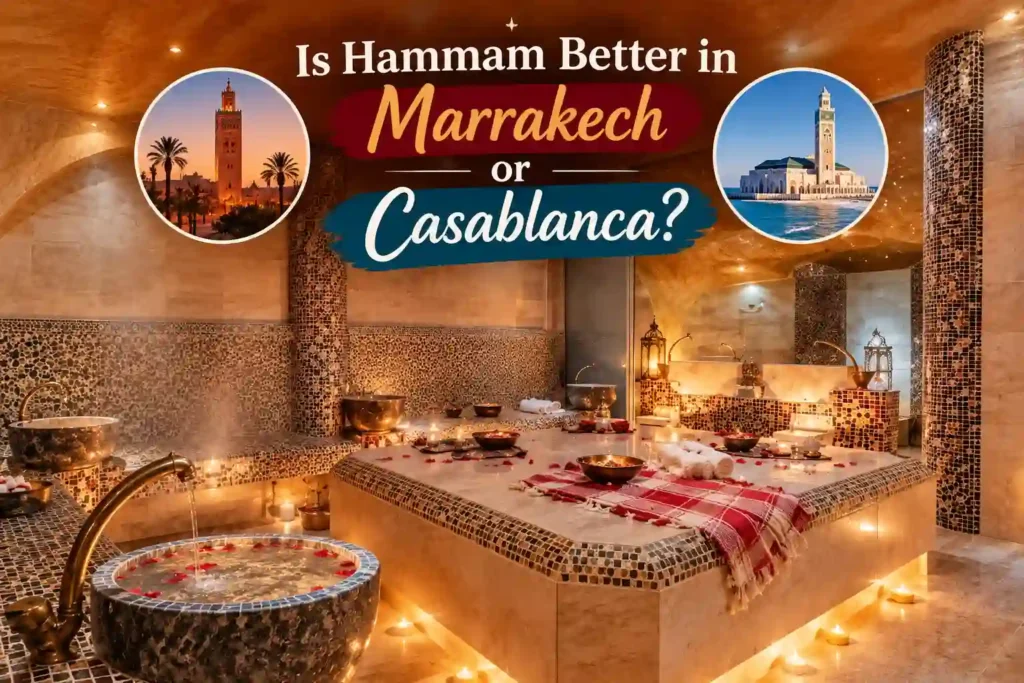
If a proper hammam experience is on your Morocco bucket list, and it genuinely should be, you’ll eventually run into this exact question: does it matter which city you do it in? The short answer is yes, somewhat, though maybe not for the reasons you’d expect. Marrakech and Casablanca offer genuinely different hammam scenes, shaped by what each city actually is, one built around tourism and centuries of riad culture, the other a modern, international business hub with its own distinct spa identity. This guide breaks down exactly how they compare, so you can decide which fits your trip, or which one to prioritize if you’re only doing one.
Quick Comparison at a Glance
| Category | Marrakech | Casablanca |
|---|---|---|
| Number of hammam options | Extremely high, dozens of public, riad, and luxury choices | Fewer overall, but genuinely high quality |
| Style | Traditional, riad-based, deeply tourist-oriented | More modern, international, contemporary design |
| Authenticity level | Both traditional public hammams and polished tourist versions available | Leans more modern, though older-neighborhood public hammams still exist |
| Price range | 30-50 MAD (traditional) up to 500+ MAD (luxury spa) | Similar range, with several well-regarded mid-range and upscale options |
| Best for | First-timers wanting the full traditional Moroccan hammam experience | Travelers wanting a hammam with a more contemporary, international spa feel |
| Crowds/tourism pressure | Higher, especially in medina-based hammams during peak season | Lower, since Casablanca sees considerably less tourist foot traffic overall |
What a Hammam Actually Is, Quickly
Before comparing cities, it’s worth a quick refresher on what you’re actually booking. A hammam is a traditional Moroccan steam bath, and the classic ritual follows a fairly consistent structure wherever you go: sitting in a hot, steamy room to soften the skin, a full-body scrub using a rough exfoliating mitt called a kessa, sometimes a black soap and clay mask treatment, and a final rinse, often followed by an oil massage. Historically, before most homes had private plumbing, the hammam functioned as more than a bathing spot, it was a genuine social hub where news traveled, matches were arranged, and community bonds were built, a role that still echoes today in how central hammam culture remains to Moroccan daily life.
The Marrakech Hammam Scene: Depth, Choice, and Tradition
Marrakech is, without much argument, Morocco’s hammam capital in terms of sheer volume and variety. The city offers every tier of the experience: traditional public hammams tucked into the medina used daily by locals, mid-range riad hammams offering a more private, comfortable version of the same ritual, and a genuinely impressive stretch of ultra-luxury spa hammams inside hotels like La Mamounia, Royal Mansour, and Amanjena, some spanning thousands of square meters with private treatment rooms, heated pools, and full wellness facilities built around the traditional hammam ritual. Traditional public hammams in Marrakech run genuinely cheap, often in the 30-50 MAD range, while luxury spa versions can run into the hundreds of dirhams once massages and additional treatments are added. Marrakech’s advantage here is really about choice, whatever budget or comfort level you’re working with, the city has a hammam option built specifically for it, and its deep riad culture means many mid-range guesthouses have their own small, lovely genuinely hammam facilities built directly into the property.
The Casablanca Hammam Scene: Modern, International, Less Touristy
Casablanca’s hammam identity is shaped by what the city actually is, Morocco’s economic and business capital rather than its tourism showcase. The spa scene here leans noticeably more modern and international, contemporary design, global product lines, and a style that blends traditional Moroccan ritual with a more international wellness sensitivity rather than leaning hard into an “authentic medina” atmosphere. Well-regarded options like Hammam Ziani offer a genuinely local, well-maintained experience with a more contemporary vibe than a traditional Marrakech medina hammam, while hotel spas like Le Lido Thalasso and Spa pair hammam treatments with sea-facing settings and broader wellness facilities. Public hammams do still exist in Casablanca’s older neighborhoods, so the traditional, budget-friendly option isn’t absent here, it’s simply less of a dedicated tourist industry than in Marrakech, and correspondingly, you’ll find noticeably less English-language signage and tourist infrastructure built around the experience.
So, Which One Is Actually Better?
Here’s the honest answer: it depends entirely on what you’re looking for, not which city is objectively superior. If you want the single most traditional, immersive hammam experience possible, one that leans into centuries of riad culture, with a genuinely enormous range of choice from bare-bones authentic to five-star opulent, Marrakech wins clearly, simply on depth and variety alone. If you’re already in Casablanca for business, a stopover, or as part of a wider Morocco route, and you want a high-quality hammam experience without the tourist-heavy feel some Marrakech medina hammams can carry during peak season, Casablanca delivers a genuinely excellent, more modern version of the ritual with considerably less crowd pressure. Neither city offers a “worse” hammam in any meaningful sense, they’re simply built around different identities, Marrakech leans into tradition and tourism-scale choice, Casablanca leans into modern polish and a more local, less performative atmosphere.
A Few Practical Tips Either Way
Book ahead during peak season. Popular hammams and spas in both cities, but especially in Marrakech, fill up quickly during high season (October-April), so reserving in advance avoids disappointment.
Decide between public and private before you go. A public hammam offers the cheapest, most culturally authentic experience but involves communal, same-gender nude bathing, not for everyone. A private riad or spa hammam costs more but offers privacy and guided assistance, generally the most comfortable choice for first-timers.
Avoid peak midday hours if you want a quieter session. Early morning or late afternoon slots tend to be considerably less crowded than the 11 AM to 3 PM window in busier hammams.
If it’s a special occasion, ask about a bridal-style hammam package. Many higher-end spas in both cities offer an extended, multi-hour ritual modeled on the traditional pre-wedding hammam al-aaroussa, a genuinely indulgent option if you want to treat the experience as a full afternoon rather than a quick add-on.
A Brief History: Why Each City’s Hammam Culture Developed Differently
The difference between Marrakech and Casablanca’s hammam scenes isn’t accidental, it reflects each city’s distinct historical role. Marrakech has functioned as one of Morocco’s four imperial cities for centuries, and its deep riad culture, homes built around private courtyards for wealthy merchant and noble families, naturally produced a tradition of high-end, semi-private hammam spaces alongside the neighborhood public bathhouses ordinary residents relied on. Casablanca, by contrast, grew rapidly into its current form largely during the 20th century as Morocco’s commercial and industrial hub, a much younger city in its current urban form than Marrakech or Fes, which is part of why its wellness scene developed along more modern, internationally-influenced lines rather than inheriting centuries of riad-based hammam tradition in the same way.
Named Recommendations Worth Knowing
If you want specific starting points rather than just categories, a few names come up repeatedly in each city. In Marrakech, La Mamounia’s spa is frequently cited for its sheer scale and traditional-meets-luxury design, while smaller riad-based options like Hammam de la Rose and Heritage Spa are well regarded for a more intimate, boutique version of the experience. In Casablanca, Hammam Ziani stands out repeatedly for combining an authentic local atmosphere with modern facilities, while Hotel Casablanca Le Lido Thalasso and Spa pairs a coastal setting near the Hassan II Mosque with a broader range of thalassotherapy and hammam treatments. In both cities, checking recent reviews before booking is worth it, since staff quality and specific therapists can vary meaningfully even within a well-regarded establishment.
What to Bring and Wear
A few practical packing notes make your first hammam considerably smoother in either city. Most private and luxury hammams provide everything you need, robes, disposable underwear or slippers, and towels, so you genuinely don’t need to bring much beyond yourself. If you’re heading to a traditional public hammam, however, bringing your own kessa mitt, a bar of black soap (savon beldi), a bucket, and a change of underwear is standard practice, since public hammams are typically bare-bones bathing facilities rather than full-service spas. Flip-flops are worth bringing regardless of which type you choose, since floors can be wet and, in public hammams, shared. Modesty expectations vary, private spas generally provide full coverage garments, while public hammams often involve simply keeping underwear on rather than full nudity, though norms can vary slightly by establishment.
Hammam Etiquette in Morocco
A little cultural awareness goes a long way, especially at a traditional public hammam rather than a hotel spa built specifically around foreign visitors. Keep noise levels low and modest, public hammams are still a genuine community space for local women and men, not a tourist attraction, even when visitors are welcomed. Tipping the attendant who performs your scrub (called a tayeba for women or a kiyass for men) is customary and appreciated, generally a modest amount reflecting the service provided rather than a large percentage-based tip. And arriving with reasonable modesty expectations, rather than assuming a Western spa’s exact norms will apply, helps the experience feel respectful rather than awkward for everyone involved.
Health Benefits Behind the Ritual
Beyond relaxation, the hammam ritual carries genuine, longstanding wellness benefits that explain its centuries of staying power. The combination of steam and heat opens pores and improves circulation, while the kessa scrub physically removes dead skin cells far more thoroughly than a standard shower ever could, most first-timers are genuinely surprised by how much visible buildup comes off during a proper scrub. The black soap used throughout the ritual, traditionally made from olives, is naturally moisturizing, and the final oil massage, often using argan oil in Morocco specifically, helps lock in hydration afterward. Regular hammam use has traditionally been associated with improved skin texture, reduced muscle tension, and a general sense of detoxification, benefits substantial enough that the ritual remains genuinely popular with Moroccans themselves, not just something maintained purely for tourists.
Hammam vs. Turkish Bath vs. Sauna: What’s Actually Different?
Since these terms get used somewhat interchangeably by travelers, it’s worth clarifying the real distinctions. A Turkish bath (hamam) and a Moroccan hammam share the same root word and a similar broadly steam-and-scrub concept, but Moroccan hammams traditionally use less intense steam than a classic Turkish bath and center more heavily on the black soap and kessa scrub sequence specifically. A sauna, by contrast, uses dry heat rather than steam and generally doesn’t include any scrubbing or exfoliation ritual at all, it’s a fundamentally different, more passive kind of heat therapy. If you’re comparing the three, a Moroccan hammam sits somewhere between a wet steam room and an active spa treatment, considerably more hands-on and ritualistic than simply sitting in heat.
Combining Hammam With Other Traditional Treatments
Many hammam sessions, particularly in mid-range and luxury settings in both cities, are booked as part of a longer package alongside other traditional Moroccan treatments. A rhassoul clay mask, made from mineral-rich clay traditionally sourced from Morocco’s Atlas Mountains, is a common add-on, applied to hair and skin for its deep-cleansing properties. Henna application is sometimes offered as a follow-up treatment, particularly at riad spas leaning into a fuller cultural experience rather than just the bathing ritual. And a post-hammam massage, often using warmed argan oil, is close to a standard pairing at this point, capping off the ritual with the same moisturizing, muscle-relaxing finish traditionally associated with a proper Moroccan spa day.
Frequently Asked Questions About Is Hammam Better in Marrakech or Casablanca?
Which city has better hammams, Marrakech or Casablanca? Marrakech offers considerably more choice and a deeper tradition of tourist-oriented hammam culture, while Casablanca offers a more modern, less crowded, and generally more locally-focused experience. Neither is objectively “better,” it depends on the experience you want.
Is a hammam in Marrakech touristy? Many are, particularly in the medina and at luxury hotels, though genuinely authentic public hammams used by locals still exist alongside the more polished, tourist-facing options.
Is Casablanca’s hammam scene less authentic than Marrakech’s? Not necessarily less authentic, just differently styled. Casablanca’s spa scene leans more modern and international, though traditional public hammams still operate in the city’s older neighborhoods.
How much does a hammam cost in Morocco? Traditional public hammams generally cost 30-50 MAD, while mid-range and luxury spa hammams can range from around 200 MAD up to 500 MAD or more depending on included treatments.
Should I do a public or private hammam for my first time? Most first-timers find a private riad or spa hammam more comfortable, since a guided attendant walks you through the ritual step by step. A public hammam is cheaper and more culturally immersive but requires comfort with communal, same-gender nude bathing.
Can couples do a hammam together in Morocco? Traditional hammams are gender-segregated, but many upscale hotel spas in both Marrakech and Casablanca now offer private couples’ hammam treatments as an alternative.
Final Thoughts
If you genuinely only have time for one proper hammam experience on your Morocco trip, Marrakech is the safer, more complete choice, simply because of how much range and depth the city offers across every price point and comfort level. But if your route naturally includes Casablanca, don’t skip the hammam there assuming it’s a lesser version, it’s a genuinely different, well-executed take on the same ancient ritual, just with a more modern, international polish and noticeably fewer crowds. Either way, a proper hammam is one of those Morocco experiences that’s genuinely hard to overhype, steam, scrub, and a mint tea afterward tends to be remembered as fondly as any monument on the itinerary.
Ready to Build a Hammam Stop Into Your Morocco Trip?
A hammam pairs naturally with almost any Morocco itinerary, whether you’re spending most of your time in Marrakech or passing through Casablanca on a longer route.
- Tours from Marrakech for travelers wanting to pair the city’s hammam scene with a Sahara excursion.
- Morocco desert tours covering the full range of routes and experiences across the country.
- Tours from Fes for a route through the imperial cities and beyond.
- Tours from Ouarzazate for a shorter path into the south.
- Tours from Tangier for trips starting in the north.
- Tours from Casablanca for travelers wanting a custom route starting from Morocco’s largest city.
Not sure how to build mountain scenery into your route? Contact us, and we will help you plan a trip that gives the Atlas Mountains the time they deserve.