
Morocco Sightseeing: A Real Guide to the Landmarks Worth Your Time
Morocco has an unusual problem for a sightseeing guide to solve: there’s simply too much of it, and too much of it is genuinely good. Twelve-hundred-year-old universities, palaces with carved cedar ceilings that took master craftsmen a decade to finish, a mosque built partly over the ocean, Roman ruins with mosaics still intact after two thousand years, kasbahs that have been in more films than most actors. The challenge isn’t finding things worth seeing; it’s figuring out which ones actually deserve your limited days.
This is a sightseeing guide built around that problem. Not a list of “50 things to do,” but an honest walk through Morocco’s landmarks, organized by city, with enough real detail that you can decide what’s worth your time and what you can skip without regret.
Quick Facts for Sightseeing in Morocco
| Fact | Detail |
|---|---|
| UNESCO World Heritage Sites | 9, including four full medinas and one archaeological site |
| Best sightseeing season | March-May and September-November |
| Typical mosque access for non-Muslims | Exterior only, with one major exception (Hassan II Mosque) |
| Busiest sightseeing city | Marrakech |
| Most underrated sightseeing city | Meknes |
| Oldest continuously operating university | Al Quaraouiyine, Fes, founded 859 AD |
Marrakech: The City Where Sightseeing Never Really Stops
Marrakech front-loads its landmarks close together, which makes it an efficient sightseeing base even on a short trip. The Koutoubia Mosque , with its 12th-century minaret rising above the palm trees, is the city’s most recognizable silhouette, and while non-Muslims can’t enter, the surrounding gardens make for an easy, atmospheric stop. A short walk away, Bahia Palace is the single best example of what Moroccan craftsmanship at its height looks like, room after room of carved cedar, painted ceilings, and zellige tilework, built in the late 19th century specifically to be the grandest palace in the country at the time.
El Badi Palace , by contrast, is mostly ruins now, its once-legendary gold-covered walls stripped away centuries ago, but the scale of what remains, along with storks nesting on the crumbling ramparts, makes it a genuinely worthwhile stop rather than just a footnote. The Saadian Tombs , rediscovered only in 1917 after being sealed for centuries, hold some of the most intricate marble and gold decoration in the country in a surprisingly small, hushed space. And Jardin Majorelle, the cobalt-blue garden restored by Yves Saint Laurent, remains one of Marrakech’s most photographed sights for a reason; it’s simply unlike anything else in the city.
Fes: Sightseeing That Feels Like Walking Through History
Fes rewards patience more than any other Moroccan city. Its medina, Fes el Bali, is the largest car-free urban area in the world, and getting genuinely lost in its alleyways is arguably part of the sightseeing itself, not a detour from it. The Al Quaraouiyine University and Mosque , founded in 859 AD and recognized as one of the oldest continuously operating universities on earth, can’t be entered by non-Muslims, but its ornate gates are worth seeking out regardless. The Bou Inania Madrasa, a 14th-century Islamic school, is one of the few religious buildings in the city that non-Muslims can actually enter, and its carved plaster, cedar, and zellige work rival anything in Marrakech’s palaces.
No sightseeing trip to Fes skips the Chouara Tannery, dozens of stone vats of dye and lime where leather has been treated by hand for centuries, viewed from surrounding terraces (you’ll be handed mint to hold near your nose, and you’ll understand why within seconds). The Royal Palace gates (Dar el Makhzen), an enormous set of brass-covered doors, can’t be entered but are a striking, easy photo stop on the edge of the Mellah, the city’s old Jewish quarter.
Casablanca: One Landmark That Justifies the Detour
Casablanca isn’t a sightseeing city in the way Marrakech or Fes is, it’s Morocco’s modern, business-driven metropolis, and most of its skyline is unremarkable by design. But the Hassan II Mosque is truly one of the most impressive religious buildings anywhere in the world, one of the largest mosques on the planet, built partly over the Atlantic Ocean with a retractable roof and a minaret among the tallest religious structures ever built. Crucially, it’s also one of the only mosques in Morocco where non-Muslims can join a guided tour of the interior, which makes it a rare, worthwhile stop even for travelers who’d otherwise skip Casablanca entirely.
Rabat: The Capital’s Quiet Sightseeing Trio
Rabat doesn’t try to overwhelm visitors, and its sightseeing highlights reflect that. The Hassan Tower, the unfinished minaret of a mosque begun in 1184, stands alongside rows of stone columns that hint at how massive the original structure was meant to be. Right beside it, the Mausoleum of Mohammed V holds the tombs of the king who led Morocco to independence, widely considered one of the finest examples of modern Alaouite architecture. A short distance away, the Kasbah des Oudaias, a 17th-century fortress perched above the Atlantic and the Bou Regreg River, combines sweeping coastal views with a quiet Andalusian garden inside its walls, one of the most peaceful sightseeing stops in the country.
Meknes and Volubilis: Morocco’s Most Underrated Sightseeing Pair
This combination gets skipped far more than it deserves. Meknes, one of Morocco’s four imperial cities, has a genuinely walkable medina and one of the most monumental gates in the country, Bab Mansour, without anything close to the crowd pressure of Fes just down the road. Twenty minutes further, Volubilis is Morocco’s best-preserved Roman archaeological site, once the capital of the ancient Kingdom of Mauretania, with mosaic floors nearly 2,000 years old still visible in their original locations rather than removed to a museum. Storks nest on top of the old columns, and on a quiet weekday you might have long stretches of the ruins entirely to yourself.
Ait Ben Haddou: A Sightseeing Stop That’s Also a Film Set
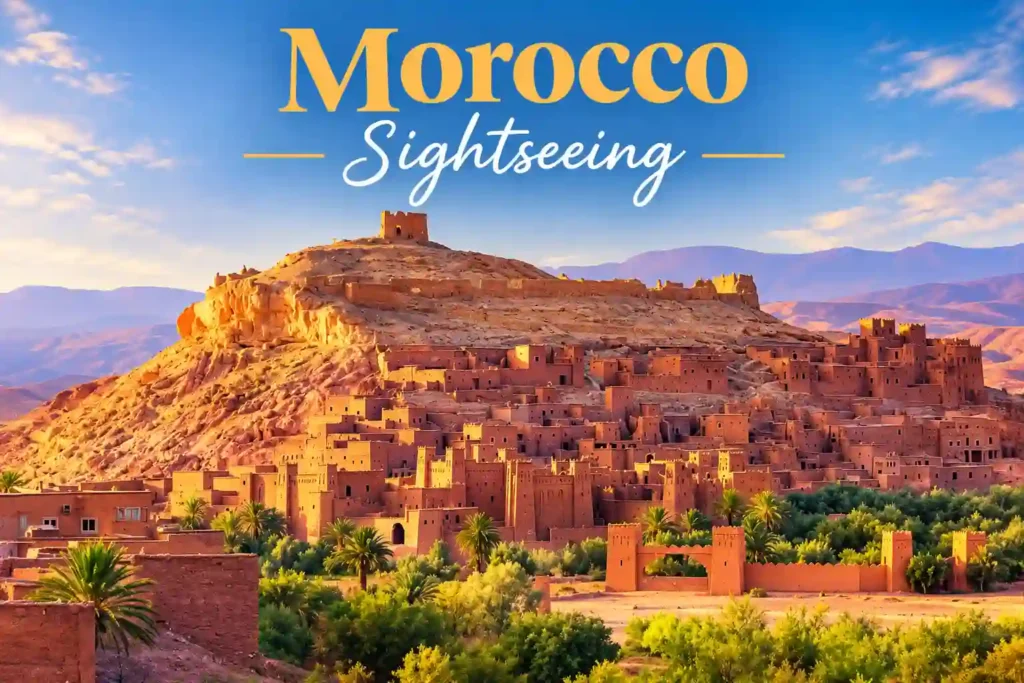
Somewhere between Marrakech and the Sahara, Ait Ben Haddou rises out of the landscape like something out of, well, a movie, which is fitting, since it’s appeared in dozens of them, Gladiator and Game of Thrones among the most recognizable. This UNESCO-listed fortified village of earthen kasbahs, built from rammed earth and straw using techniques centuries old, is best explored on foot, crossing the river (or a small footbridge, depending on water levels) and climbing up through the narrow passages to the top for a sweeping view over the valley below.
Chefchaouen: Sightseeing Without a Checklist
Chefchaouen doesn’t really work as a “landmark” city; its appeal is the town itself, every wall, door, and staircase painted in varying shades of blue, a sight that genuinely doesn’t translate fully through photos until you’re standing in it. The closest thing to a formal sightseeing stop is the Spanish Mosque, a short hike above the town, less notable for the building itself than for the sweeping view it offers back down over the entire blue medina, especially at sunset.
Essaouira: Coastal Sightseeing With a Different Rhythm
Essaouira’s sightseeing centers on its fortified 18th-century medina, a UNESCO World Heritage site built according to European military engineering principles. The Skala de la Ville, a seafront rampart lined with old cannons, is the city’s signature sightseeing walk, offering some of the best ocean views in town along with a genuine sense of the port’s defensive history. The medina’s blue-shuttered, whitewashed streets are worth simply wandering rather than following a fixed route, since much of Essaouira’s charm is architectural texture rather than individual monuments.
What Non-Muslim Visitors Should Know About Mosque Access
This comes up constantly for sightseeing travelers, so it’s worth addressing directly. In Morocco, non-Muslims generally cannot enter the interior of active mosques, a policy that applies even to famous ones like the Koutoubia in Marrakech or the Al Quaraouiyine in Fes. The major exception is the Hassan II Mosque in Casablanca, which offers guided tours to non-Muslim visitors during specific hours outside of prayer times. This isn’t a barrier so much as a different way of experiencing these buildings; admiring the exteriors, gates, and surrounding architecture is still genuinely rewarding, and it’s simply part of how sightseeing works in a country where these buildings remain active places of worship rather than museums.
Best Time of Day (and Year) for Sightseeing
Morocco’s cities get genuinely hot, especially inland ones like Marrakech and Fes, so sightseeing is generally more comfortable in the early morning or late afternoon, both for the temperature and for softer light if you’re taking photos. Seasonally, spring (March to May) and autumn (September to November) offer the most comfortable overall conditions for a sightseeing-heavy itinerary, mild enough for long days on foot without the punishing summer heat that can make an afternoon of walking between monuments genuinely exhausting.
Tangier: The North’s Overlooked Sightseeing City
Tangier tends to get treated as a transit point rather than a destination, which is a genuine shame for sightseeing purposes. The Kasbah, perched at the top of the old medina, holds the former Sultan’s palace, now the Kasbah Museum, along with narrow lanes and sweeping views over the Strait of Gibraltar, close enough on a clear day to make out the coast of Spain. A short drive out of the city, Cape Spartel marks the point where the Atlantic Ocean meets the Mediterranean Sea, with a lighthouse and dramatic cliff views, while the nearby Caves of Hercules, according to local legend, once home to the mythological hero himself, have a strange, famous opening shaped like the map of Africa when viewed from inside looking out to sea.
Museums Worth Building Into Your Sightseeing Route
Palaces and mosques tend to dominate Morocco sightseeing lists, but a handful of museums genuinely add depth to a trip. The Yves Saint Laurent Museum in Marrakech, next to Jardin Majorelle, traces the designer’s decades-long relationship with the city through his sketches, garments, and the North African influences visible throughout his work. In Fes, the Dar Batha Museum , housed in a 19th-century palace, holds an excellent collection of traditional Moroccan crafts, ceramics, woodwork, and carpets, in a setting almost as interesting as the objects themselves. And in Rabat, the Mohammed VI Museum of Modern and Contemporary Art offers a rare look at Morocco’s 20th and 21st-century art scene, a useful counterweight if your trip has otherwise been entirely historical monuments.
Gardens Beyond Jardin Majorelle
Jardin Majorelle gets most of the attention, understandably, but Marrakech has a genuinely strong bench of garden sightseeing beyond it. The Agdal Gardens , dating back to the 12th century, are a vast expanse of olive and fruit orchards built around a historic irrigation system still partly in use today, a quieter, more agricultural counterpoint to Majorelle’s manicured design. Le Jardin Secret , tucked inside the medina itself, restores a 19th-century riad garden across two distinct styles, an Islamic-style courtyard garden and an “exotic” garden, connected by a small museum on the history of Marrakech’s traditional water systems. If you only have time for one, Majorelle remains the most photogenic, but Le Jardin Secret offers the most genuine sense of what a private riad garden actually looked like historically.
Desert Kasbahs Worth a Sightseeing Stop, Beyond Ait Ben Haddou
Ait Ben Haddou gets the fame, but the route toward the Sahara is genuinely dotted with kasbahs worth a slower look. The Kasbah Amridil in the Skoura Oasis, one of the best-preserved examples in the country, appears on the 50-dirham banknote and offers a rare, detailed look inside a traditional fortified family home, complete with its original grain stores and living quarters. Further along, the Dades and Todra Gorges are lined with smaller, less-visited kasbahs built directly into the cliffside, many still inhabited by the families who’ve maintained them for generations, offering a genuinely different, quieter kind of sightseeing than the more polished, restored sites closer to Marrakech.
Guided vs. Self-Guided Sightseeing: What Actually Works Better
This is worth thinking through honestly rather than assuming one approach is always right. In Fes and Marrakech’s medinas specifically, a guide genuinely earns their fee, both cities are mazes by design, and a good guide adds historical context to buildings that often have little or no posted information. For more open sites like Volubilis, Ait Ben Haddou, or Rabat’s Kasbah des Oudaias, self-guided exploration works perfectly well, especially with a bit of reading beforehand, since the layout is easier to navigate and the sites are less densely packed with unmarked detail. A reasonable middle ground many travelers land on: guided for the medinas, self-guided (or with a driver who can offer light context) for the more open historical sites along a desert route.
A Note on Entrance Fees and Tickets
Most of Morocco’s major sightseeing stops charge a modest entrance fee, generally inexpensive by international standards, though it adds up across a multi-city trip if you’re visiting several palaces, gardens, and museums each day. Some sites, like the Bahia Palace or Jardin Majorelle, can have long queues during peak season, particularly midday, so buying tickets online in advance where available, or visiting right at opening time, saves real time better spent actually looking at the site rather than standing in line for it.
Frequently Asked Questions About Sightseeing in Morocco
Morocco’s landmarks are generally family-friendly, but a few adjustments make sightseeing with children considerably smoother. Palaces and gardens, Bahia Palace, Jardin Majorelle, the Agdal Gardens, tend to hold kids’ attention better than mosque exteriors or historical plaques, since there’s more to physically explore, courtyards, fountains, hidden corners. Ait Ben Haddou is a genuine hit with most children, since climbing through the kasbah’s narrow passageways feels more like an adventure than a history lesson. The Chouara Tannery in Fes is worth previewing with kids beforehand, the smell is intense enough to catch some off guard, though the mint sprigs handed out at the entrance help. Building in downtime, a mint tea break, a slower afternoon, between sightseeing stops matters more with children than adults, since Morocco’s cities reward a wandering pace that’s hard to sustain with a tired kid in tow.
Dress Code and Etiquette at Historic and Religious Sites
Morocco is generally relaxed about tourist dress in cities like Marrakech’s newer districts, but a bit more modesty goes a long way at religious and historic sites specifically. Covering shoulders and knees is appreciated, and sometimes required, at mosque exteriors, madrasas, and mausoleums, and it’s worth carrying a light scarf or shawl even in summer heat for spots that ask for a bit more coverage. Photography is usually fine at exteriors and open historical sites, but always worth checking for posted signs at museums and interiors, some restrict photography specifically to protect fragile artifacts or historic tilework, and a quick glance around (or a polite question to staff) avoids an awkward moment.
Night Sightseeing: A Different Version of the Same Places
A number of Morocco’s daytime sightseeing spots take on a genuinely different character after dark, and it’s worth building at least one evening into your plans around it. The Koutoubia Mosque and its gardens are lit up at night, and the surrounding area takes on a calm, more atmospheric feel than the midday crowds. Jemaa el-Fnaa itself is arguably a nighttime sight more than a daytime one, transforming from a fairly ordinary square into a full open-air food market and performance space once the sun goes down. In Fes, walking sections of the medina’s outer walls after dark, when they’re subtly lit, offer a quieter perspective on a city that can feel overwhelming during the day.
A Sample 5-Day Sightseeing-Focused Itinerary
If you want a rough framework rather than building one from scratch, here’s how a sightseeing-heavy (rather than desert-heavy) trip might realistically be structured across two of Morocco’s richest cities.
| Day | Focus |
|---|---|
| Day 1 | Arrive in Marrakech, Jemaa el-Fnaa and surrounding souks, evening rooftop sunset |
| Day 2 | Bahia Palace, El Badi Palace, Saadian Tombs, afternoon at Jardin Majorelle and Le Jardin Secret |
| Day 3 | Day trip to Ait Ben Haddou and Ouarzazate, returning to Marrakech in the evening |
| Day 4 | Travel to Fes, evening exploring the edge of Fes el Bali |
| Day 5 | Chouara Tannery, Al Quaraouiyine exterior, Bou Inania Madrasa, Dar Batha Museum |
This framework leaves room to extend with Meknes and Volubilis as a day trip from Fes, or a coastal add-on to Essaouira from Marrakech, depending on how many days you actually have.
Frequently Asked Questions About Sightseeing in Morocco
What are the must-see sightseeing spots in Morocco? Bahia Palace and Jardin Majorelle in Marrakech, the Chouara Tannery and Al Quaraouiyine in Fes, the Hassan II Mosque in Casablanca, and Ait Ben Haddou on the route to the Sahara are consistently the highest-value stops.
Can tourists enter mosques in Morocco? Generally no, with one major exception: the Hassan II Mosque in Casablanca offers guided interior tours for non-Muslim visitors.
How many days do you need for good sightseeing coverage of Morocco? A solid sightseeing-focused trip covering Marrakech, Fes, and a stop like Ait Ben Haddou or the Sahara typically takes 7 to 10 days, though a shorter 4-5 day trip can still cover one or two cities properly.
Is Meknes worth visiting for sightseeing, or is Fes enough? If your route passes nearby, Meknes and Volubilis together are genuinely worth the extra day, offering a walkable imperial city and Morocco’s best Roman ruins without Fes’s crowds.
Do I need a guide for sightseeing in Morocco? Not strictly, but a guide adds real value in Fes and Marrakech’s medinas specifically, both for navigation in genuinely maze-like streets and for historical context you’d otherwise miss at unmarked or minimally-labeled sites.
Final Thoughts
Sightseeing in Morocco isn’t really about racing through a checklist; it rewards slowing down at the handful of places that actually matter to you rather than rushing through everything the internet says you should see. Whether that’s spending an unhurried hour in Bahia Palace’s carved courtyards, standing quietly at Volubilis while storks nest overhead, or simply letting Chefchaouen’s blue streets be the whole point rather than a backdrop for a single photo, the best Morocco sightseeing trips leave room for the places to actually sink in.
Ready to See It for Yourself?
Once the landmarks pull you in, the rest of Morocco, especially the Sahara, is worth building into the same trip.
- Morocco desert tours covering the full range of routes and experiences across the country.
- Marrakech desert tours for travelers starting in Marrakech.
- Fes desert tours for a route through the imperial cities and beyond.
- Ouarzazate desert tours for a shorter path into the south.
- Tangier desert tours for trips starting in the north.
Not sure how to fit the sightseeing and the desert into one trip? Check our Morocco itineraries page, or contact us and we’ll help you build a route around the landmarks that matter most to you.