
Volubilis, Morocco: The Complete Guide to the Country’s Best Roman Ruins
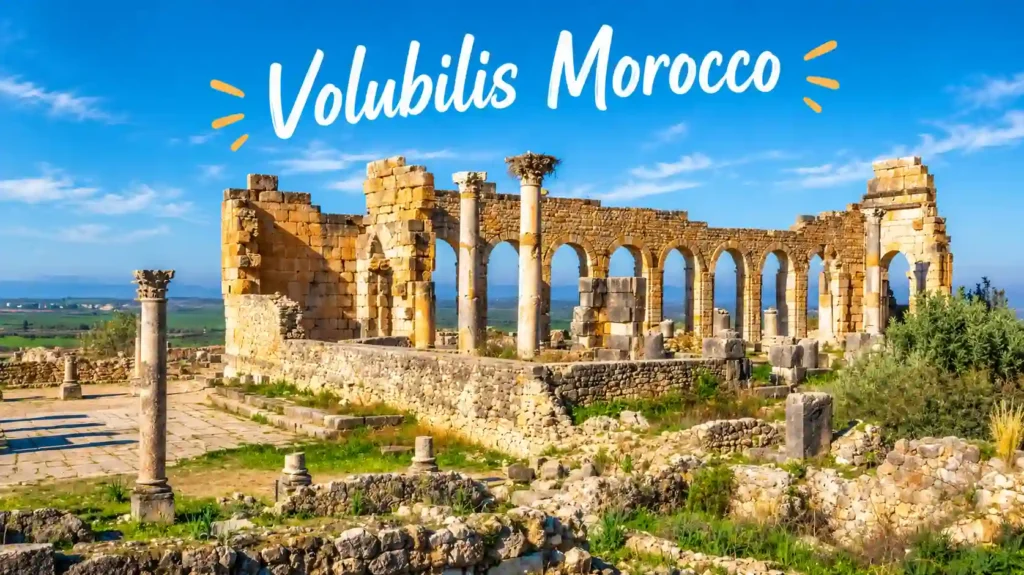
Most people picture Roman ruins in Italy, Greece, or maybe Tunisia, not tucked into the fertile hills of northern Morocco. Yet Volubilis is genuinely one of the best-preserved Roman sites anywhere in North Africa, with mosaics still vivid enough to photograph well, columns still standing after two thousand years, and a setting so peaceful it feels almost accidental that more travelers haven’t found it yet. This guide covers everything: what Volubilis actually is, its layered history, what you’ll see when you visit, and how to fit it into a wider Morocco trip.
Quick Facts About Volubilis
| Fact | Detail |
|---|---|
| Location | Near Moulay Idriss Zerhoun, about 30 km from Meknes and 60 km from Fes |
| UNESCO status | World Heritage Site since 1997 |
| Site size | About 42 hectares |
| Founded | 3rd century BC (as capital of the Kingdom of Mauretania) |
| Roman period began | 1st century AD |
| Peak population | Around 20,000 residents |
| Excavated | Roughly 50% of the site |
| Typical visit length | 2-3 hours |
What Exactly Is Volubilis?
Volubilis is an archaeological site containing the remains of a fortified Roman city, built on a commanding position at the foot of Jebel Zerhoun. It’s widely considered the main Roman ruin in Africa and stands as a genuine symbol of Morocco’s layered cultural history, with traces of successive civilizations, Berber, Punic, Roman, Christian, and Islamic, all represented at the same site. Unlike a ruin that’s been continuously built over or heavily restored, Volubilis was abandoned for nearly a thousand years, which is a big part of why it retains such a high level of authenticity today.
A History That Goes Back Further Than Rome
Although it’s known primarily as a Roman site, Volubilis is actually considerably older than its Roman occupation. The settlement was founded around the 3rd century BC and served as the capital of the Kingdom of Mauretania before the Romans arrived in earnest. Under Juba II, King of Mauretania around 23 AD, a scholarly ruler who spoke Latin and Greek, published a treatise on Roman archaeology, and married Cleopatra Selene (daughter of Cleopatra of Egypt and Mark Antony), the city flourished as a center of arts and science, and many of the mosaics uncovered today depicting Greek mythology date from his rule. When Juba II’s successor died, Mauretania was formally annexed by Rome, and Volubilis became a source of olive oil and wheat for the wider Roman economy, evidence of this agricultural industry, including numerous olive presses, is still visible among the ruins today.
At its height, the city was home to around 20,000 residents and featured grand civic structures: a basilica, a triumphal arch, and lavish villas decorated with intricate mosaics. After Rome withdrew from the region around 285 AD, Volubilis didn’t simply disappear, it remained inhabited and even served as the first capital of Idris I, founder of Morocco’s Idrisid dynasty and the country’s first independent Islamic state, in the late 8th century. By the 11th century, though, the city had been largely abandoned, leaving its ruins remarkably undisturbed for the better part of a millennium.
Why Volubilis Earned UNESCO Recognition
Volubilis was inscribed as a UNESCO World Heritage Site in 1997, recognized for its outstanding preservation of Roman frontier architecture and its role as a genuine cultural crossroads. Covering 42 hectares, the site is considered of outstanding importance for demonstrating urban development and “Romanization” at the edges of the Roman Empire, offering a clear, physical illustration of how Roman and indigenous cultures interfaced with one another. Its long isolation and near-thousand-year gap without occupation gave it an unusually high level of authenticity, and the site has produced substantial artistic material, mosaics, marble and bronze statuary, and hundreds of inscriptions, that continue to inform historians’ understanding of Roman North Africa.
What You’ll Actually See at the Site
Volubilis rewards visitors with a genuinely dense concentration of well-preserved structures, especially considering only about half the site has been excavated so far.
The Triumphal Arch of Caracalla is one of the most photographed structures on site, built to honor the Roman emperor and marking a clear entry point into the city’s most significant civic architecture.
The Basilica and Capitol Temple represent the city’s administrative and religious core, giving a strong sense of how a Roman provincial capital organized its public life.
The House of Orpheus and House of Venus, along with several other wealthy residential villas, are where the site’s best mosaics are found, intricate floor artwork depicting mythological scenes, remarkably vivid even after two thousand years underground and exposed to the elements.
Olive presses scattered throughout the site are a quieter but genuinely fascinating detail, direct physical evidence of the agricultural economy that made Volubilis valuable to Rome in the first place.
Because there are relatively few information signs on-site, hiring a guide at the entrance, generally available for a reasonably priced tour lasting about an hour, adds real value if you want the history behind what you’re actually looking at rather than just admiring photogenic stonework.
The View That Comes With It
Part of what makes Volubilis special isn’t just the ruins themselves, it’s the setting. The site sits amid rolling hills and fertile farmland, a landscape that connects naturally to the city’s agricultural past, and on a clear day, you can see the sacred hilltop town of Moulay Idriss Zerhoun in the distance, adding a genuine sense of spiritual and historical depth to the view. Unlike Morocco’s busier, more crowded attractions, Volubilis tends to feel peaceful and unhurried, letting visitors explore at their own pace rather than navigating around large tour groups.
Moulay Idriss Zerhoun: The Natural Pairing
Most visits to Volubilis are paired with a stop in nearby Moulay Idriss Zerhoun, and for good reason. This hillside town is named after and holds the tomb of Moulay Idriss I, an enormously significant figure in Moroccan history, who fled the Abbasid Caliphate in the late 8th century, arrived in Morocco, and with the support of local Berber tribes, established the authority that laid the foundation for an independent Moroccan state and the Idrisid dynasty. His tomb remains a highly revered pilgrimage site for Moroccans today, and the town itself, with its whitewashed hillside houses, offers a genuinely worthwhile stop either before or after exploring the ruins just down the road.
How to Get to Volubilis
Volubilis sits about 30 km from Meknes and roughly 60 km from Fes, making it an easy half-day trip from either imperial city. Most visitors arrange a taxi, private driver, or join a small group tour from Meknes or Fes, often combined with a stop in Moulay Idriss Zerhoun along the same route. If you’re driving independently, the roads connecting these towns are generally well-maintained and straightforward to navigate.
Best Time to Visit
Spring is generally considered the best season to visit, when wildflowers and greenery surround the excavation site, adding a layer of natural beauty to the ancient stonework that isn’t there in drier months. That said, the site is worth visiting in any season. Whenever you go, bring a hat, sunglasses, and plenty of water, ideally in a refillable bottle, since there’s minimal shade across most of the site and a proper visit involves a fair amount of walking on open, sun-exposed ground.
Volubilis Mosaics
The mosaics are, for most visitors, the single biggest highlight of a Volubilis trip, and they’re spread across several of the site’s grandest former homes.
The Orpheus Mosaic
Found in the House of Orpheus, this mosaic depicts the mythological musician Orpheus charming wild animals with his lyre, one of the best-known and most photographed pieces at the entire site.
The Labours of Hercules Mosaic
Located in a separate villa, this mosaic illustrates the twelve labours of Hercules in a sequence of small panels, a genuinely impressive piece of storytelling rendered entirely in small stone and glass tesserae.
The Bathing Nymphs Mosaic
Found in the House of the Bathing Nymphs, this mosaic shows a mythological bathing scene and remains one of the better-preserved decorative floors on site, giving a real sense of how wealthy Roman households used art to display status.
Volubilis Opening Hours and Entrance Fee
Volubilis is open daily, typically from early morning until sunset, with slightly shorter hours in winter months. Entrance fees are modest by international standards, and hiring an official guide at the entrance costs a separate, reasonably priced fee, generally well worth it given the limited signage across the site. It’s worth bringing small cash for both the entrance fee and a guide, since card payment isn’t always reliably available on-site.
Volubilis vs Other Roman Ruins in North Africa
Travelers who’ve also visited sites like Carthage in Tunisia or Leptis Magna in Libya sometimes wonder how Volubilis compares. Volubilis is smaller in scale than Carthage but arguably better preserved in terms of visible mosaics still in their original location rather than moved to a museum. Leptis Magna is considered by many historians to be more monumental in scale, but its remote location in Libya makes it far less accessible to travelers than Volubilis, which sits an easy hour from Fes. For a North Africa trip focused specifically on Morocco, Volubilis is simply the best and most convenient Roman site available, and it holds its own respectably even against the region’s larger, more famous ruins.
Things to Do Near Volubilis
Visit Moulay Idriss Zerhoun
As covered earlier, this hillside pilgrimage town sits just a few minutes from Volubilis and pairs naturally with a visit to the ruins.
Explore Meknes
Morocco’s most underrated imperial city, with its massive Bab Mansour gate and walkable medina, sits about 30 km away and is easily combined with Volubilis in a single day trip.
Stop in Fes
For travelers based in Fes, Volubilis makes for a rewarding half-day or full-day excursion, often combined with Meknes for a fuller day covering both Roman and Islamic imperial history.
Volubilis Facts You Might Not Know
A few details about Volubilis surprise even travelers who’ve already done their research. The site was formally excavated starting in the early 20th century under the French Protectorate, and excavation work has continued gradually ever since, currently led in part by University College London alongside Moroccan archaeological institutions. Roughly half of the 42-hectare site still remains unexcavated, meaning new discoveries are genuinely still possible in the years ahead. And a well-preserved bust of the Roman philosopher Cato the Younger was found still sitting on its original pedestal, a small but striking detail of just how undisturbed parts of this site remained for nearly a thousand years.
The Storks of Volubilis
One small but memorable detail travelers often mention after visiting: storks nesting on top of the ruins’ tallest columns and arches. These large white birds build their nests directly on ancient Roman stonework, creating a genuinely striking visual, modern wildlife perched on two-thousand-year-old architecture, and their presence has become almost as much a symbol of Volubilis as the mosaics themselves. Spring is typically the best time to see nesting storks actively raising chicks, adding another reason the season is considered the ideal time to visit.
What to Wear and Bring to Volubilis
A few practical packing notes make a real difference on-site. Comfortable walking shoes matter more than people expect, the ground is uneven ancient stone and gravel paths rather than a paved museum floor. A hat, sunscreen, and sunglasses are genuinely necessary given how little shade exists across the open site, especially in the warmer months. A refillable water bottle is worth carrying, since there’s minimal shopping or refreshment available on-site itself. And a small amount of cash covers both the entrance fee and an optional guide, since card payment isn’t always dependable this far from a major city center.
Best Photo Spots at Volubilis
If photography is part of why you’re visiting, a few specific spots consistently deliver the best results. The Triumphal Arch of Caracalla, especially photographed from a slight distance with the surrounding hills in the background, is the classic, most-shared image of the site. The House of Orpheus and House of Venus offer the best close-up mosaic photography, though a wide, level angle usually captures the detail better than a straight overhead shot. And for a wider, more atmospheric shot, climbing to one of the site’s higher vantage points and looking back toward Moulay Idriss Zerhoun in the distance captures both the ruins and the surrounding landscape in a single frame.
Volubilis Weather by Season
Since the site offers little shade, timing your visit around the weather matters more here than at some of Morocco’s other attractions. Spring (March-May) offers the most comfortable temperatures alongside the wildflowers and nesting storks mentioned earlier, generally considered the ideal season. Summer (June-August) can get genuinely hot with little relief from shade, an early morning visit is considerably more comfortable than a midday one during this season. Autumn (September-November) offers a similar mild, pleasant experience to spring, without quite the same wildflower bloom. Winter (December-February) stays mild during the day but can be cool and occasionally damp, still a perfectly good time to visit with a light jacket on hand.
Frequently Asked Questions About Volubilis Morocco
How long does it take to visit Volubilis? Around two to three hours is generally enough to see the main structures and mosaics, longer if you’re touring with a guide who adds historical context along the way.
Is Volubilis worth visiting? Yes, it’s widely regarded as the most significant Roman archaeological site in Morocco and a UNESCO World Heritage Site, with mosaics and ruins that rival sites found in Europe.
Do I need a guide to visit Volubilis? It’s not required, but genuinely recommended, there are very few information signs on-site, and a guide adds real depth to understanding what you’re looking at.
How far is Volubilis from Fes? About 60 km, roughly an hour’s drive, making it an easy half-day or full-day trip when combined with Meknes and Moulay Idriss Zerhoun.
What is the best time of year to visit Volubilis? Spring, when wildflowers and greenery surround the site, though it’s a rewarding visit in any season with proper sun protection.
Can I combine Volubilis with other sites in one day? Yes, it’s most commonly visited alongside Meknes and Moulay Idriss Zerhoun, all conveniently close together in the same region.
Final Thoughts
Volubilis doesn’t get nearly the same attention as Marrakech’s medina or the Sahara’s dunes, and that’s honestly part of its appeal. Standing among two-thousand-year-old columns and mosaics, with storks nesting overhead and rolling farmland stretching out in every direction, offers a genuinely different, quieter kind of Morocco experience than the country’s busier tourist circuit. For anyone with an interest in history, or simply a route that passes through Fes or Meknes, it’s a stop well worth the detour.
Ready to Add Volubilis to Your Morocco Trip?
Volubilis fits naturally into a route through Morocco’s imperial cities, and pairs well with a wider itinerary that includes the Sahara or the Atlas Mountains.
- Tours from Fes for a route through Morocco’s imperial cities, including a stop at Volubilis, on the way to the Sahara.
- Morocco Desert Tours covering the full range of routes and experiences across the country.
- Tours from Marrakech for travelers starting in Marrakech.
- Tours from Ouarzazate for a shorter path into the south.
- Tours from Tangier for trips starting in the north.
- Tours from Casablanca for travelers wanting a custom route starting from Morocco’s largest city.
Not sure how to fit Volubilis into your route? Contact us and we’ll help you plan a trip that includes this remarkable piece of Roman history.