
Is Morocco in Europe? The Simple Answer and the Surprising Story
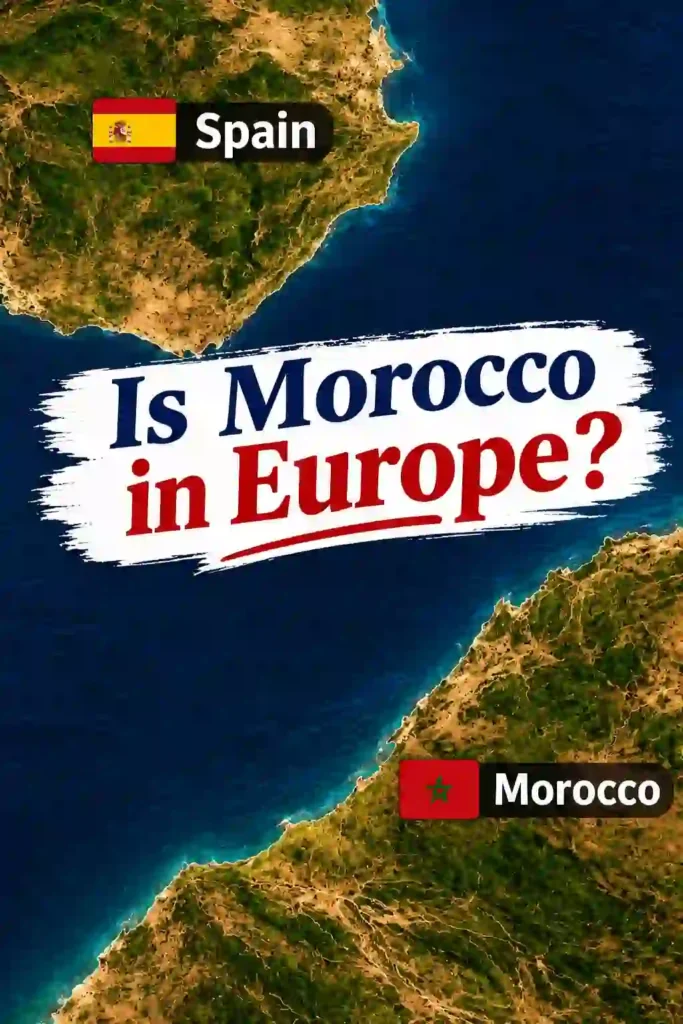
It is one of the most searched questions about Morocco: Is Morocco in Europe? The short answer is no. Morocco is in North Africa. But the full answer is much more interesting, because Morocco is closer to Europe than any other African country, and the two have shared history, trade, culture and even mountains for thousands of years.
From some beaches near Tangier, you can see Spain with your own eyes. Morocco once even asked to join the European Community. We cover everything: where Morocco is on the map, why some people think it is European, how close it really is to Europe, what Morocco shares with Europe and what makes it clearly African and Arab-Amazigh, plus practical tips for travelers who want to combine Europe and Morocco in one trip.
Is Morocco in Europe? Quick Answer
| Question | Answer |
|---|---|
| Is Morocco in Europe? | No, Morocco is in North Africa |
| Which continent? | Africa |
| Region | North Africa, part of the Maghreb |
| Distance to Europe | About 14 km at the narrowest point of the Strait of Gibraltar |
| Closest European country | Spain |
| Is Morocco in the EU? | No, but it has a special “advanced status” with the EU |
| Did Morocco apply to join? | Yes, in 1987, but it was refused because it is not a European country |
| Currency | Moroccan dirham, not the euro |
| Football confederation | Africa (CAF) |
| Member of the African Union? | Yes, since rejoining in 2017 |
Where Is Morocco on the Map?
Morocco is in the northwest corner of Africa. It has coastlines on two seas: the Mediterranean Sea in the north and the Atlantic Ocean in the west. It is the only African country with coastlines on both. To the east, it borders Algeria, and to the south lies the Sahara region and Mauritania.
With a population of around 37 million people, Morocco is one of the largest countries in North Africa, with big modern cities, ancient medinas, high mountains and a long desert south.
Morocco is part of the Maghreb, an Arabic word meaning “the place where the sun sets” or “the west”. The Maghreb also includes Algeria, Tunisia, Libya and Mauritania. In Arabic, Morocco’s name is Al-Maghrib, “the farthest west” of the Arab world. For more, read our guides Is Morocco a country? and countries close to Morocco.
Why Do Some People Think Morocco Is in Europe?
If Morocco is clearly in Africa, why do so many people ask this question? There are several good reasons:
- It is very close to Spain. Only about 14 km of sea separate the two continents.
- European cities on the African coast. Ceuta and Melilla, two cities on the Moroccan coast, are administered by Spain.
- Short flights from Europe. Many European cities are only 2 to 4 hours away by plane.
- Same time zone as much of Europe. Morocco uses UTC+1 most of the year, like Paris, Madrid and Rome in winter.
- European languages are common. French and Spanish are widely spoken.
- Strong ties with the EU. Europe is Morocco’s biggest trading partner.
- Morocco took part in Eurovision. Yes, really, once, in 1980.
A note on time zones: Morocco uses UTC+1 for most of the year. In winter, this is the same time as Paris, Madrid and Rome. But in summer, when Europe moves its clocks forward, Morocco stays on UTC+1, so it is one hour behind Spain and France. And during Ramadan, Morocco moves back to UTC+0. If you are taking a ferry or a flight between Spain and Morocco, always check which time zone your ticket uses, because this small detail confuses many travelers every year.
All these links make Morocco feel close to Europe, especially for European travelers. But geographically, politically and culturally, Morocco is an African country with Arab, Amazigh and Mediterranean influences.
10 Surprising Facts About Morocco and Europe
Here are the 10 facts our travelers find the most surprising when we talk about Morocco and Europe during our tours:
- You can see Europe from Africa. On clear days, the Spanish coast is visible from near Tangier.
- Morocco asked to join Europe. In 1987, King Hassan II’s government applied to the European Communities and was refused.
- Gibraltar has a Moroccan story. Its name comes from Jabal Tariq, after the commander who crossed from North Africa in 711.
- Marrakech and Seville have “sister” towers. The Koutoubia and the Giralda were built by the same Almohad dynasty.
- The EU has land borders in Africa. Ceuta and Melilla, on the Moroccan coast, are Spanish cities.
- Morocco sang at Eurovision. In 1980, it became the only African country ever to compete, with a song in Arabic.
- The same monkeys live on both continents. Barbary macaques live in Morocco and on the Rock of Gibraltar.
- Morocco will co-host a World Cup with Europe. The 2030 FIFA World Cup is shared by Morocco, Spain and Portugal.
- Many Moroccan cities have European names. Casablanca (Spanish for “white house”) and Essaouira’s old name Mogador come from European languages.
- Moroccan and European wildlife cross the strait. Thousands of migrating birds, like storks and eagles, fly over the Strait of Gibraltar between the two continents every spring and autumn.
How Close Is Morocco to Europe?
Very close. At the narrowest point of the Strait of Gibraltar, Morocco and Spain are only about 14 kilometers apart. This strait connects the Mediterranean Sea with the Atlantic Ocean and is one of the busiest sea routes in the world.
| Route | Approximate distance or time |
|---|---|
| Narrowest point of the Strait | About 14 km |
| Ferry Tarifa to Tangier | About 1 hour |
| Ferry Algeciras to Tanger Med | About 1 to 1.5 hours |
| Flight Madrid to Marrakech | About 1.5 hours |
| Flight Paris to Marrakech | About 3 hours |
| Flight London to Marrakech | About 3.5 hours |
On a clear day, from Cap Spartel or the coast road east of Tangier, you can see the mountains of southern Spain across the water. Standing in Africa and looking at Europe is one of the most special moments of a trip to northern Morocco. See our guide where is Tangier and how long is the flight to Morocco.
Tangier and the Pillars of Hercules: Where Two Continents Meet
In ancient Greek and Roman legends, the two mountains on each side of the Strait of Gibraltar were called the Pillars of Hercules. On the European side stands the Rock of Gibraltar. On the African side, the most common candidate is Jebel Musa, a dramatic mountain on the Moroccan coast between Tangier and Ceuta. For the ancient world, these pillars marked the edge of the known world.
Near Tangier, you can also visit the Caves of Hercules at Cap Spartel. According to local legend, Hercules rested here after separating Europe and Africa. One opening of the cave looks out to the Atlantic in a shape that many people say looks like the map of Africa. A short drive away, the lighthouse of Cap Spartel stands at the point where the Atlantic Ocean meets the Mediterranean Sea. It is one of the best places in Morocco to feel how close the two continents are.
Will There Be a Tunnel Between Morocco and Spain?
For decades, Morocco and Spain have studied the idea of a fixed link under the Strait of Gibraltar, most often a railway tunnel similar to the Channel Tunnel between France and the UK. The project has been discussed again in recent years, especially with the 2030 World Cup shared by Morocco, Spain and Portugal. However, the strait is deep, the currents are strong and the geology is complex, so for now there is no confirmed opening date. Until then, ferries and flights remain the way to cross.
Morocco and the European Union
Morocco Applied to Join in 1987
Here is a fact that surprises many people: in July 1987, Morocco officially applied to join the European Communities, the organization that later became the European Union. The application was refused because Morocco was not considered a “European state”, and only European countries can join according to the treaties.
A Special “Advanced Status”
Even without membership, Morocco has one of the closest relationships with the EU of any non-European country. In 2008, the EU gave Morocco an “advanced status”, often described as “more than association, less than membership”. Morocco and the EU cooperate on trade, energy, education, security and migration, and the first EU-Morocco summit took place in 2010 in Granada, Spain. Europe is by far Morocco’s biggest trading partner.
What This Means for Travelers
Because Morocco is not in the EU or the Schengen area, you go through passport control when you travel between Europe and Morocco, even on a one-hour ferry. Many nationalities, including citizens of EU countries, the UK, the USA and Canada, can usually visit Morocco without a visa for short stays, but rules depend on your passport, so always check before you travel.
Ceuta and Melilla: Europe on African Soil
One of the most unusual geographic facts in the region: on the northern coast of Morocco, there are two cities administered by Spain, Ceuta and Melilla. They are part of the European Union, use the euro and are the only land borders between the EU and Africa. Morocco considers them Moroccan and has long claimed them, while Spain considers them Spanish cities. There are also a few small Spanish islands and rocks near the Moroccan coast.
Ceuta is very close to Tetouan and Tangier, and Melilla is near Nador. Crossing these land borders can be slow and busy, and the rules for visitors change from time to time, so check the latest information if you plan to visit them.
Morocco and Europe Through the Centuries
The relationship between Morocco and Europe is thousands of years old. Here are the key moments, in a simple timeline:
| Period | What happened | What you can see today |
|---|---|---|
| Antiquity | Phoenicians, Carthaginians and later Romans traded and built cities in Morocco | The Roman ruins of Volubilis near Meknes |
| 711 | Tariq ibn Ziyad crossed to Spain | The Rock of Gibraltar, named after him |
| 8th to 15th century | Al-Andalus: Moroccan dynasties ruled parts of Spain | The Koutoubia, Hassan Tower and the Giralda in Seville |
| After 1492 | Andalusian Muslims and Jews settled in Morocco | The medinas of Fes, Tetouan and Chefchaouen |
| 15th to 18th century | Portuguese built forts on the Atlantic coast | The Portuguese City of El Jadida, the ramparts of Asilah |
| 1912 to 1956 | French and Spanish protectorates; Tangier became an international zone | Art Deco Casablanca, Spanish buildings in Tetouan and Tangier |
| 1956 | Morocco became independent | A modern country with strong European ties |
What Morocco Shares With Europe
A Long Shared History
In 711, an army led by the commander Tariq ibn Ziyad crossed from North Africa to the Iberian Peninsula. The famous Rock of Gibraltar takes its name from him: Jabal Tariq, “the mountain of Tariq”. For almost 800 years, a large part of Spain and Portugal, called Al-Andalus, was ruled by Muslim dynasties, several of them from Morocco, like the Almoravids and the Almohads.
This shared history is still visible today, and many Spanish and Portuguese words even come from Arabic, like the Spanish “aceite” (oil) and “azúcar” (sugar). The Koutoubia in Marrakech, the Hassan Tower in Rabat and the Giralda in Seville were built by the same Almohad dynasty and look like sisters. When Muslims and Jews left Spain after 1492, many settled in Moroccan cities like Fes, Tetouan, Chefchaouen and Rabat, bringing Andalusian music, architecture and recipes.
Mountains That Belong to the Same Family
Geologically, Morocco sits on the African plate, but the Rif Mountains in northern Morocco and the mountains of southern Spain are part of the same mountain arc that curves around the Strait of Gibraltar. Millions of years ago, the two continents were connected in this area, and the Mediterranean was even cut off from the Atlantic for a time.
Monkeys on Both Sides
The Barbary macaque lives in the cedar forests of the Middle Atlas in Morocco, and a small population also lives on the Rock of Gibraltar, where they are the only wild monkeys in Europe. They are a living symbol of how close the two continents are.
Languages, Food and Daily Life
Because of the French protectorate and the Spanish presence in the north and south, French and Spanish are widely spoken in Morocco. You will see French on many signs, menus and official documents, and older people in Tetouan or Tangier often speak Spanish. European-style cafés, bakeries and pastries are part of daily life in Moroccan cities. Learn more in our guide to the languages of Morocco.
What Makes Morocco Clearly African and Arab-Amazigh
Despite all these links, Morocco has its own strong identity that is not European:
- Geography: Morocco is on the African continent, with the Sahara Desert in the south and the Atlas Mountains in the center.
- Amazigh roots: the Amazigh (Berber) people have lived in North Africa for thousands of years, and Tamazight is an official language.
- Arab and Islamic culture: Arabic is an official language, and Islam is the religion of the state. Read Is Morocco a Muslim country?.
- African institutions: Morocco is a member of the African Union and plays football in the Confederation of African Football. It hosted the Africa Cup of Nations in 2025.
- Saharan and African connections: for centuries, caravans linked Morocco with West Africa, bringing gold, salt and culture. Gnaoua music has roots in sub-Saharan Africa.
- Its own currency: the Moroccan dirham, not the euro.
For European Travelers: What Feels Familiar and What Feels New
What Feels Familiar
- Short flights and often the same time zone as home in winter.
- French spoken in many shops, hotels and offices, and Spanish in the north.
- Modern trains, highways, cafés, croissants and supermarkets in big cities.
- A Mediterranean lifestyle, with long lunches, terraces and evening walks.
- Similar electric plugs to most of continental Europe.
What Feels New
- The call to prayer five times a day and the rhythm of Islamic life.
- Bargaining in the souks instead of fixed prices.
- The maze-like medinas, with donkeys carrying goods through narrow streets.
- Amazigh villages, kasbahs and the immense landscapes of the Sahara.
- A different currency, the dirham, and a cash-based daily life.
This mix is exactly why so many Europeans choose Morocco: it is close and easy to reach, yet it feels like a completely different world.
How Moroccans See Their Own Identity
If you ask Moroccans whether they feel European, most will smile and say no: they are Moroccan. The Moroccan constitution describes a national identity built from many parts: Arab-Islamic, Amazigh and Saharan-Hassani, enriched by African, Andalusian, Hebrew and Mediterranean influences. Many Moroccans have family members living in France, Spain, Belgium, the Netherlands or Italy, and they feel close to Europe in daily life, but their roots, language, faith and traditions are Moroccan and African.
Morocco vs Europe: Key Differences for Travelers
| Topic | Morocco | Most of Europe |
|---|---|---|
| Continent | Africa | Europe |
| Currency | Moroccan dirham | Euro and other currencies |
| Main languages | Arabic, Tamazight, French | Local European languages |
| Religion | Mostly Muslim | Mostly Christian or secular |
| Weekend | Saturday and Sunday (Friday is the main prayer day) | Saturday and Sunday |
| Shopping | Bargaining in souks is normal | Mostly fixed prices |
| Driving | On the right | On the right (except UK and Ireland) |
| Plugs | Type C and E, 230V | Similar in continental Europe |
| Schengen area | No | Many countries, yes |
Morocco’s Place in the World: Africa, the Arab World and the Mediterranean
Morocco is a country at a crossroads. It belongs to several worlds at the same time, which is part of what makes it unique:
- Africa: Morocco is a member of the African Union, which it rejoined in 2017, and has strong economic links with West Africa.
- The Arab world: Morocco is a member of the Arab League, and Arabic is one of its official languages.
- The Amazigh world: millions of Moroccans speak Tamazight, and Amazigh culture is part of the national identity.
- The Mediterranean: Morocco is a member of the Union for the Mediterranean, together with EU countries and other Mediterranean nations.
- The Islamic world: Morocco is a member of the Organisation of Islamic Cooperation.
This mix explains why Moroccans often describe their country as a bridge: between Africa and Europe, between the Atlantic and the Mediterranean, and between tradition and modernity.
Is Morocco Considered a Western Country?
It depends on what you mean by “Western”. Geographically, Morocco is the most western country of the Arab world; its very name in Arabic means “the west”. But in the cultural and political sense often used in the media, “Western” usually means Europe, North America and similar countries, and Morocco is not part of that group.
In daily life, travelers find a mix. Big cities like Casablanca, Rabat and Tangier feel modern, with malls, high-speed trains, international brands and café culture. At the same time, the medinas, the countryside and the desert keep traditions that feel very different from Europe. This balance is one of the main reasons people love visiting Morocco.
Is the Weather in Morocco Like Southern Europe?
Partly. Northern Morocco and the Atlantic coast have a Mediterranean-type climate similar to southern Spain or Portugal: mild, rainy winters and warm, dry summers. Tangier, Rabat and Casablanca can feel quite similar to Malaga or Lisbon. But the further south and inland you go, the more different it becomes. The Atlas Mountains get snow in winter, Marrakech is much hotter in summer, and the Sahara has a true desert climate with very hot days and cold nights.
For details by city and month, read our guides to the weather in Tangier and the best time to visit Morocco.
Driving From Europe to Morocco
Many Europeans, and many Moroccans living in Europe, drive to Morocco with their own car. The usual route is through Spain to the ports of Algeciras or Tarifa, then by ferry to Tanger Med or Tangier. At the Moroccan port, you go through passport control and customs, and your car is registered for temporary entry. Make sure your car insurance covers Morocco, carry your registration documents, and expect long queues in summer. Once in Morocco, you drive on the right, and highways connect Tangier with Rabat, Casablanca, Fes, Marrakech and Agadir.
Where to Feel Europe and Africa in Morocco
One of the best ways to understand Morocco is to visit places that show both sides of its story. Here are our favorites:
Places With a European Touch
- Tangier: views of Spain, the old international zone and the Cap Spartel lighthouse.
- Tetouan: a white medina with Andalusian heritage and Spanish colonial buildings.
- Asilah: Portuguese ramparts and whitewashed streets by the Atlantic.
- El Jadida: the Portuguese City and its famous underground cistern.
- Casablanca: Art Deco boulevards from the early 20th century.
Places That Show Morocco’s African Heart
- Merzouga and Zagora: the golden dunes and nomad culture of the Sahara.
- Khamlia: the Gnaoua village near Merzouga, with music rooted in sub-Saharan Africa.
- Aït Ben Haddou: an earthen ksar on the old caravan route.
- The Draa Valley: palm groves and kasbahs once linked to trans-Saharan trade.
- Rissani: near the ruins of Sijilmassa, once a great caravan city.
A trip that starts in Tangier and ends in the Sahara is like traveling from the doorstep of Europe to the heart of Africa in just a few days.
Combining Spain and Morocco in One Trip
Because they are so close, many travelers combine southern Spain and Morocco in one trip. It is an remarkable way to see how two continents meet. Here is an easy idea:
| Day | Route |
|---|---|
| Days 1 to 3 | Seville, Granada and the Alhambra in Andalusia |
| Day 4 | Drive to Tarifa, ferry to Tangier (about 1 hour) |
| Day 5 | Tangier and the blue town of Chefchaouen |
| Days 6 to 7 | Fes, the oldest imperial city |
| Days 8 to 9 | Through the Middle Atlas to the Sahara and Merzouga |
| Days 10 to 11 | Dades, Todra, Ouarzazate and Aït Ben Haddou to Marrakech |
Tip: Ferries can be crowded in summer, especially in July and August when many Moroccans living in Europe travel home. Book in advance and arrive early at the port. For flights, see our guide to cheap flights to Morocco from the USA.
Common Myths About Morocco and Europe
| Myth | Fact |
|---|---|
| Morocco is in Europe | Morocco is in North Africa |
| Morocco is part of the EU | No, but it has an advanced status with the EU |
| Morocco uses the euro | It uses the Moroccan dirham |
| Morocco is a Middle Eastern country | It is in North Africa, though it shares Arab culture |
| Morocco is all desert | It has mountains, forests, beaches and green valleys |
| You need a visa from Spain to enter Morocco | Moroccan entry rules depend on your passport, not on Spain |
Quick Cheat Sheet: Is Morocco in Europe?
- Morocco is in North Africa, not Europe
- Only 14 km from Spain across the Strait of Gibraltar
- Applied to join the European Communities in 1987, refused
- Has an advanced status with the EU since 2008
- Ceuta and Melilla are Spanish cities on the Moroccan coast
- Uses the Moroccan dirham, not the euro
- Member of the African Union and plays in African football
- Took part in Eurovision once, in 1980
Frequently Asked Questions
Is Morocco in Europe or Africa?
Morocco is in Africa, in the northwest of the continent, in the region called the Maghreb.
How far is Morocco from Europe?
About 14 km at the narrowest point of the Strait of Gibraltar, between Morocco and Spain.
Is Morocco part of the European Union?
No. Morocco applied in 1987 but was refused. It has a special advanced status with the EU since 2008.
Can you see Europe from Morocco?
Yes, on clear days you can see the Spanish coast from near Tangier.
Is Morocco a Middle Eastern country?
No. Morocco is in North Africa, although it is part of the Arab world and the Arab League.
Does Morocco use the euro?
No. The currency is the Moroccan dirham.
Is Morocco in the Schengen area?
No. You pass through passport control between Europe and Morocco.
Can I take a ferry from Spain to Morocco?
Yes. Ferries connect Tarifa and Algeciras to Tangier and Tanger Med, in about one to one and a half hours.
Did Morocco participate in Eurovision?
Yes, once, in 1980, with an Arabic song. It is still the only African country to have competed.
Is Morocco safe for European travelers?
Morocco welcomes millions of European visitors every year. Normal travel precautions are enough for most trips.
Is Morocco closer to Europe or the Middle East?
Morocco is much closer to Europe. Spain is about 14 km away, while the Middle East is thousands of kilometers to the east.
Is Casablanca in Europe?
No. Casablanca is a city on the Atlantic coast of Morocco, in North Africa. Its name is Spanish, which can be confusing.
Why is Morocco in African football competitions?
Because Morocco is an African country and a member of the Confederation of African Football. It even hosted the Africa Cup of Nations in 2025.
Related reading: Where Is Morocco in Africa?
Final Thoughts
So, is Morocco in Europe? No, Morocco is a proud North African country. But it is also the African country closest to Europe, linked by history, trade, languages and a strait only 14 km wide. That is exactly what makes Morocco so fascinating: in a single trip, you can feel Andalusian echoes in the medinas of Fes and Tetouan, European café culture in Casablanca, and pure African charm in the Sahara. Morocco is not in Europe, and that is exactly why it is worth the short trip across the sea.
Want to cross from Europe to Africa and discover Morocco? Contact us and we will meet you at the port of Tangier or any airport and plan a good route.
Explore our Morocco trips:
Tours from Marrakech: Fly in from Europe in just a few hours and start in the red city, then cross the Atlas to the Sahara, where you will feel very far from Europe and deep in the heart of Africa.
Morocco Desert Tours: Nothing shows that Morocco is African like the golden dunes of the Sahara. Ride a camel at sunset and spend a night under the stars in Merzouga or Zagora.
Tours from Fes: Discover the city where many Andalusian families settled after leaving Spain, then continue through the cedar forests of the Middle Atlas to the desert.
Tours from Ouarzazate: Explore the kasbahs and ksour of the south, a world of Amazigh traditions and desert landscapes that feels completely different from Europe.
Tours from Tangier: Arriving by ferry from Spain? We meet you at the port and take you from Europe’s doorstep to Chefchaouen, Fes and the Sahara.
Tours from Casablanca: Land at Casablanca airport, see the European-style Art Deco streets and the Hassan II Mosque, then head south to discover the African heart of Morocco.
Contact us

Your Local Experts
Our Moroccan team organizes private tours from every major city in Morocco: Marrakech, Fes, Casablanca, Tangier, Rabat, Agadir, Ouarzazate and more. Wherever you land, we pick you up and design your trip around your dates and interests.
Plan Your Trip
Click any destination to see more:
Marrakech Desert Tours
- 2 Days Desert Tour from Marrakech
- 3 Days Marrakech to Merzouga
- 3 Days Marrakech to Fes
- 4 Days Marrakech to Merzouga
- 4 Days Marrakech to Fes
- 5 Days Marrakech to Merzouga
- 5 Days Morocco Tour from Marrakech
- 6 Days Morocco Tour from Marrakech
- 7 Days Morocco Tour from Marrakech
- 8 Days Morocco Tour from Marrakech
- 8 Days with Imperial Cities
- 9 Days Morocco Tour from Marrakech
- 10 Days Morocco Tour from Marrakech
- 12 Days Morocco Tour from Marrakech
- 14 Days Morocco Tour from Marrakech