
Dar El Bacha Marrakech: The Palace, the Museum and the Famous Coffee
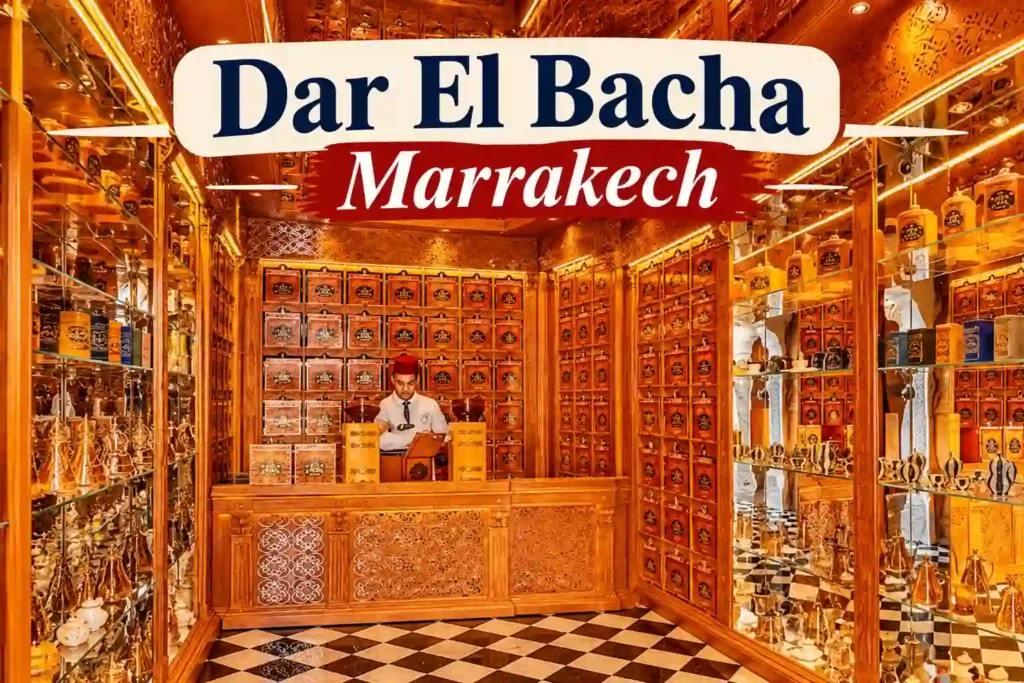
Hidden behind a simple wall in the medina of Marrakech, Dar El Bacha is one of the finest palaces in the city. Its name means “House of the Pasha”, and it was built for one of the most powerful and controversial men in Moroccan history. Today, it is a museum with striking courtyards, carved cedar ceilings and colorful zellige, and it is also home to Bacha Coffee, one of the most famous cafés in Morocco.
We cover everything: the history of the palace and the Pasha, what you will see inside, ticket prices and opening hours, how to avoid the long queue at Bacha Coffee, photo tips, how to get there, what to see nearby and the mistakes most visitors make.
Dar El Bacha at a Glance
| Detail | Info |
|---|---|
| Name | Dar El Bacha – Musée des Confluences |
| Meaning | “House of the Pasha” |
| Built | 1910 |
| Built for | Thami El Glaoui, Pasha of Marrakech |
| Opened as a museum | 2017 |
| Location | Route Dar El Bacha, in the medina, near the Mouassine area |
| Opening days | Usually Tuesday to Sunday, closed on Monday |
| Opening hours | Around 10:00 am to 6:00 pm |
| Ticket | About 70 MAD for foreign visitors (lower price for Moroccans and residents) |
| Time needed | About 1 hour for the museum, plus time for Bacha Coffee |
| Famous for | Palace architecture, courtyard garden and Bacha Coffee |
Note: Hours and prices can change, especially during Ramadan and holidays. Check before your visit.
What Is Dar El Bacha?
Dar El Bacha is a palace built in 1910 in the old medina of Marrakech. It was the private home of Thami El Glaoui, who became the Pasha (governor) of Marrakech. He built it on a grand scale to impress his guests, and for decades it was one of the most luxurious houses in the city.
After years of decline, the palace was restored by Morocco’s National Foundation of Museums and opened as the Musée des Confluences (Museum of Confluences) in 2017. The name “confluences” refers to the meeting of cultures that shaped Morocco: Amazigh, Arab, Jewish, Andalusian, African and Mediterranean. The museum hosts temporary exhibitions inside the beautiful rooms of the palace.
Why It Is Called the Museum of Confluences
A “confluence” is the place where two rivers meet and become one. The museum uses this idea to tell the story of Morocco as a meeting point of peoples and cultures. Over thousands of years, Amazigh communities, Arab dynasties, Jewish families, Andalusian refugees, African caravan traders and Mediterranean merchants all left their mark on Moroccan art, music, food and architecture.
The exhibitions at Dar El Bacha often show objects from these different traditions side by side: jewelry, textiles, manuscripts, ceramics, religious objects and works of art. The goal is to show how they influenced each other and created something uniquely Moroccan. It is a message that fits Marrakech perfectly, a city that has welcomed travelers, traders and artists for almost a thousand years.
The History of Dar El Bacha and the Pasha El Glaoui
Who Was Thami El Glaoui?
Thami El Glaoui (around 1879–1956) came from a powerful Amazigh family of the High Atlas, the Glaoua, whose base was the Kasbah of Telouet near the Tichka pass. In 1912, Sultan Moulay Youssef named him Pasha of Marrakech. During the French protectorate, he became the most powerful figure in southern Morocco, controlling a huge territory from the Atlas Mountains to the desert.
He was famous for his wealth, his love of luxury and his lavish parties. His palace welcomed many international guests, including the French writer Colette, the composer Maurice Ravel, the actor Charlie Chaplin and the British statesman Winston Churchill, who loved to paint in Marrakech.
A Controversial Figure
El Glaoui’s story is also controversial. He supported the French authorities against Sultan Mohammed V, who was sent into exile in 1953. When the Sultan returned in 1955, El Glaoui publicly asked for his forgiveness. Morocco became independent in 1956, and El Glaoui died the same year. After his death, his family lost most of their properties, and many of his palaces and kasbahs slowly fell into ruin.
From Palace to Museum
For many years, Dar El Bacha was closed to the public. In the 2010s, the National Foundation of Museums (FNM) started a major restoration. The palace reopened in 2017 as a museum, and the historic coffee tradition of the house was revived with the opening of Bacha Coffee. Today, it is one of the most visited cultural places in the medina, and a symbol of how Morocco protects its heritage.
Marrakech in the Time of the Pasha
To imagine Dar El Bacha in its golden age, picture Marrakech in the 1920s and 1930s. Outside the medina walls, the French were building the new town of Gueliz, with wide avenues, gardens and European-style villas. In 1923, the famous La Mamounia hotel opened, attracting rich travelers, artists and politicians from around the world. Winston Churchill stayed there several times and painted views of the Atlas Mountains from his balcony.
Inside the medina, life continued in the traditional way, with souks, mosques, craftsmen and caravans arriving from the south. Dar El Bacha stood between these two worlds. Guests could enjoy Moroccan music, huge banquets and mint tea in a traditional palace, while discussing politics and business in French and English. This mix of tradition and modernity is still visible today in the palace’s decoration.
What to See Inside Dar El Bacha
The Courtyard Garden
The heart of the palace is a large riad garden with orange trees, flowers, fountains and paths covered with zellige tiles. It follows the traditional Moroccan design of four garden beds around a central fountain, a symbol of paradise. The sound of water and the smell of orange blossoms in spring make it one of the most peaceful places in the medina. Take a few minutes to sit on a bench in the shade and simply listen: this calm is exactly what the Pasha wanted his guests to feel.
The Architecture
- Zellige: hand-cut colorful tiles in geometric patterns on floors, walls and fountains.
- Carved plaster (gebs): delicate white stucco carved like lace, with Arabic calligraphy and floral designs.
- Painted cedar ceilings: some of the most lovely wooden ceilings in Marrakech, carved and painted in bright colors.
- Huge wooden doors: decorated with carved and painted patterns.
- Marble columns and arches: elegant galleries around the courtyard.
- A mix of styles: traditional Moroccan art with some European touches from the early 20th century.
The Exhibitions
The rooms around the courtyard host temporary exhibitions about art, history and the many cultures that met in Morocco. Past exhibitions have included objects from different religions and civilizations, traditional crafts, textiles, jewelry and contemporary art. Because exhibitions change, every visit can be a little different.
The Hammam
The palace also has its own traditional hammam, with domed rooms and small star-shaped openings in the roof that let in light. It shows how the Pasha and his family lived in comfort, with private baths inside the palace.
Moroccan Palace Architecture Explained Simply
Dar El Bacha is a perfect place to understand how traditional Moroccan palaces and riads work. Here are the key ideas, in simple words:
- Looking inward: from the street, the walls are plain and simple. All the beauty is inside, around the courtyard. This protects privacy and keeps the house cool.
- The courtyard as the heart: rooms open onto a central garden or patio, which brings light, air and the sound of water into the house.
- Water and paradise: fountains and four-part gardens are inspired by descriptions of paradise in Islamic tradition.
- No pictures of people: decoration uses geometry, plants and calligraphy instead of images of humans or animals.
- Cool materials: thick walls, tiles and marble keep the inside fresh in the hot Marrakech summer.
| Material or craft | Where you see it | Made by |
|---|---|---|
| Zellige | Floors, fountains, lower walls | Tile cutters who shape each small piece by hand |
| Gebs (carved plaster) | Upper walls, arches | Plaster carvers working on fresh plaster |
| Cedar wood | Ceilings, doors, balconies | Woodcarvers and painters using cedar from the Middle Atlas |
| Tadelakt | Hammam walls | Artisans polishing lime plaster with stones and black soap |
| Marble | Columns, basins | Stone workers |
Each of these crafts is passed from master (maalem) to apprentice, often within the same family. Some of the artisans who restored Dar El Bacha learned their skills this way, which is why the restoration respects the original style so well.
Bacha Coffee: The Most Famous Café in Marrakech
One of the main reasons many people visit Dar El Bacha is Bacha Coffee. The coffee room is set in an elegant salon of the palace, with high ceilings, tiled walls and staff in traditional uniforms. The menu offers a huge choice of 100% Arabica coffees from many countries, served in pretty golden pots, often with pastries and light meals.
The café revives the coffee culture of the palace in the Pasha’s time. It has become so famous that Bacha Coffee is now an international brand, with boutiques in several countries. But the original experience is here in Marrakech.
Prices at Bacha Coffee
Coffee starts from about 40 to 50 MAD per pot, and a full breakfast or lunch with pastries can cost a few hundred dirhams per person. It is expensive by Moroccan standards, but most visitors say the setting is worth it.
How to Avoid the Queue
- Arrive at opening time (around 10:00 am) and put your name on the waiting list first.
- Visit the museum while you wait. Staff usually take your name and phone number.
- Avoid weekends and holidays, when the line is longest.
- Go on weekdays in the late morning or mid-afternoon.
- Be patient: waiting times of one hour or more are common in high season.
- Buy coffee to take home at the boutique if you do not want to wait for a table.
Important: To enter Bacha Coffee, you usually need a museum ticket, because the café is inside the museum.
Coffee Culture in Morocco
Mint tea is Morocco’s national drink, but coffee is also a big part of daily life, especially in cities. Café terraces are full from morning to night, with people chatting, reading the newspaper or watching football. Here are a few Moroccan coffee habits to know:
- Nous-nous: “half-half” in French, a popular coffee made with half espresso and half milk, served in a small glass.
- Café noir: a strong black coffee, often very sweet.
- Spiced coffee: in some homes and cafés, coffee is flavored with spices like cinnamon, ginger or cardamom.
- Coffee with pastries: a coffee with msemen, baghrir or a croissant is a classic breakfast.
Bacha Coffee takes this tradition to a luxury level, but a coffee on a simple café terrace in the medina is also a great way to feel the rhythm of Moroccan life.
Tickets and Opening Hours
| Ticket | Approximate price |
|---|---|
| Foreign adults | About 70 MAD |
| Moroccans and residents | About 25 MAD |
| Children | Often free or reduced |
| Bacha Coffee | Not included; pay separately |
The museum is usually open from Tuesday to Sunday, from around 10:00 am to 6:00 pm, and closed on Monday. Tickets are sold at the entrance; bring cash in Moroccan dirhams, although cards may be accepted. Read our guide to the Moroccan dirham for money tips.
Dar El Bacha Through the Seasons
| Season | What to expect | Tip |
|---|---|---|
| Spring (March to May) | Orange blossoms, perfect temperatures | The most fine time; arrive early |
| Summer (June to August) | Hot afternoons in the medina | Visit at opening, rest in the afternoon |
| Autumn (September to November) | Pleasant weather, fewer crowds | Great time for a relaxed visit |
| Winter (December to February) | Cool mornings, sunny days | Bring a light jacket for the shaded rooms |
Whatever the season, the inner courtyard stays calm and shaded, a true refuge from the noise and heat of the medina.
Best Time to Visit Dar El Bacha
| Time | What to expect |
|---|---|
| 10:00 am (opening) | Calm courtyard, best for photos, short coffee queue |
| 11:30 am to 2:00 pm | Busiest time, long queue at Bacha Coffee |
| 3:00 to 5:00 pm | Calmer again, soft light in the courtyard |
Best season: spring is special, when the orange trees are in flower and the courtyard smells wonderful. In summer, visit in the morning, because the medina gets very hot in the afternoon. See our guide to the weather in Marrakech.
Dar El Bacha vs Other Palaces in Marrakech
| Palace | Period | Best for | Crowds |
|---|---|---|---|
| Dar El Bacha | Early 20th century | Elegant courtyard, exhibitions, Bacha Coffee | Medium |
| Bahia Palace | 19th century | Huge rooms, gardens and painted ceilings | High |
| El Badi Palace | 16th century | Impressive ruins and views from the walls | Medium |
| Dar Si Said | 19th century | Museum of weaving and carpets | Low |
| Le Jardin Secret | Restored 19th century riad | Gardens and a tower with views | Medium |
If you have time for only one palace, choose the Bahia for its size and fame, or Dar El Bacha for a calmer and more elegant experience with excellent coffee. If you love history, add El Badi Palace for its dramatic ruins. Read our guide to Marrakech attractions and the history of Marrakech.
The Glaoui Legacy Beyond Marrakech
Dar El Bacha is only one part of the Glaoui story. The family’s original home was the Kasbah of Telouet, in the High Atlas, on the old caravan route between Marrakech and the Sahara. Once one of the richest kasbahs in the south, it is now partly in ruins, but some rooms still show remarkable zellige, carved plaster and painted ceilings, similar to Dar El Bacha.
In Ouarzazate, the Taourirt Kasbah also belonged to the Glaoui family and is one of the most famous kasbahs in Morocco. Visiting Dar El Bacha in Marrakech and then Telouet and Taourirt on the road to the desert is a fascinating way to follow the story of the Pasha and his family across the landscapes they once controlled.
How to Get to Dar El Bacha
Dar El Bacha is in the northwest part of the medina, near the Mouassine neighborhood and not far from Bab Doukkala. From Jemaa el-Fnaa, it takes about 15 minutes on foot through the souks. Taxis cannot enter the narrow streets, but they can drop you near Bab Doukkala or the nearest road, then you walk a few minutes. Read our guide to Jemaa el-Fnaa Square.
Tip: Use an offline map on your phone. The medina is a maze, and some people may offer to “show you the way” and then ask for money. Politely say “no, thank you” and follow your map.
Photo Tips for Dar El Bacha
- Arrive at opening for photos of the courtyard without people.
- Look up: the painted cedar ceilings make great photos.
- Shoot the zellige details close up for colorful patterns.
- Use the arches to frame the garden.
- Respect the rules inside Bacha Coffee and do not disturb other guests with long photo sessions.
What to See Near Dar El Bacha
| Place | Distance | Why go |
|---|---|---|
| Mouassine Mosque and Fountain | A few minutes on foot | Beautiful old fountain and a lively neighborhood |
| Le Jardin Secret | About 10 minutes | A restored garden-palace in the medina |
| The souks | About 5 to 10 minutes | Crafts, spices, lamps and leather |
| Ben Youssef Madrasa | About 15 minutes | A striking old Quranic school |
| Jemaa el-Fnaa | About 15 minutes | The famous main square, best at sunset |
| Jardin Majorelle | About 15 minutes by taxi | The blue garden in Gueliz |
Planning your day? Read our guides to Jardin Majorelle, what to see in Marrakech and free things to do in Marrakech.
Half-Day Walking Itinerary Around Dar El Bacha
| Time | Stop | Tip |
|---|---|---|
| 9:45 am | Arrive at Dar El Bacha | Put your name on the Bacha Coffee list |
| 10:00 am | Visit the museum and courtyard | Take photos before the crowds arrive |
| 11:00 am | Coffee at Bacha Coffee | Try a single-origin coffee with a pastry |
| 12:00 pm | Walk to the Mouassine fountain | Admire the old public fountain and the local life |
| 12:30 pm | Le Jardin Secret | Climb the tower for views over the medina |
| 1:30 pm | Lunch on a rooftop terrace | Choose a terrace with views of the Koutoubia |
In the afternoon, continue to the souks, the Ben Youssef Madrasa or Jemaa el-Fnaa for sunset. Read our 4-day Marrakech itinerary for more ideas.
Shopping and Eating Near Dar El Bacha
The Mouassine area around Dar El Bacha is one of the most pleasant parts of the medina for shopping. You will find workshops making lanterns, leather bags, babouche slippers, textiles and wooden boxes, plus small concept stores with modern Moroccan design. The Bacha Coffee boutique also sells coffee, tea, cups and gifts.
For lunch, many restaurants and cafés with rooftop terraces are within a few minutes’ walk, serving tagines, salads and fresh juices. Read our guides to the best food in Marrakech and what not to eat in Marrakech. When shopping, bargain politely and compare prices, and see our tipping in Marrakech guide for small tips.
Is the Area Around Dar El Bacha Safe?
Yes. The Mouassine and Dar El Bacha area is a busy part of the medina, with many visitors, shops and local families. Use normal precautions: keep your bag closed, watch your phone in crowded streets, and ignore people who insist on guiding you. Women travelers can read our guide Is Marrakech safe for women?, and everyone can find useful advice in what to avoid in Marrakech.
10 Must-Know Tips for Visiting Dar El Bacha
Here are the 10 tips we share with our travelers before they visit Dar El Bacha:
- Check the opening days: the museum is usually closed on Mondays.
- Arrive at opening time for an empty courtyard and a short coffee queue.
- Put your name on the Bacha Coffee list first, then visit the museum while you wait.
- Buy your museum ticket before trying to enter the café.
- Bring cash in dirhams for the ticket and small purchases.
- Look up at the ceilings in every room; they are the highlight.
- Read the exhibition panels to understand the idea of “confluences”.
- Use an offline map to find the entrance in the medina.
- Combine your visit with Mouassine, Le Jardin Secret and the souks.
- Visit in spring if you can, when the orange trees are in flower.
Visiting Dar El Bacha With Children or Reduced Mobility
Dar El Bacha is a calm and easy place to visit with children, who usually enjoy the fountains, the garden and the colorful tiles. The main courtyard is mostly flat, but some rooms have small steps, and the medina streets around the palace are narrow and busy. Strollers can be difficult in the souks, so a baby carrier is easier. Waiting at Bacha Coffee can be long for small children, so arrive early.
Common Mistakes When Visiting Dar El Bacha
| Mistake | Fix |
|---|---|
| Going on a Monday | The museum is usually closed on Mondays |
| Arriving at lunchtime for Bacha Coffee | Arrive at opening and put your name on the list |
| Thinking the café is separate | You usually need a museum ticket to enter |
| Rushing through the rooms | Take time to look at the ceilings and details |
| Following street “guides” | Use an offline map |
| Bringing no cash | Carry dirhams for tickets and small purchases |
Is Dar El Bacha Worth Visiting?
Yes. Dar El Bacha is one of the best places in Marrakech to see traditional Moroccan palace architecture in a calm setting. It is smaller than the Bahia Palace, but more peaceful and elegant, and the courtyard is one of the finest in the city. Add the experience of Bacha Coffee, and it becomes a perfect morning in the medina. If you love architecture, history or good coffee, do not miss it. Even travelers who are “tired of palaces” after several days in Morocco often tell us that Dar El Bacha was one of their favorite visits, because it feels intimate, well cared for and full of stories. It is also a great place to rest for an hour in the middle of a busy medina day, surrounded by the sound of fountains instead of motorbikes.
Quick Cheat Sheet: Dar El Bacha
- Built in 1910 for Pasha Thami El Glaoui
- Museum since 2017
- Open usually Tuesday to Sunday, about 10 am to 6 pm
- Ticket about 70 MAD
- Bacha Coffee inside; arrive early for the queue
- About 15 minutes on foot from Jemaa el-Fnaa
- Best time: opening time, especially in spring
Frequently Asked Questions About Dar El Bacha
What is Dar El Bacha?
A palace built in 1910 for Thami El Glaoui, Pasha of Marrakech, now a museum called the Musée des Confluences.
How much is the ticket to Dar El Bacha?
About 70 MAD for foreign visitors, with a lower price for Moroccans and residents.
Is Dar El Bacha open on Monday?
It is usually closed on Mondays. Check before your visit.
Do I need a museum ticket for Bacha Coffee?
Usually yes, because the café is inside the museum.
How long is the wait at Bacha Coffee?
It can be more than an hour in busy times. Arrive at opening to wait less.
How long does a visit take?
About one hour for the museum, plus time for coffee.
Where is Dar El Bacha?
In the northwest of the Marrakech medina, near Mouassine and Bab Doukkala, about 15 minutes on foot from Jemaa el-Fnaa.
Is Dar El Bacha worth it?
Yes, for its lovely architecture, peaceful courtyard and the unique Bacha Coffee experience.
Can I visit Bacha Coffee without visiting the museum?
In most cases, you need a museum ticket to reach the café, because it is inside the palace.
Who built Dar El Bacha?
It was built in 1910 for Thami El Glaoui, the Pasha of Marrakech.
Is Dar El Bacha the same as Bahia Palace?
No. They are two different palaces in the Marrakech medina. Bahia is older and bigger; Dar El Bacha is smaller, calmer and home to Bacha Coffee.
Can I take photos inside Dar El Bacha?
Yes, photos are generally allowed in the courtyard and most rooms. Follow any signs in special exhibitions.
Final Thoughts
Dar El Bacha is more than a pretty palace. It tells the story of a powerful Pasha, of Marrakech in the early 20th century, and of the many cultures that met in Morocco. Arrive early, walk slowly through the courtyard, look up at the painted ceilings, and finish with a pot of coffee in one of the most elegant salons in the city. It is a small palace with a big story, and a perfect introduction to the elegance of Moroccan art de vivre.
Want to discover the palaces of Marrakech and the kasbahs of the Glaoui family in the mountains? Contact us and we will plan your perfect route.
Explore our Morocco trips:
Tours from Marrakech: After visiting the Pasha’s palace in Marrakech, follow the Glaoui story over the Tichka pass to the Kasbah of Telouet, then continue to Aït Ben Haddou and the Sahara.
Morocco Desert Tours: The Glaoui family once controlled the routes from the Atlas to the desert. Travel the same roads to the dunes of Merzouga for a camel ride and a night under the stars.
Tours from Fes: From the oldest imperial city, cross the Middle Atlas to the Sahara, and end your journey in Marrakech with a visit to Dar El Bacha and its famous coffee.
Tours from Ouarzazate: Discover the kasbahs of the south, including the Taourirt Kasbah once linked to the Glaoui family, before heading to the Dades and Todra gorges and the desert.
Tours from Tangier: Start in the north, visit Chefchaouen and Fes, cross to the Sahara, and finish among the palaces and gardens of Marrakech.
Tours from Casablanca: Land in Casablanca, drive to Marrakech to explore its palaces like Dar El Bacha, then continue to the mountains and the desert with a private driver.
Contact us

Your Local Experts
Our Moroccan team organizes private tours from every major city in Morocco: Marrakech, Fes, Casablanca, Tangier, Rabat, Agadir, Ouarzazate and more. Wherever you land, we pick you up and design your trip around your dates and interests.
Plan Your Trip
Click any destination to see more:
Marrakech Desert Tours
- 2 Days Desert Tour from Marrakech
- 3 Days Marrakech to Merzouga
- 3 Days Marrakech to Fes
- 4 Days Marrakech to Merzouga
- 4 Days Marrakech to Fes
- 5 Days Marrakech to Merzouga
- 5 Days Morocco Tour from Marrakech
- 6 Days Morocco Tour from Marrakech
- 7 Days Morocco Tour from Marrakech
- 8 Days Morocco Tour from Marrakech
- 8 Days with Imperial Cities
- 9 Days Morocco Tour from Marrakech
- 10 Days Morocco Tour from Marrakech
- 12 Days Morocco Tour from Marrakech
- 14 Days Morocco Tour from Marrakech